 Reading Ants
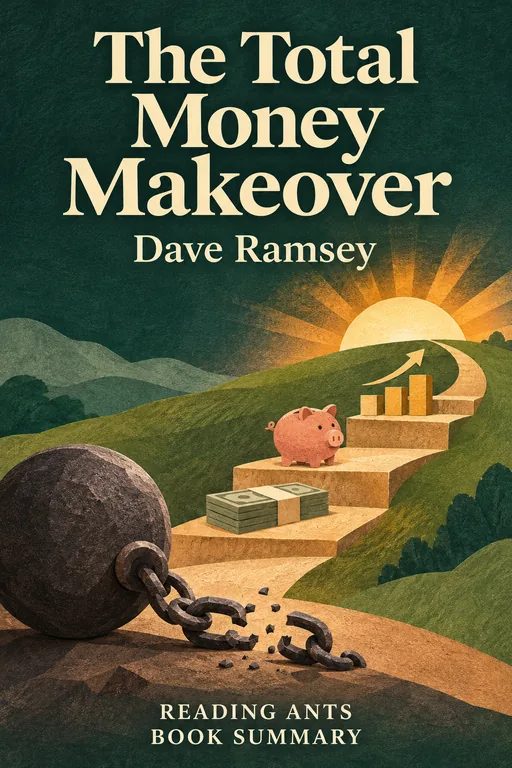
Dave Ramsey presents a step-by-step plan, called the Baby Steps, to get out of debt, build savings and invest, based on cash, a budget and the firm belief that the real problem with money is behavior and not information.
Overview
The Total Money Makeover was published in 2003 by Dave Ramsey, an American radio host and author. Ramsey says that he once built a real estate business on debt, lost it and went bankrupt, and that this changed his thinking. The book is a motivational guide for people who feel trapped by credit cards, loans and paycheck-to-paycheck living. Ramsey’s message is blunt and energetic: personal finance is mostly about behavior and only a little about knowledge, so the way to win is to change habits. He offers a clear order of steps to follow.
Full Summary
1. Money problems are behavior problems
The idea: Ramsey says that most people do not need more complicated financial tools. They need the motivation to change their behavior. He criticizes the common attitude that debt is normal, and he challenges the view that being broke is simply bad luck. He asks readers to take personal responsibility, to stop making excuses and to set a goal for a new way of living.
In real life: Knowing that sleeping early is healthy does not help unless you actually turn off the screen at bedtime.
2. Baby Step 1: a small emergency fund
The idea: The first step is to save a small amount of money, a starter emergency fund of about a thousand dollars in the original book, as quickly as possible. Ramsey says that this cushion keeps a small emergency, such as a car repair, from pushing you back into debt. He suggests selling things you do not need and taking extra work to get started.
In real life: If your phone breaks and you have a little saved, you can fix it without borrowing.
3. Baby Step 2: the debt snowball
The idea: Next, you list all your debts, except the house, from the smallest balance to the largest, and pay the minimum on all but the smallest. You attack the smallest with all the extra money, and when it is gone, you add that payment to the next one. The method is called the debt snowball because each win makes the next one faster. Ramsey says that small victories give motivation, and that this matters more than the mathematical order of interest rates.
In real life: Clearing the easiest task on a long to-do list first gives you energy to tackle the harder ones.
4. Baby Steps 3 and 4: a full fund, then investing
The idea: Once the debts are gone, Ramsey tells you to build a full emergency fund of three to six months of expenses. Then you begin to invest a portion of your income, which in his plan is fifteen percent, for retirement, using mutual funds. The aim is to have a safety net, so that you are not forced to borrow, and to let compound growth work over the long term.
In real life: A student who saves part of every payment from a first job builds a habit that lasts for life.
5. Baby Steps 5, 6 and 7: college, home and giving
The idea: The later steps are to save for children’s education, to pay off the home mortgage early and finally to build wealth and give generously. Ramsey connects money with values and encourages sharing with others. He believes that being free from debt allows people to live and give in ways that they otherwise could not.
In real life: A family without debt may be able to support a local charity, or to help a relative, in a way that a stretched family cannot.
6. Cash, a budget and no credit cards
The idea: Ramsey advises readers to use cash or debit instead of credit cards, which he says encourage overspending. He also insists on a written monthly budget, made before the month starts, in which every dollar is given a job. He recommends talking about the budget with your spouse or partner, and describes the “envelope system,” in which cash is put into labeled envelopes for different categories.
In real life: When a weekly allowance for snacks is in an envelope, you can see how much is left, and it is harder to overspend.
Why It Matters
The Total Money Makeover has been a bestseller for many years, and it has made Dave Ramsey one of the most influential voices in American personal finance. Many readers say that its plain language and its step-by-step plan helped them to get out of debt. Its Baby Steps have become a common framework for money classes and for many people who are working to get out of debt. The book matters because it speaks to people who feel ashamed or overwhelmed by money problems, and gives them a clear route and hope. It also helped to popularize the debt snowball. Even those who disagree with parts of it often agree that its emphasis on behavior, budgeting and avoiding debt is useful.
Key Takeaways
- Behavior beats knowledge. Changing habits matters more than learning clever tricks.
- Start with a small cushion. A little emergency money helps you to avoid new debt.
- Build momentum with small wins. Paying off the smallest debt first keeps you motivated.
- Budget before the month starts. Planning where money goes prevents it from disappearing.
- Freedom allows generosity. Being debt-free makes it easier to help others.
What We Can Learn
Even if you do not follow every step, you can borrow the main habits. Make a simple plan for your money before you receive it, and write it down. Save a small amount for emergencies. If you have debts, list them and choose a method, perhaps the snowball, and stick to it. Be careful with credit cards and with buying on installments. Share your goals with a family member or friend who will encourage you. Remember that this is general advice from one point of view, and that you should check your own circumstances, or ask a trusted adult or an adviser.
Criticism and Counterpoints
Many financial experts point out that the debt snowball can cost more than paying off the debts with the highest interest rates first, which is called the avalanche method. Ramsey’s claim that investments can return around twelve percent a year is considered too optimistic by many professionals. His rejection of all credit cards ignores the benefits of using them carefully, such as building a credit history and getting protection on purchases. Some feel that the tone is harsh or judgmental toward people in debt, and that it does not account for situations such as low wages, medical bills or unstable work. The core ideas are useful but not a perfect fit for everyone.
Who Should Read It
This book is for people who feel overwhelmed by debt and want a simple, motivating plan. It is also useful for families starting to talk about money. Readers who like careful financial analysis, or who already manage debt well, may find it too simple or too strict. The advice is aimed mostly at readers in the United States.
Want the whole book?
A summary is a taste, not the meal. Here is where to find the full book.
You reached the end 🎉
Nicely done. Mark this one as read, and we will suggest what to read next.
Read this next
I Will Teach You to Be Rich
Ramit Sethi
Ramit Sethi gives young adults a practical six-week program to set up accounts, automate saving and investing, and spend freely on what they love, without having to track every coffee.
💰 Money & Economics
Your Money or Your Life
Vicki Robin and Joe Dominguez
Vicki Robin and Joe Dominguez teach that money is something you trade your life energy for, and they offer a step-by-step program to track every cent, spend on what truly matters and reach financial independence.
💰 Money & Economics
The Simple Path to Wealth
J. L. Collins
J. L. Collins explains, in the form of letters to his daughter, how to build wealth with a simple plan: avoid debt, spend less than you earn, and invest steadily in a low-cost fund that owns the whole stock market.
💰 Money & Economics
Rich Dad Poor Dad
Robert T. Kiyosaki
Schools teach people to work for money, but the rich learn to make money work for them by understanding the difference between assets and liabilities and by building businesses and investments.
💰 Money & Economics
The Psychology of Money
Morgan Housel
How you behave with money matters more than how much you know about it, and good financial outcomes come from humility, patience and avoiding big mistakes, not from being the smartest person in the room.
💰 Money & Economics
The Wealth of Nations
Adam Smith
A nation's true wealth is not its stock of gold but the goods and services its people produce, and that wealth grows fastest when people specialize, trade freely and compete, with government providing justice, defense and public goods.
💰 Money & EconomicsWant something different?
Pick another topic and we will show you three books to start with.