 Reading Ants
Napoleon Hill claims that wealth and success begin with a burning desire, firm belief and persistent action, and presents thirteen principles he says were distilled from the habits of successful people.
Overview
Think and Grow Rich was written by Napoleon Hill, an American author of self-improvement books, and first published in 1937, during the Great Depression. Hill said that the steel magnate Andrew Carnegie had challenged him to study successful people and create a philosophy of achievement that anyone could use, and that over some twenty years he interviewed hundreds of wealthy individuals. The book, which presents thirteen principles as steps to riches, has sold tens of millions of copies and is among the best-selling self-help books of all time. Its tone is that of a sermon: it urges readers to take charge of their thinking, and it is full of anecdotes and short case histories.
Full Summary
1. Thoughts are things: desire
The idea: Hill begins with the claim that thoughts can become reality. He tells of men who achieved big goals by holding a clear picture of what they wanted. The first step is desire: not a mere wish but a burning, definite desire with a specific target. He urges readers to write down exactly how much money they want, what they will give in return, a date for achieving it and a plan, and to read this statement aloud twice a day, seeing and feeling themselves already in possession of it.
In real life: A student who writes down a specific goal, such as a score or a skill by a certain date, is more likely to act than one who vaguely hopes.
2. Faith and autosuggestion
The idea: The second and third principles are faith and autosuggestion. Hill says that faith is a state of mind that can be built by repeating positive instructions to oneself. Autosuggestion is the practice of feeding your subconscious mind with confident messages, through repetition and imagination, until they take hold. He argues that doubt and fear are the main enemies of achievement, and that a person can program themselves to believe in success.
In real life: Athletes often use positive self-talk and visualization before competitions to build confidence.
3. Specialized knowledge, imagination and planning
The idea: Hill stresses that general knowledge is not enough; a person needs specialized knowledge that can be applied, and the ability to organize or hire it. He also stresses imagination, which he calls the workshop where all plans are shaped, and organized planning, putting ideas into action through a practical plan, with the help of others. If a plan fails, he says, one should replace it with a new one, not give up.
In real life: An entrepreneur must be able to turn an idea into a business plan with steps, budgets and partners.
4. Decision and persistence
The idea: The next principles are decision and persistence. Hill claims that people who succeed make decisions quickly and change them slowly, while failures take a long time to decide and change often. Persistence is the will to continue despite setbacks. He tells of people who stayed with their goals through years of failure, and argues that most people give up just before success. He recommends building persistence by having a definite purpose, a strong desire and self-reliance.
In real life: Many writers are rejected many times before a book is published, and those who keep sending their work are the ones who succeed.
5. The master mind and the subconscious
The idea: The principle of the master mind is the idea that a group of people working together in harmony toward a goal can produce more than any individual. Hill urges readers to build an alliance with others who have complementary skills. Between the master mind and the subconscious, Hill devotes a chapter to what he calls the transmutation of sexual energy into creative drive, a controversial idea that this summary does not cover in detail. He then describes principles related to the subconscious mind, the brain as a kind of receiving station and the “sixth sense,” which he claims allows access to creative ideas. Some of these chapters are more mystical than practical.
In real life: Founders often succeed by teaming up with partners whose strengths balance their own.
6. The fears to overcome
The idea: In the final chapter, Hill lists six basic fears that hold people back: poverty, criticism, ill health, loss of love, old age and death. He argues that these fears drive most failure and that they must be recognized and mastered. He ends with a call to take control of one’s thinking, saying that anyone who masters these principles can shape their destiny, and he encourages readers to read the book more than once and to apply it.
In real life: Many people avoid trying new things because they fear criticism, which keeps them from growing.
Why It Matters
Think and Grow Rich has influenced generations of self-help authors, motivational speakers and business leaders. It helped establish the idea that attitude and belief are central to success, a theme found in many later books, including modern books on mindset and the “law of attraction.” It has been translated into dozens of languages and has been recommended by many entrepreneurs.
The book remains a landmark in the history of self-improvement writing, and its emphasis on definite goals, planning and persistence is echoed in modern goal-setting methods.
Many readers say its most useful part is simply the habit of writing a specific goal and reading it daily, a practice that requires no belief in anything mystical and that is supported by research on goal-setting.
Key Takeaways
- Start with a definite desire. Know exactly what you want.
- Belief shapes action. Confidence helps people persevere.
- Make a plan and act. Dreams need practical steps.
- Persist through failure. Many give up too soon.
- Work with others. A team can achieve more than one person.
What We Can Learn
The book teaches the value of clarity. If we want something, we need to define it, set a date and take steps, instead of wishing.
It also underlines persistence and the willingness to adjust plans. Many achievements come after setbacks, and what matters is to keep going and learn.
Finally, it encourages us to look at our fears. Naming what holds us back, whether fear of criticism or failure, is a first step to overcoming it. The habit of writing a plan down, setting a deadline and reviewing it often is something almost anyone can try, whatever they think of the book’s other claims.
Criticism and Counterpoints
Critics point out that the book’s central claims are not supported by evidence. Researchers have found no record of Hill’s supposed meetings with Carnegie or of many of the hundreds of wealthy people he claims to have studied, and Hill’s own business history included legal troubles and accusations of exaggeration. Many of the stories are anecdotal and many of the people he described later lost their fortunes.
Others say that the book implies that failure is due to a lack of belief, ignoring luck, discrimination and economic conditions, and that some of its ideas, such as thoughts as magnetic forces, are pseudoscience. Some readers find the advice helpful for motivation, but the book should be read with skepticism, not as a guaranteed formula.
Who Should Read It
This book suits teenagers and adults interested in motivation and the history of self-help. It is written in an old-fashioned, preachy style. Readers should treat its claims about wealth and thought as inspirational ideas and not as proven science.
Want the whole book?
A summary is a taste, not the meal. Here is where to find the full book.
You reached the end 🎉
Nicely done. Mark this one as read, and we will suggest what to read next.
Read this next
The Richest Man in Babylon
George S. Clason
Through simple stories set in ancient Babylon, this short classic teaches that wealth comes from saving part of everything you earn, making that money work for you, and protecting it from loss.
💰 Money & Economics
Rich Dad Poor Dad
Robert T. Kiyosaki
Schools teach people to work for money, but the rich learn to make money work for them by understanding the difference between assets and liabilities and by building businesses and investments.
💰 Money & Economics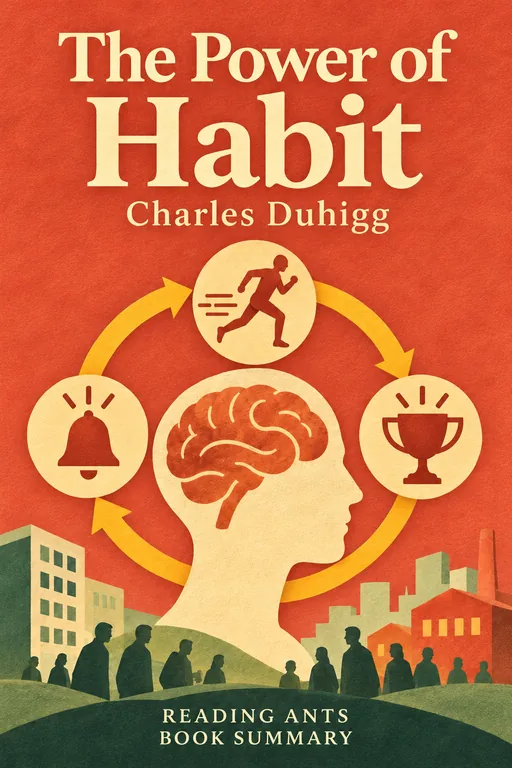
The Power of Habit
Charles Duhigg
Charles Duhigg shows that habits follow a loop of cue, routine and reward, and that by understanding the loop we can change our own habits, as well as those of companies and societies.
🌱 Self-Improvement
How to Win Friends and Influence People
Dale Carnegie
People are driven by emotion and the desire to feel important, so the way to get along with them, and win them to your point of view, is to stop criticizing, show genuine interest and appreciation, and see things from their side.
🌱 Self-Improvement
The Secret
Rhonda Byrne
Rhonda Byrne presents the "law of attraction," the claim that thoughts and feelings attract matching events, so that by focusing on what you want and believing you will receive it, you can gain wealth, health and happiness.
🌱 Self-Improvement
Atomic Habits
James Clear
Big changes in life come not from huge leaps but from tiny habits repeated every day, and you can build good habits (and break bad ones) by designing your life so the right choices are obvious, attractive, easy and satisfying.
🌱 Self-ImprovementWant something different?
Pick another topic and we will show you three books to start with.