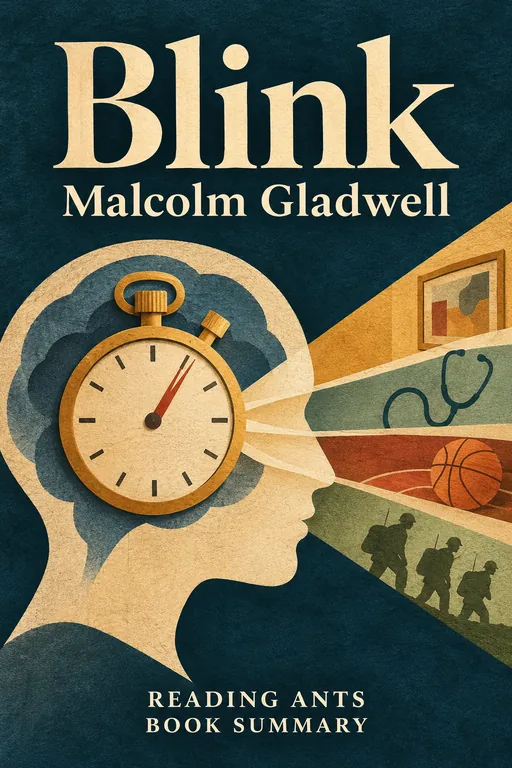
Blink
Malcolm Gladwell explores how quick, unconscious judgments, made in the blink of an eye, can be remarkably accurate, but can also be misled by prejudice and pressure, and how we can learn to trust and improve our instincts.
Overview
Blink: The Power of Thinking Without Thinking was published in 2005 by Malcolm Gladwell, a journalist at the New Yorker who has written several bestselling books of popular social science. The book is about “thin-slicing,” the ability of the mind to find patterns in situations and behavior based on very narrow slices of experience, and to reach conclusions in two seconds that might otherwise take much longer. Gladwell tells stories from art, medicine, sports, psychology and the military, and draws on research from psychologists such as John Gottman and Paul Ekman.
Full Summary
1. The theory of thin slices
The idea: Gladwell begins with an example: a museum acquired an ancient Greek statue that scientific tests supported, yet several experts felt at first sight that it was wrong, and its authenticity is still debated. They could not say why, only that it felt wrong. He says that the unconscious mind can make fast, accurate judgments from tiny amounts of information. He cites the research of John Gottman, who could predict whether a couple would stay married after watching a short conversation between them.
In real life: A teacher can often tell within seconds that a class is going to be lively.
2. The locked door of the unconscious
The idea: The author explains that much of our thinking takes place behind a locked door, and we cannot always say how we came to a conclusion. He describes the adaptive unconscious, which handles quick decisions, like a powerful computer. This is why experts can make good snap decisions, but also why they sometimes cannot explain them. Gladwell says that thinking more is not always better, and that too much information may even interfere with a good judgment.
In real life: You may sense that someone is upset without being able to say how you know.
3. Priming and hidden influences
The idea: Gladwell discusses experiments showing that the unconscious can be influenced by subtle cues. In one, students who were exposed to words associated with old age walked more slowly down the hall afterward. The implication is that our judgments and actions are shaped by factors that we are not aware of. This can work for us or against us, and it is why it matters what we expose ourselves to. He says that we should be aware of the influence of our environment. Later researchers have had trouble repeating some priming studies of this kind, so the results should be treated with caution.
In real life: A calm room may make you feel more relaxed without you noticing.
4. Experts, intuition and when to trust it
The idea: The book argues that intuition is most reliable when it is built on experience, such as that of a tennis coach who can tell when a player is about to double-fault, or an art expert who spots a fake at a glance. These experts often sense that something is wrong without being able to say why. In contrast, snap judgments can fail when they are steered by surface impressions, bias, too much information or panic, and Gladwell argues that we can learn to protect them.
In real life: A skilled mechanic can often tell what is wrong with a car from a sound.
5. When snap judgments go wrong: prejudice
The idea: Gladwell shows that rapid cognition can be distorted by unconscious bias. He describes the Implicit Association Test, which shows that many people have automatic associations that conflict with their stated beliefs, such as linking race with certain traits. He also tells the story of Warren Harding, who looked so distinguished and presidential that people assumed he had the qualities of a leader, though his record gave little reason to think so. Gladwell calls this kind of mistake the Warren Harding error. He says that we should be aware of our biases, and take steps to counteract them, such as by changing the conditions in which decisions are made.
In real life: Hiring decisions may be affected by a candidate’s appearance in ways that interviewers do not realize.
6. Under pressure: the limits of the blink
The idea: The final chapters consider how stress can impair the ability to make good judgments. Extreme arousal and fear can narrow what a person perceives, so that reading a face or a situation correctly becomes very hard. Gladwell discusses the 1999 shooting of Amadou Diallo, an unarmed man shot by police officers in New York, and suggests that the tragedy came from the effects of fear and haste, and from the limits of snap judgments in confusing circumstances. He argues that rehearsing for stressful situations and slowing things down can help.
In real life: A person who is panicking may not think clearly, and a short pause can help.
Why It Matters
Blink was a major bestseller and helped to popularize the idea that intuition is a form of intelligence, and that the unconscious mind plays a major role in our decisions. It reached a wide audience, and became a part of discussions on management, medicine, education and policing. Its stories made research findings accessible and memorable. The book also drew attention to the problem of unconscious bias. At the same time, its claims have been debated, and it is often read together with Daniel Kahneman’s Thinking, Fast and Slow, which gives a more cautious view of intuition.
Key Takeaways
- Quick judgments can be accurate. The mind can find patterns in thin slices.
- Experience builds reliable intuition. Experts can trust their instincts in their field.
- Too much information can hinder. Sometimes less is more.
- Bias works unconsciously. We need to guard against hidden prejudice.
- Stress degrades judgment. Slow down when the pressure is high.
What We Can Learn
You can use the book to think about when to trust your gut. If you have a lot of experience in an area, your instincts are probably good; if you are a beginner, check them with facts. Be aware of possible biases, and try ways of reducing their influence, such as making decisions based on set criteria. When you feel stress or panic, take a moment to breathe before acting. Notice what environments and cues affect your mood and choices. And do not assume that a quick judgment is always wrong or always right.
Criticism and Counterpoints
Critics say that Gladwell’s book is a collection of engaging stories connected by a loose thesis, and that it cherry-picks evidence, with limited attention to cases where intuition fails. Daniel Kahneman has said that the belief that intuition works magically is false, and other psychologists note that snap judgments are often unreliable. Some of the studies cited, such as those on priming, have been difficult to replicate. The judge and legal scholar Richard Posner argued that Gladwell makes unsupported assumptions and mistakes in how he presents his evidence. Still, the book is valued for its readability and for raising interesting questions.
Who Should Read It
This book is for readers who like lively stories about psychology and decision making. It is easy and entertaining. Those who want a more rigorous examination of intuition and bias should read Kahneman’s work, and treat Gladwell’s claims with some caution.
Want the whole book?
A summary is a taste, not the meal. Here is where to find the full book.
You reached the end 🎉
Nicely done. Mark this one as read, and we will suggest what to read next.
Read this next
Thinking, Fast and Slow
Daniel Kahneman
Our minds run on two systems, a fast, intuitive one and a slow, careful one, and understanding how the fast system fools us can help us make better decisions about money, risk, work and happiness.
🧩 Mind & Psychology
Predictably Irrational
Dan Ariely
Behavioral economist Dan Ariely uses entertaining experiments to show that people's decisions are shaped by predictable mental quirks, such as relativity, the lure of "free" and social norms, rather than by cool, rational calculation.
🧩 Mind & Psychology
Outliers
Malcolm Gladwell
Malcolm Gladwell argues that extraordinary success comes not only from talent and effort but from hidden advantages of timing, place, culture and opportunity, so we should look at the whole story behind every "self-made" success.
🧩 Mind & Psychology
Drive: The Surprising Truth About What Motivates Us
Daniel H. Pink
Daniel Pink argues that, for creative and complex work, carrots and sticks such as bonuses are less effective than the inner drive provided by autonomy, mastery and purpose, and that businesses and schools should be redesigned around them.
🧩 Mind & Psychology
Stumbling on Happiness
Daniel Gilbert
Harvard psychologist Daniel Gilbert explains, with wit and research, that we are surprisingly poor at predicting what will make us happy, because the imagination fills in details wrongly, and he suggests that other people's experience is often a better guide than our own forecasts.
🧩 Mind & Psychology
Nudge
Richard H. Thaler and Cass R. Sunstein
Because people are not perfectly rational, the way choices are presented strongly affects what they choose, and designers of choices can gently steer people toward better decisions without taking away their freedom.
🧩 Mind & PsychologyWant something different?
Pick another topic and we will show you three books to start with.