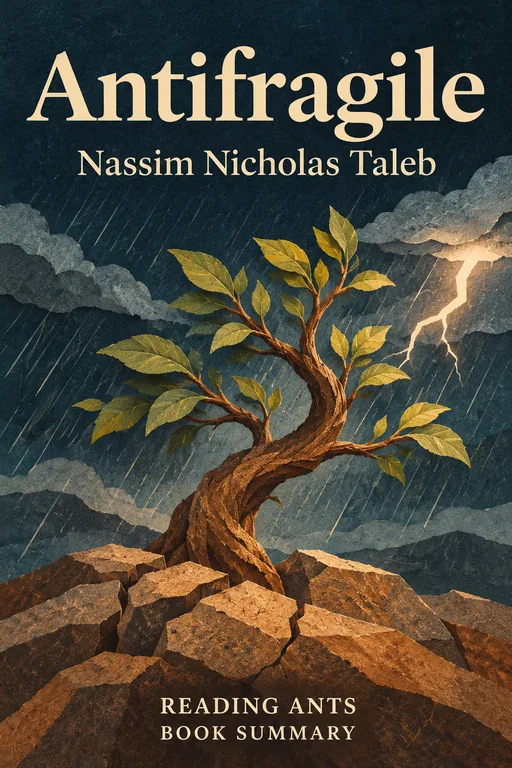
Antifragile
Nassim Nicholas Taleb argues that some things, like muscles, immune systems and economies, actually benefit from shocks and stress, and that we should build lives and institutions that gain from disorder, not just resist it.
Overview
Antifragile: Things That Gain from Disorder was published in 2012 by Nassim Nicholas Taleb, a former options trader, essayist and professor of risk engineering, who became famous for The Black Swan. He says that the opposite of fragile is not robust, or resilient, since those things merely resist shocks and stay the same, but something that gets better with them, for which no word existed, so he coined “antifragile.” The book is a mix of philosophy, anecdotes, finance and opinion, divided into seven parts. Taleb’s style is provocative and personal.
Full Summary
1. The triad: fragile, robust, antifragile
The idea: Taleb distinguishes three kinds of things. The fragile is harmed by volatility, like a wine glass that shatters when it is struck. The robust stays the same, like a block of metal. The antifragile gains from stress, like the immune system, which gets stronger by exposure to germs, or like bones that get stronger under stress. Many things in nature, he says, are antifragile, and modern life, by removing stress, can make us fragile, as when we over-protect children.
In real life: A muscle grows when it is tested, but weakens if never used.
2. Hormesis and the benefits of small stress
The idea: The author says that small doses of harm can be good, a concept called hormesis. Exercise, fasting and other mild stress can make the body stronger, while avoiding all stress leaves us weaker. He suggests that overprotecting the body, such as treating minor problems that would heal alone, can backfire. He also applies this to the mind and to organizations: a bit of disorder, such as small mistakes, teaches us and makes the system stronger.
In real life: A child who is never allowed to fall may not learn to balance.
3. Convexity and optionality
The idea: Taleb explains a key idea: it is better to be in situations where the upside is larger than the downside, which he calls convexity. Having options, the right but not the obligation to do something, allows you to benefit from good surprises while limiting losses from bad ones. Trial and error is an example: try many small experiments, keep those that work, and drop those that do not. This, he claims, is how innovation really happens, much more than by planning.
In real life: Trying several small projects, and continuing with the one that succeeds, is better than betting everything on one.
4. The barbell strategy
The idea: A practical rule is the barbell: combine extreme safety with a small amount of high risk. For example, keep most of your money in very safe assets and put a small part in speculative ones, or, as a writer, take a stable job and write on the side without the pressures of the market. Avoid the middle, which is moderately risky and offers neither safety nor large gains. This strategy protects you from catastrophe while leaving you open to positive surprises.
In real life: A student with a solid plan who also tries a wild side project has a barbell.
5. The role of time: the Lindy effect and via negativa
The idea: Taleb says that for things that do not die by themselves, such as ideas, books and technologies, each additional period of survival suggests a longer remaining life, which he calls the Lindy effect. A book that has stayed in print for a century is likely to stay in print for roughly another one. He also argues for via negativa, improving by subtraction: removing harmful things, such as excess sugar or bad habits, is often more effective than adding new ones.
In real life: A classic book that has been read for centuries is a safer bet than this week’s bestseller.
6. Skin in the game, and the fragility of systems
The idea: The author argues that those who make decisions should bear the consequences, and that harms are transferred when this is not the case, as with managers who collect large benefits when they are right but leave others to pay when they are wrong. He also argues that debt makes people and systems fragile, and that smaller political units such as city-states are better than large nation-states. He warns against intervening when it is not needed, such as unnecessary medical treatment, and treats skipping the doctor for minor illnesses as an example of improving by subtraction.
In real life: A designer who has to use their own building may take more care.
Why It Matters
Antifragile was a bestseller, and gave readers a new word and a new way of thinking about risk and resilience. It influenced discussions in finance, business, health and policy, and its concepts, such as the barbell, optionality and skin in the game, are often used. The book also encouraged people to appreciate trial and error, and to see failure as a source of learning. Some of its ideas, such as skin in the game, were expanded in his later book Skin in the Game. His ideas about fragility and robustness have been applied to supply chains, institutions and personal life, and the word itself has entered ordinary speech among managers, investors and readers.
Key Takeaways
- Some things gain from stress. Antifragility goes beyond resilience.
- Keep options open. Small experiments let you benefit from surprises.
- Use a barbell. Combine safety with a bit of bold risk.
- Time tests ideas. What has lasted tends to last.
- Share the risk. Decision makers should bear consequences.
What We Can Learn
You can apply the ideas by giving yourself small challenges, such as exercise, new tasks or fasting, to build strength. Avoid putting all of your effort into a single plan, and try several small experiments. Keep most of your resources safe and take small risks on potential big wins. Prefer well-tested books and habits, and try removing a bad habit before adding a new one. And ask who really bears the risk in any proposal. At the same time, be careful to avoid harmful risks, and consult experts about your health or money.
Criticism and Counterpoints
Some critics say that Taleb’s tone is arrogant, and that he insults academics, economists and journalists, and that the book is repetitious and self-indulgent. Others argue that the claim that antifragility is a general principle is overstated, since too much stress can destroy. His health suggestions are closer to personal opinion than to settled medical evidence. One reviewer also called the concept antisocial and disputed his claim that government debt is a form of fragility. Still, many find his ideas thought-provoking.
Who Should Read It
This book is for readers who like big ideas about risk, uncertainty and resilience, and can tolerate a combative style. It is wide-ranging and sometimes dense. Those who want a more neutral treatment of risk might start with a more conventional book.
Want the whole book?
A summary is a taste, not the meal. Here is where to find the full book.
You reached the end 🎉
Nicely done. Mark this one as read, and we will suggest what to read next.
Read this next
The Black Swan
Nassim Nicholas Taleb
Rare, unpredictable events with huge impact, which Nassim Taleb calls Black Swans, shape history far more than we admit, and we should build lives and systems that can survive or even benefit from them instead of pretending to predict them.
🧩 Mind & Psychology
The Art of Thinking Clearly
Rolf Dobelli
Swiss author Rolf Dobelli collects about a hundred short chapters on common thinking errors, such as confirmation bias, survivorship bias and the sunk-cost fallacy, to help readers make fewer foolish decisions.
🧩 Mind & Psychology
Thinking in Bets
Annie Duke
Former professional poker player Annie Duke argues that life's decisions are bets made with incomplete information, and shows how to judge decisions by their quality and not their results, by thinking in probabilities and by learning with the help of honest groups.
🧩 Mind & PsychologyThe Most Important Thing
Howard Marks
Howard Marks, a veteran investor, argues that successful investing depends on thinking more deeply than the crowd, understanding risk and cycles, and avoiding big mistakes, more than on finding secret formulas.
💰 Money & Economics
Thinking, Fast and Slow
Daniel Kahneman
Our minds run on two systems, a fast, intuitive one and a slow, careful one, and understanding how the fast system fools us can help us make better decisions about money, risk, work and happiness.
🧩 Mind & Psychology
Predictably Irrational
Dan Ariely
Behavioral economist Dan Ariely uses entertaining experiments to show that people's decisions are shaped by predictable mental quirks, such as relativity, the lure of "free" and social norms, rather than by cool, rational calculation.
🧩 Mind & PsychologyWant something different?
Pick another topic and we will show you three books to start with.