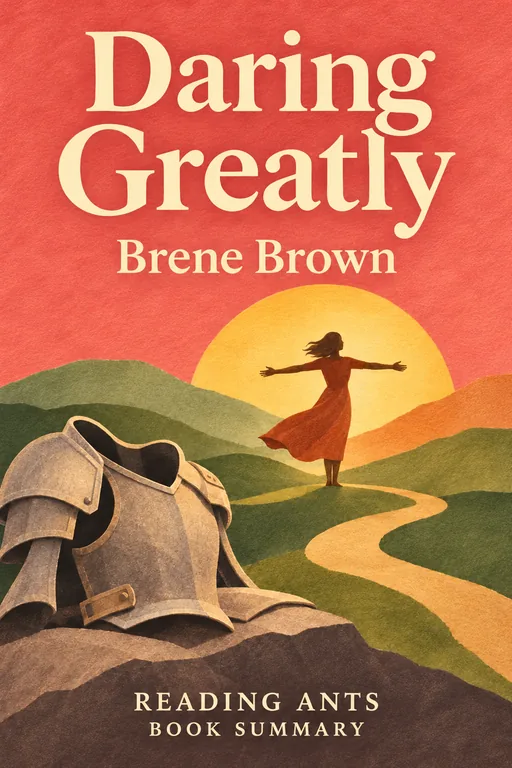
Daring Greatly
Researcher Brené Brown argues that vulnerability, the willingness to show up and be seen when outcomes are uncertain, is not weakness but the foundation of courage, connection and creativity.
Overview
Daring Greatly: How the Courage to Be Vulnerable Transforms the Way We Live, Love, Parent, and Lead was written by Brené Brown, a research professor at the University of Houston who studies shame, courage and empathy, and published in 2012. It followed her popular TED talk “The Power of Vulnerability.” The book’s title comes from a famous passage in a 1910 speech by former President Theodore Roosevelt, which praises the person who is actually in the arena, trying and failing, instead of critics who watch from the sidelines. Drawing on more than a decade of interviews and research, Brown explains why we armor ourselves against vulnerability and how we can learn to engage with our lives wholeheartedly.
Full Summary
1. What vulnerability is, and what it isn’t
The idea: Brown begins by redefining vulnerability. It is not weakness, oversharing or something to be avoided, but uncertainty, risk and emotional exposure: starting a business, saying “I love you” first, admitting you need help. She found in her research that everyone fears being vulnerable, but the people who live most fully accept it as part of life. She stresses that vulnerability is the birthplace of love, belonging, joy and creativity, since we cannot have these without risk.
In real life: Raising your hand to ask a question in class takes a little vulnerability, and it often leads to learning.
2. The culture of scarcity and “never enough”
The idea: Brown argues that we live in a culture of scarcity, where people feel they are never good enough, successful enough, thin enough or safe enough. This pervasive feeling drives comparison and fear of being ordinary. Scarcity feeds shame and the desire to hide. She suggests that the opposite of scarcity is not abundance but a sense of enough, a belief in our own worthiness as we are.
In real life: Social media can feed the scarcity mindset, as we compare our everyday lives with others’ highlights.
3. Shame, guilt and the shame shields
The idea: The author distinguishes shame, the painful belief that we are flawed and unworthy of love, from guilt, the feeling that we did something bad. Guilt can motivate us to make amends, while shame often leads to hiding, blaming or acting out. She says that shame thrives on secrecy, silence and judgment, and cannot survive being spoken and met with empathy. People protect themselves from shame in three common ways, which Brown describes as moving away (withdrawing and keeping secrets), moving toward (trying to please and appease) and moving against (gaining power over others).
In real life: Saying “I made a mistake” is healthier than “I am a mistake.”
4. Armor: the ways we protect ourselves
The idea: Brown describes common forms of “armor” that people use to avoid vulnerability. They include perfectionism, trying to look perfect so as to avoid criticism; numbing, using busyness, food, alcohol or screens to dull painful feelings; and foreboding joy, expecting disaster when things go well, so as to be prepared. She notes that these defenses protect us from pain, but also from joy and connection, and suggests that we can learn to put them down.
In real life: A person who cannot enjoy a happy moment because they are waiting for something to go wrong is practicing foreboding joy.
5. Vulnerability in parenting, work and leadership
The idea: The later chapters apply these ideas to families, schools and workplaces. In parenting, she says that who we are matters more than what we know about parenting, and that parents who accept their own imperfection raise children who feel they are enough. In organizations, she argues that leaders who are open, admit mistakes and give feedback with kindness build more trusting, creative teams, while cultures based on shame and blame suppress innovation.
In real life: A manager who says “I don’t know, let’s figure it out together” invites honesty from the team.
6. Wholehearted living
The idea: Brown concludes by describing wholehearted living, which means engaging with life from a place of worthiness, with courage, compassion and connection. She says that we cannot selectively numb emotions: numbing pain also dulls joy. She encourages readers to choose courage over comfort, to share their stories with trusted people and to be the kind of person who dares to show up. Daring greatly, she says, means being brave enough to step into the arena, whatever the result.
In real life: Sharing a worry with a friend, instead of hiding it, can bring comfort and deepen the friendship.
Why It Matters
Daring Greatly became a long-running bestseller and made Brené Brown one of the best-known voices on vulnerability and shame. Her TED talk is one of the most watched ever, and her ideas have been taken up by teachers, therapists, managers and parents. The book has influenced workplace conversations about psychological safety and leadership.
It also helped to move the conversation about emotions toward openness and empathy, and it has been followed by other widely read books and a popular series on streaming services.
Many readers say that the book gave them words for feelings they had never named, such as foreboding joy, and that discovering they were not alone in them was a relief that made change possible.
Key Takeaways
- Vulnerability is courage. Taking emotional risks leads to connection.
- Shame hides in secrecy. Speaking about it with empathy weakens it.
- Enough is a choice. We can reject the culture of scarcity.
- Armor protects but isolates. Perfectionism and numbing cost us joy.
- Leaders benefit from openness. Trust grows when people admit mistakes.
What We Can Learn
The book suggests that being open about our imperfections is not a risk to be avoided but a path to deeper relationships. Sharing a struggle with a trusted friend can bring support and show that we are not alone.
It also helps us tell the difference between guilt and shame. When we make mistakes, we can say “I did something wrong” and learn from it, without believing “I am bad.”
Finally, it encourages us to value effort over outcome. Trying, even if we fail, is a way of living with courage.
Criticism and Counterpoints
Some psychologists say that Brown’s research, based on interviews and grounded theory, is not as rigorous as experiments and that some of her claims are broad. Others feel that the book presents vulnerability as universally beneficial, whereas in some settings, such as hostile workplaces, being open can be risky, and people with less power may pay a higher price.
Critics also point to the book’s use of self-help language, stories and a tendency to repeat. Some argue that it focuses on individual attitudes and does not address social structures that create shame and inequality. Still, many readers find the message supportive and practical.
Who Should Read It
This book suits teenagers and adults. It is easy to read and personal in tone. It may be helpful for parents, teachers and managers, and for anyone who feels pressure to be perfect.
Want the whole book?
A summary is a taste, not the meal. Here is where to find the full book.
You reached the end 🎉
Nicely done. Mark this one as read, and we will suggest what to read next.
Read this next
Mindset: The New Psychology of Success
Carol S. Dweck
Psychologist Carol Dweck shows that people who believe abilities can grow, a growth mindset, learn, cope with failure and achieve more than people who believe their talents are fixed.
🌱 Self-Improvement
The Subtle Art of Not Giving a F*ck
Mark Manson
Mark Manson argues that a good life comes not from relentless positivity but from choosing what is worth caring about, accepting that problems and limits are unavoidable, and taking responsibility for your own choices.
🌱 Self-Improvement
The Courage to Be Disliked
Ichiro Kishimi and Fumitake Koga
In a dialogue between a philosopher and a skeptical young man, this book introduces the psychology of Alfred Adler and argues that we can be free from our past, from others' expectations and from the need for approval, by choosing how we live.
🌱 Self-Improvement
Atomic Habits
James Clear
Big changes in life come not from huge leaps but from tiny habits repeated every day, and you can build good habits (and break bad ones) by designing your life so the right choices are obvious, attractive, easy and satisfying.
🌱 Self-Improvement
The 7 Habits of Highly Effective People
Stephen R. Covey
Lasting success in life and work comes not from quick tricks or a charming personality but from good character, built through seven habits that move us from depending on others, to standing on our own, to working well with others.
🌱 Self-Improvement
How to Win Friends and Influence People
Dale Carnegie
People are driven by emotion and the desire to feel important, so the way to get along with them, and win them to your point of view, is to stop criticizing, show genuine interest and appreciation, and see things from their side.
🌱 Self-ImprovementWant something different?
Pick another topic and we will show you three books to start with.