 Reading Ants
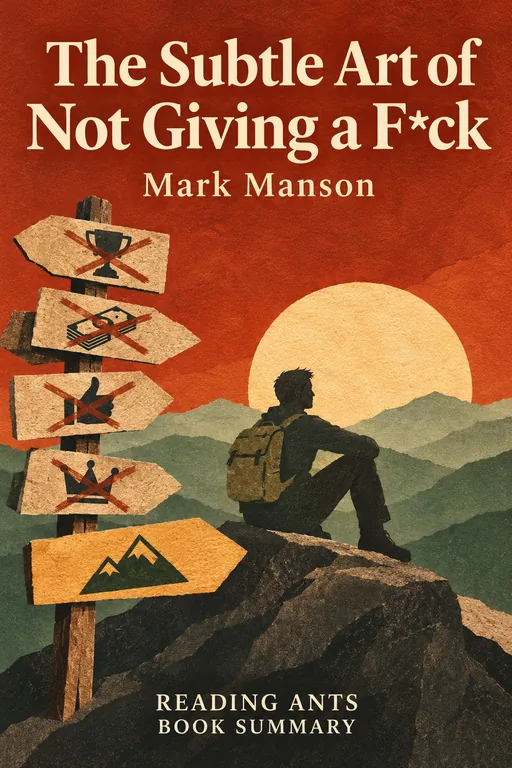
The Subtle Art of Not Giving a F*ck
Mark Manson argues that a good life comes not from relentless positivity but from choosing what is worth caring about, accepting that problems and limits are unavoidable, and taking responsibility for your own choices.
Overview
The Subtle Art of Not Giving a F*ck: A Counterintuitive Approach to Living a Good Life was written by Mark Manson, an American blogger and author, and published in 2016. It grew from his popular blog posts about self-improvement and relationships, written in a blunt and funny style with plenty of strong language. Manson’s argument is a response to the usual advice to be positive and chase success. He says that the key to a good life is not to care about more things but to care about fewer, and to choose them carefully. The book became a huge international bestseller and was one of the top-selling books of the late 2010s.
Full Summary
1. Don’t try
The idea: Manson begins with the story of the poet Charles Bukowski, whose headstone says “Don’t try,” and argues that Bukowski’s success came from accepting that he was flawed and a failure by many measures and writing honestly about it, rather than from striving to look like a winner. Manson presents this as a model of honest acceptance of one’s flaws. He criticizes the “feedback loop from hell,” in which people feel bad about feeling bad, and the culture of constant positivity that tells us we must always be happy and successful. Accepting negative experiences as part of life, he says, is itself a positive act.
In real life: Feeling anxious about being anxious makes the anxiety worse, while accepting it can make it fade.
2. Happiness is a problem
The idea: Manson argues that life is made up of problems, and that happiness comes from solving them, not from avoiding them. When one problem is solved, another appears, so the real question is which problems you want to have. He says that people who seek comfort and avoid pain will end up miserable, while people who accept and work on meaningful challenges will find purpose. He also says that our emotions are only feedback, not directions to follow blindly.
In real life: A person who wants to be fit must accept the discomfort of exercise, and a person who wants a deep friendship must accept the discomfort of honest conversations.
3. You are not special
The idea: In a culture that tells everyone they are exceptional, Manson argues that most of us are ordinary, and that thinking we are special can make us entitled or fearful. He suggests that real self-esteem comes from the ability to face the negative, not from avoiding it, and that being ordinary is liberating, because it frees us to do good work without having to be the best.
In real life: A student who stops worrying about being the top of the class and focuses on learning can enjoy the process more.
4. The value of suffering and choosing your values
The idea: Manson says that we all suffer, and that the question is what we suffer for. He urges readers to choose values that are healthy and constructive, such as honesty, curiosity and humility, instead of values that are out of our control or that depend on external things, such as popularity or pleasure. He also discusses responsibility: even if something is not our fault, it is our responsibility to respond, since we are always choosing how to interpret and handle what happens.
In real life: If you are treated unfairly, you cannot control the event, but you can choose how to respond.
5. You are wrong about everything
The idea: Manson encourages readers to be uncertain about their beliefs and to be open to being wrong, using the idea that we should aim to be “less wrong” over time. He discusses the importance of testing our assumptions and of questioning our own certainty, which he says can prevent growth. He also points out that failure is a necessary part of improvement and is more valuable than avoiding risk.
In real life: Trying something new and failing teaches more than not trying.
6. Commitment, saying no and death
The idea: The final chapters emphasize commitment: a meaningful life requires saying no to many options in order to commit to a few. Boundaries in relationships, he says, are healthy, and a good relationship involves accepting each other’s flaws and respecting each other’s freedom. The book ends with a reflection on death. Remembering that we will die can clarify what matters, and Manson suggests that doing something that outlasts us, or living for something larger than ourselves, gives meaning.
In real life: Choosing to spend your limited time on a few important projects and people, and saying no to the rest, is a practical form of commitment.
Why It Matters
The Subtle Art of Not Giving a F*ck was one of the top-selling nonfiction books in the world, with millions of copies sold in dozens of languages. It stood out in the crowded self-help field by being funny, direct and skeptical of forced positivity, and it appealed to many readers who were tired of conventional motivational books.
It has influenced a broader trend of “anti-self-help” or realistic self-help books and spawned a sequel and a series of online guides. The title phrase has become part of everyday conversation as a shorthand for focusing on what truly matters.
For many readers the main benefit is permission: permission to feel bad sometimes, to say no, and to stop trying to be perfect, and that relief is a large part of why the book resonated.
Key Takeaways
- Accept negative emotions. Trying to avoid them makes them worse.
- Choose your problems. A good life comes from meaningful struggles.
- You are responsible. Even when it is not your fault, you choose your response.
- Be open to being wrong. Humility enables growth.
- Commit and say no. Focus gives life depth.
What We Can Learn
The book encourages us to be honest about what we truly value. Instead of chasing every goal, we can ask which few things are worth our time and effort, and accept the trade-offs.
It also teaches us to stop being afraid of discomfort. Facing difficulty, such as having a hard conversation or trying something new, is often the way to growth.
Finally, it reminds us that we are limited and temporary, and that this can be freeing. Realizing that our worries are mostly small can help us let go of what does not matter.
Criticism and Counterpoints
Some critics say that the book’s ideas are not new and are taken from older philosophers, such as the Stoics and the existentialists, expressed in a casual style. Others dislike the heavy use of profanity and the male-centered, sometimes cynical, tone. Some of the stories and claims, such as those about historical figures, are used loosely.
Psychologists have also noted that Manson’s advice does not address people who face serious difficulties such as trauma, poverty or mental illness, and that “not caring” is not always healthy. Others argue that the book is more about caring about the right things than not caring, so the title can be misleading. Still, many readers find it refreshing.
Who Should Read It
This book suits older teenagers and adults. It contains strong language throughout, and some readers will find the tone abrasive. It is a quick read and may be a good introduction to practical philosophy for those who dislike traditional self-help.
Want the whole book?
A summary is a taste, not the meal. Here is where to find the full book.
You reached the end 🎉
Nicely done. Mark this one as read, and we will suggest what to read next.
Read this next
The Courage to Be Disliked
Ichiro Kishimi and Fumitake Koga
In a dialogue between a philosopher and a skeptical young man, this book introduces the psychology of Alfred Adler and argues that we can be free from our past, from others' expectations and from the need for approval, by choosing how we live.
🌱 Self-Improvement
Man's Search for Meaning
Viktor E. Frankl
A psychiatrist who survived the Nazi concentration camps explains that even in the worst suffering, people can choose their attitude, and that finding a reason to live is what gives us the strength to endure.
👤 Real Lives
The Power of Now
Eckhart Tolle
Eckhart Tolle teaches that much of our suffering comes from living in thoughts about the past and future, and that peace is found by paying full attention to the present moment.
🌱 Self-Improvement
Meditations
Marcus Aurelius
The private notebook of a Roman emperor, reminding himself daily to accept what he cannot control, to act with justice and kindness, and to remember that life is short.
🕊️ Philosophy & Religion
Can't Hurt Me
David Goggins
David Goggins tells how he rose from a violent, poor childhood and an overweight, aimless young adulthood to become a Navy SEAL and an ultramarathon runner, and shares the mental toughness methods he used.
🌱 Self-Improvement
Atomic Habits
James Clear
Big changes in life come not from huge leaps but from tiny habits repeated every day, and you can build good habits (and break bad ones) by designing your life so the right choices are obvious, attractive, easy and satisfying.
🌱 Self-ImprovementWant something different?
Pick another topic and we will show you three books to start with.