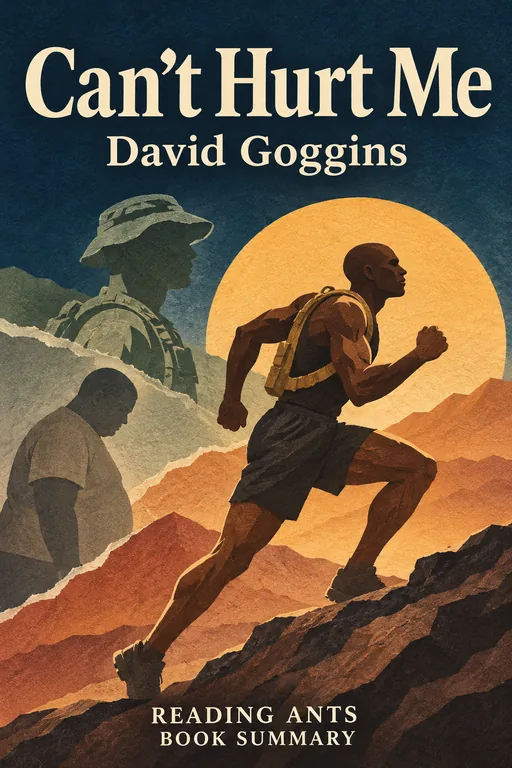
Can't Hurt Me
David Goggins tells how he rose from a violent, poor childhood and an overweight, aimless young adulthood to become a Navy SEAL and an ultramarathon runner, and shares the mental toughness methods he used.
Overview
Can’t Hurt Me: Master Your Mind and Defy the Odds is a memoir and self-help book by David Goggins, a former Navy SEAL, a graduate of Army Ranger School and an ultra-endurance athlete, published in 2018. Goggins grew up in Buffalo, New York, and later in Indiana, and endured abuse and poverty. As an adult he trained himself, through enormous effort, to complete some of the hardest military and athletic challenges in the world. Each chapter of the book tells part of his story and ends with a “challenge” for the reader. The book is blunt, profane and intense, and it became a bestseller, particularly among athletes and military readers.
Full Summary
1. A hard start
The idea: Goggins describes a childhood in which his father, who ran a roller-skating rink, was violent and abusive toward him and his mother. His mother eventually left and took the boys to Brazil, Indiana, where Goggins faced poverty, racism in a mostly white town and difficulties at school, including a learning problem and an inability to read well, which led to shame. He says that these experiences left him feeling worthless and angry, with a mind that told him he could not succeed. He calls this period the foundation that he would later reshape.
In real life: Difficult early experiences can shape how we see ourselves, and recognizing this is a first step in changing it.
2. Rock bottom and the decision to change
The idea: As a young man, Goggins worked at night killing cockroaches for a pest control company, weighed nearly three hundred pounds and felt stuck. One night, seeing a documentary about Navy SEAL training, he decided that he wanted to become a SEAL, though he was far from fit and, as he only learned years later, had a heart defect. He lost over a hundred pounds in a few months, using extreme workouts and strict discipline, and signed up for training.
In real life: Sometimes a clear, difficult goal can be the push that changes a person’s direction.
3. Hell Week and the SEAL path
The idea: Goggins went through Navy SEAL training, known as BUD/S, an extremely demanding program. He struggled through the early stages and was forced to start again twice because of injuries and illness. Finally, on his third attempt at BUD/S, he made it through the infamous Hell Week, the brutal period of near-constant exertion and sleep deprivation, and graduated, pushing on through pain and injuries. He describes the pain and the mental battle of continuing when his body told him to stop.
In real life: Many people quit tasks not because of physical limits but because the mind gives up early.
4. The ideas: callous the mind and the 40 percent rule
The idea: Goggins introduces some of his methods. He argues from his own experience that most people use only a fraction of their capacity, and that when the mind says you are done, you are usually only about forty percent done, which he calls the 40 percent rule. He teaches the accountability mirror, in which one faces oneself and tells honest truths and sets goals, and the cookie jar, a mental collection of past successes to draw on in tough times. He also advises seeking discomfort on purpose to “callous” the mind.
In real life: Doing a hard workout or a cold shower when you don’t feel like it is a way to practice pushing through resistance.
5. Ultra-endurance feats
The idea: After the SEALs, Goggins took on ultra-marathons, in some of which he finished with serious injuries. He ran the Badwater 135, a race across Death Valley, and entered other long events, often with little training. He also set a world record for pull-ups in twenty-four hours, though in the course of it he injured his hands and body. He explains that he used these events to test himself and to raise money for charity.
In real life: Setting a challenging goal in a new area, such as running a first race, can reveal strengths you did not know you had.
6. Other setbacks and the lessons
The idea: The last part describes how he coped with health problems, including a heart defect that he discovered years after becoming a SEAL and underwent surgery for, and how the pursuit of toughness can become a way of life. He emphasizes that the process of self-improvement is endless, and that facing weaknesses honestly is the point. He ends with a call to readers to take responsibility for their own lives, to do the hard things and to stop making excuses.
In real life: Getting help for a health problem, as he eventually did, can be a form of strength and not weakness.
Why It Matters
Can’t Hurt Me became a huge success, reaching bestseller lists and becoming one of the most popular books among fitness and motivational audiences. Goggins himself became a prominent public speaker and social media figure, and his sequel, Never Finished, followed. The book’s message of mental toughness and radical accountability has influenced athletes, soldiers and many ordinary people.
It also helped to spread a conversation about resilience and discipline that is now widely discussed, and it has been used in sports teams and in fitness programs as a motivating text.
Many readers say its key lesson is simple and practical: do one thing each day that you would rather avoid, and notice that you survive it, which builds confidence for harder tasks.
Key Takeaways
- Your mind quits before your body. You can often do more than you think.
- Own your story. Use past pain as fuel, not as an excuse.
- Seek discomfort. Hard tasks build resilience.
- Be honest with yourself. Face your weaknesses directly.
- Keep improving. Growth is a continuing process.
What We Can Learn
The book shows that effort and discipline can transform a life. Goggins’s story reminds us that starting from a difficult place does not prevent change.
It also offers simple tools, such as breaking a big goal into smaller parts and keeping a list of past successes, that anyone can use.
Finally, it encourages us to examine the stories we tell ourselves. Many limits are in the mind, and testing them, safely and sensibly, can show how much more we can do.
Criticism and Counterpoints
Some critics say that Goggins’s approach glorifies pain and extreme risk, and may encourage injury, burnout or ignoring health warnings, and that his own body has paid a price. Others note that his methods work for a particular type of person and goal, and that “toughness” is not always the right approach to problems like trauma or mental illness, which need support and rest.
Some readers find his language and tone aggressive or self-centered, and the book’s detailed claims, such as particular records or timelines, are hard to verify. The advice should be adapted sensibly, with attention to medical guidance. Still, many are moved by his story.
Who Should Read It
This book suits older teenagers and adults. It contains strong language and descriptions of abuse and extreme physical suffering. Readers should not try extreme training without proper preparation and medical advice.
Want the whole book?
A summary is a taste, not the meal. Here is where to find the full book.
You reached the end 🎉
Nicely done. Mark this one as read, and we will suggest what to read next.
Read this next
Unbroken
Laura Hillenbrand
This is the true story of Louis Zamperini, an Olympic runner who survived a plane crash, weeks adrift on the Pacific and years in brutal Japanese prison camps during World War II, then fought to rebuild his life.
🏛️ History
Into Thin Air
Jon Krakauer
Jon Krakauer, a journalist who climbed Mount Everest in 1996, recounts the storm that killed eight people on the mountain over a single day and night, and reflects on what went wrong and on his own survivor's guilt.
🏛️ History
The Subtle Art of Not Giving a F*ck
Mark Manson
Mark Manson argues that a good life comes not from relentless positivity but from choosing what is worth caring about, accepting that problems and limits are unavoidable, and taking responsibility for your own choices.
🌱 Self-Improvement
Man's Search for Meaning
Viktor E. Frankl
A psychiatrist who survived the Nazi concentration camps explains that even in the worst suffering, people can choose their attitude, and that finding a reason to live is what gives us the strength to endure.
👤 Real Lives
Grit
Angela Duckworth
Psychologist Angela Duckworth argues that success depends not only on talent but on grit, a combination of passion and long-term perseverance, and shows how people can grow it in themselves and others.
🌱 Self-Improvement
Atomic Habits
James Clear
Big changes in life come not from huge leaps but from tiny habits repeated every day, and you can build good habits (and break bad ones) by designing your life so the right choices are obvious, attractive, easy and satisfying.
🌱 Self-ImprovementWant something different?
Pick another topic and we will show you three books to start with.