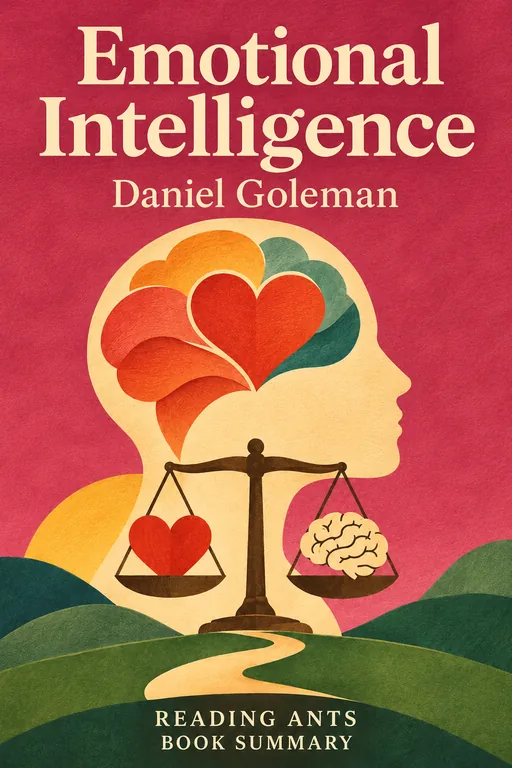
Daniel Goleman argues that the ability to understand and manage emotions, our own and others', matters as much as IQ for success, relationships and well-being, and that it can be learned.
Overview
Emotional Intelligence: Why It Can Matter More Than IQ was written by Daniel Goleman, a psychologist and science journalist who wrote for The New York Times, and published in 1995. Goleman drew on research in neuroscience and psychology, including work by Peter Salovey and John Mayer, who coined the term “emotional intelligence,” to argue that traditional ideas of intelligence leave out something essential. The book explores how the emotional brain works, why people with high IQ sometimes fail while others with ordinary IQ thrive, and how schools, workplaces and families can nurture emotional skills. It became an international bestseller and made “EQ” a common phrase.
Full Summary
1. The emotional brain
The idea: Goleman explains that the brain has both a thinking part, the neocortex, and an older emotional part, the limbic system. At the center of the emotional brain is the amygdala, which acts like an alarm system. In moments of strong feeling, the amygdala can take over before the thinking brain has time to respond, a process Goleman calls an amygdala hijack. This explains why we sometimes act in ways we later regret, such as exploding in anger.
In real life: Saying something hurtful in the heat of an argument is often a result of the emotional brain acting before the rational brain.
2. The five domains of emotional intelligence
The idea: Goleman breaks emotional intelligence into five areas. Self-awareness is knowing your own feelings as they arise. Self-regulation is managing emotions, so that they do not control you. Motivation is using emotions to pursue goals, with persistence and optimism. Empathy is sensing what others feel. Social skills are handling relationships and building networks. He argues that these abilities can be strengthened with practice.
In real life: A student who notices that they are nervous before a test and takes a few deep breaths is using self-awareness and self-regulation.
3. Delaying gratification: the marshmallow test
The idea: Goleman discusses a famous study by Walter Mischel, in which young children were offered one marshmallow now, or two if they waited a short time. Children who were able to wait later, as teenagers, tended to be more competent and do better academically. Goleman interprets this as evidence that the ability to control impulses is a core emotional skill, and one that matters for life outcomes. He also notes that such control can be learned and strengthened.
In real life: Saving some of your allowance instead of spending it immediately is a form of delayed gratification.
4. Empathy and relationships
The idea: The book explains that empathy develops early, when infants and caregivers tune in to each other. People who are skilled at reading others’ emotions through tone of voice, facial expression and body language are better at relationships and often at work. Goleman describes the harm done when empathy is missing, such as in people who hurt others without feeling guilt. He also discusses marriage, showing that couples who handle conflict gently and listen to each other are likelier to stay together.
In real life: Noticing that a friend is quiet and asking how they feel is a simple expression of empathy.
5. Emotional intelligence at work and in health
The idea: Goleman argues that emotional skills are crucial in the workplace. Studies of top performers in many fields find that technical skill is necessary but that those who excel are usually those with strong self-awareness, motivation and social skills. Leaders who can inspire and understand others get the best from teams. He also discusses health: chronic stress and unmanaged anger can contribute to illness, while social support and emotional balance help recovery.
In real life: A manager who listens and stays calm during crises can keep a team productive.
6. Educating emotions
The idea: The final part addresses children and schools. Goleman supports programs known as social and emotional learning, which teach children to identify feelings, manage anger, solve conflicts peacefully and work together. He cites schools that introduced such programs and saw improved behavior and academic results. He argues that emotional education should be considered as important as reading and math, since emotional habits formed in childhood last.
In real life: A classroom that begins the day by asking students how they feel teaches them to notice and name emotions.
Why It Matters
Emotional Intelligence spent more than a year on the New York Times bestseller list and was translated into dozens of languages. It popularized the idea that skills such as empathy and self-control are as important as cognitive abilities, and it influenced education, business and parenting. Social and emotional learning is now part of many school curricula around the world.
The book led to training programs for managers and teachers, and to follow-up books by Goleman on leadership and relationships. It also encouraged public discussion of emotions in places where they were once ignored.
Today, many job interviews and school programs mention emotional skills explicitly, which shows how much the book changed expectations about what it means to be capable and successful.
Key Takeaways
- Emotions guide decisions. Understanding them improves choices.
- The amygdala can hijack us. Learn to pause before reacting.
- Five core skills. Self-awareness, self-regulation, motivation, empathy and social skills.
- Self-control matters. Delaying gratification predicts later success.
- Emotional skills can be taught. Schools and families can help.
What We Can Learn
The book teaches us to notice our emotions before they steer us. Pausing for a moment to name a feeling, such as anger or anxiety, can give us time to choose a better response.
It also encourages us to pay attention to others. Reading faces and tone, listening and showing care strengthen friendships and families.
Finally, it reminds us that these skills can be practiced at any age. Just as we can learn a language or a sport, we can improve how we handle emotions and relationships.
Criticism and Counterpoints
Some psychologists say that Goleman’s claims are overstated and not well supported by evidence. For example, he is widely quoted as saying that emotional intelligence accounts for a large share of life success, while IQ accounts for much less, but this has been challenged by research. Others argue that the concept is vague, overlaps with personality traits such as agreeableness and conscientiousness, and is hard to measure.
Some critics also say that the book’s treatment of the marshmallow test is oversimplified, as later studies showed that family background and circumstances strongly affect results. The popular claims about EQ in the workplace have been criticized as hype. Even so, most agree that emotional skills matter.
Who Should Read It
This book suits teenagers and adults, including parents, teachers and managers. It is clearly written and uses many examples. Readers should treat some of the broader claims about success with caution.
Want the whole book?
A summary is a taste, not the meal. Here is where to find the full book.
You reached the end 🎉
Nicely done. Mark this one as read, and we will suggest what to read next.
Read this next
Daring Greatly
Brene Brown
Researcher Brené Brown argues that vulnerability, the willingness to show up and be seen when outcomes are uncertain, is not weakness but the foundation of courage, connection and creativity.
🌱 Self-Improvement
The Whole-Brain Child
Daniel J. Siegel and Tina Payne Bryson
Understanding how a child's brain develops helps parents respond to tantrums, fears and conflicts in ways that connect, calm and teach, so that different parts of the brain work together.
🎓 Parenting & Education
Mindset: The New Psychology of Success
Carol S. Dweck
Psychologist Carol Dweck shows that people who believe abilities can grow, a growth mindset, learn, cope with failure and achieve more than people who believe their talents are fixed.
🌱 Self-Improvement
Quiet: The Power of Introverts
Susan Cain
Susan Cain argues that modern society overvalues extroversion and overlooks the strengths of introverts, and she shows how quiet, thoughtful people can contribute and thrive when they understand their own nature.
🌱 Self-Improvement
How to Win Friends and Influence People
Dale Carnegie
People are driven by emotion and the desire to feel important, so the way to get along with them, and win them to your point of view, is to stop criticizing, show genuine interest and appreciation, and see things from their side.
🌱 Self-Improvement
Atomic Habits
James Clear
Big changes in life come not from huge leaps but from tiny habits repeated every day, and you can build good habits (and break bad ones) by designing your life so the right choices are obvious, attractive, easy and satisfying.
🌱 Self-ImprovementWant something different?
Pick another topic and we will show you three books to start with.