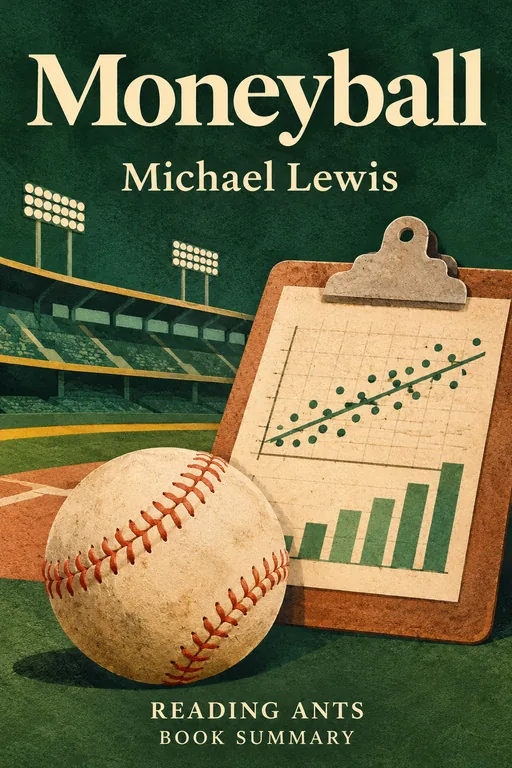
Michael Lewis tells how the Oakland Athletics, a baseball team with a small budget, used statistics to find overlooked players and compete with richer teams, and how that challenged old beliefs about talent.
Overview
Moneyball was published in 2003 by Michael Lewis. It follows the Oakland Athletics baseball team and its general manager, Billy Beane, in the years around 2002. At that time, teams in Major League Baseball had very different amounts of money, and Oakland could not afford the best-known stars. Beane and his assistants searched for a different way to win, by using careful analysis of data to find which skills actually led to victories. The book is about baseball, but it is also about how people judge talent and how clever thinking can beat large budgets.
Full Summary
1. A failed player turned general manager
The idea: Lewis begins with Billy Beane, who was once a highly rated young prospect in baseball, picked early in the draft because scouts loved his athletic look. He did not become a star, and he later moved into the front office. He realized that the old methods of judging players, based on appearance and the opinions of scouts, had misled people about him, and might mislead them about others.
In real life: A person who looks like a champion is not necessarily one, so it is wise to check the results.
2. A small budget in an unfair game
The idea: Oakland had far less money than teams such as the New York Yankees. In 2002 its payroll was about 40 million dollars, while the Yankees spent more than 125 million, and its best players kept leaving for higher salaries. Beane knew that he could not compete by spending as much, so he needed to find value others did not see. Lewis explains that the sport had an uneven playing field, with rich teams winning more often, and that the A’s had to be smarter in order to survive.
In real life: When you have fewer resources than your rivals, you can still win by being more creative, as in a school robotics contest where one team has less funding.
3. Ideas from outside baseball
The idea: Beane drew on the work of Bill James, a writer who had long argued that many traditional baseball statistics, and the instincts of scouts, were flawed. James and others used data to show what really helped a team to score and prevent runs. In particular, getting on base is more valuable than many people believed. Beane hired Paul DePodesta, a young assistant with a background in economics, to help apply these ideas.
In real life: Sometimes an outsider with a different training sees a problem more clearly than an expert who has always done it one way.
4. Finding bargains
The idea: Using the new analysis, Oakland looked for players who were cheap because other teams undervalued them. These included players who did not look the part but who were good at drawing walks and getting on base, or who had unusual styles that scared off scouts. Lewis tells stories of players such as Scott Hatteberg, a catcher who was converted to first base, and Chad Bradford, a pitcher with an odd throwing style, who both turned out to be valuable.
In real life: A second-hand bicycle that works well may be a better choice than a famous brand that costs far more.
5. Conflict with the old guard
The idea: Beane’s methods were not welcomed by everyone. The team’s scouts, who had trusted their eyes for decades, were suspicious of numbers. Lewis shows tense meetings and arguments, and he describes how Beane had to push his plan even when some of his own staff disagreed. Beane also changed how Oakland picked players in the draft, favoring college players with good records over high-school players with promise.
In real life: A new idea often meets resistance, especially from those who are proud of how they have always done things.
6. The 2002 season
The idea: Before the 2002 season, Oakland lost some of its best players, such as Jason Giambi, to richer teams, but the team still won many games. In August and September it won twenty games in a row, an American League record at the time. Lewis shows the excitement and also the tension, as the team’s success was never certain. Oakland won 103 games and the division title, and reached the playoffs, though it lost to Minnesota in the first round. The season shows both the promise of the new approach and the fact that no method can guarantee a championship.
In real life: Doing everything right does not guarantee a championship, but it raises the chance of success.
Why It Matters
Moneyball changed how many people think about sports, data and decision-making. It brought the field of baseball analytics, sometimes called sabermetrics, to a wide audience. Over the next years, professional teams in baseball and other sports hired analysts and began to examine statistics more closely. The book was made into a popular film in 2011, which helped to spread its story even more. Beyond sport, Moneyball became a symbol of a broader idea: that organizations should test their assumptions with evidence instead of trusting tradition and gut feeling. It has been used in business, politics and education as an example of how to find undervalued strengths and use limited resources wisely.
Key Takeaways
- Question old rules. Practices that everyone accepts may be wrong, and data can reveal it.
- Look for hidden value. People or ideas that others overlook can be a bargain.
- Measure what really matters. The right statistic is the one linked to winning, not the one that looks impressive.
- Biases mislead. Appearances and stories about talent can distract from results.
- Resistance is normal. Change often meets suspicion, so leaders need patience and evidence.
What We Can Learn
In your own life, you can ask what really leads to the results you want. If you want to improve at a sport, a subject or a skill, look at records and not only at feelings. You can also remember that talent comes in many forms, and that a person who does not look like a star might be extremely useful. When you form a team, look for the strengths that others undervalue. Finally, the book reminds us to be humble about our own judgment: check your impressions against facts, and be ready to change your mind.
Criticism and Counterpoints
Critics point out that Lewis’s account gives Beane a great deal of credit, and some who worked with him have said that other people, such as scouts and players, were equally important. Others say that the team had also strong pitchers who were developed through traditional methods. Some argue that the book exaggerates the conflict between data and scouting, since good teams use both. Over time, other teams copied the ideas, and the advantage disappeared, so the story is partly one of a moment in time. Sports fans also debate whether numbers can capture human qualities such as teamwork and courage.
Who Should Read It
This book is for baseball fans, but also for anyone interested in data, decisions and fairness in competition. You do not need to know much about baseball, though a little background helps. Readers who dislike sports stories might prefer a different book on data, and those who want a technical guide to statistics will find this more of a story.
Want the whole book?
A summary is a taste, not the meal. Here is where to find the full book.
You reached the end 🎉
Nicely done. Mark this one as read, and we will suggest what to read next.
Read this next
The Big Short
Michael Lewis
Michael Lewis follows a handful of unusual investors who saw that the American housing boom was a bubble before the 2008 financial crisis, bet against it, and discovered how deeply the financial system had misjudged its own risks.
💼 Business
Freakonomics
Steven D. Levitt and Stephen J. Dubner
Economics is really the study of incentives, and by asking odd questions and following the data, we can discover surprising truths about cheating, crime, parenting and everyday life.
💰 Money & Economics
Thinking, Fast and Slow
Daniel Kahneman
Our minds run on two systems, a fast, intuitive one and a slow, careful one, and understanding how the fast system fools us can help us make better decisions about money, risk, work and happiness.
🧩 Mind & PsychologyThe Signal and the Noise
Nate Silver
Statistician and election forecaster Nate Silver explains why most predictions fail, and shows that better forecasting comes from thinking in probabilities, updating with new evidence and being humble about uncertainty.
🔬 Science
The Undercover Economist
Tim Harford
Tim Harford shows how economic ideas explain everyday puzzles, from why coffee costs what it does to why used cars are risky and why poor countries struggle, in a lively and friendly style.
💰 Money & Economics
The Lean Startup
Eric Ries
Startups succeed not by following a detailed plan but by quickly testing their ideas with real customers, learning from the results and changing direction when needed.
💼 BusinessWant something different?
Pick another topic and we will show you three books to start with.