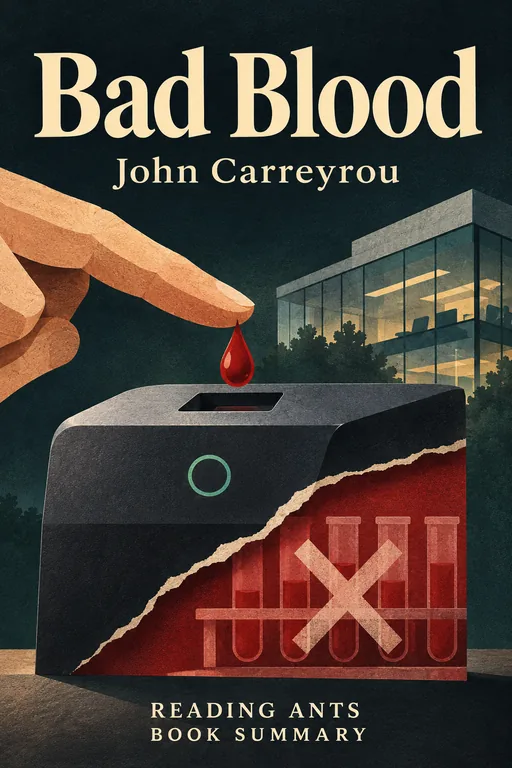
Bad Blood
John Carreyrou, the reporter who broke the story, shows how the blood-testing start-up Theranos and its young founder Elizabeth Holmes built a company worth billions on a technology that did not work, and how a few brave insiders helped to expose it.
Overview
Bad Blood was published in 2018 by John Carreyrou, a journalist at the Wall Street Journal. It tells the story of Theranos, a Silicon Valley company founded in 2003 by Elizabeth Holmes, who left Stanford University as a teenager. The company promised to run many medical tests from a few drops of blood, which would have made tests cheaper and easier. Carreyrou shows how the company attracted famous investors and board members, how its secrecy hid the fact that the machines were failing, and how the truth came out. The book reads like a thriller.
Full Summary
1. A young founder with a big promise
The idea: Elizabeth Holmes leaves university at nineteen to start a company with the idea of a device that could test for many conditions with a tiny sample of blood from a finger prick. She is charismatic and determined, speaks in a deep voice and models herself on famous technology founders. She raises money from investors who are drawn by the story and by her ability to impress powerful people.
In real life: A confident speaker can sound convincing, but a good listener asks to see the evidence before believing.
2. A board of famous names, but few experts
The idea: Holmes builds a board of directors made up of well-known former officials and business figures, including people who had served in senior government posts. Carreyrou points out that most of them came from diplomatic, military or business backgrounds, not from science or medicine. Their reputations gave the company credibility, so that others trusted it without checking. Holmes’ boyfriend, Sunny Balwani, had already joined as a senior executive, and the company becomes tightly controlled and secretive.
In real life: If a product is praised only by famous people, but not tested by independent experts, there is a good reason to ask more questions.
3. The technology does not work
The idea: Inside the company, the small devices that were meant to run a wide range of tests on tiny samples give unreliable results. Engineers and scientists find that the machines often fail or give wrong numbers. Rather than admit the problem, the company uses commercial machines made by other firms for many tests while telling the world that its own machine does the work. Employees who raise concerns are pressured or dismissed.
In real life: A team that hides a problem to avoid embarrassment usually makes it bigger.
4. A culture of secrecy and fear
The idea: Carreyrou describes how Theranos guards its secrets tightly and uses lawyers to threaten critics and former employees. A respected scientist, Ian Gibbons, who has doubts about the technology, is put under heavy pressure over a legal dispute, in which he was expected to give testimony, and in 2013 takes his own life. The company’s lawyers also go after sources who talk to the press, including a young employee who was the grandson of a board member. The book treats this loss with seriousness and shows how fear grows when truth is punished.
In real life: A workplace where people are afraid to speak up cannot fix its mistakes.
5. Partners, patients and real harm
The idea: Theranos signs deals with the pharmacy chain Walgreens and the grocery chain Safeway. Walgreens begins to offer the tests to ordinary customers, while the Safeway partnership drags on for years at great expense and never reaches the public. Some patients receive inaccurate results, which could have led to wrong decisions about their health. Inside the company, a few workers realize the danger and decide to speak out.
In real life: When a product affects health or safety, mistakes are more than a business problem, since people can be hurt.
6. The whistleblowers and the exposure
The idea: Young employees, including Tyler Shultz, the grandson of the board member George Shultz, and Erika Cheung, raise questions about the company’s lab. Carreyrou starts to investigate after a tip from a pathologist, Adam Clapper, and publishes his first articles in the Wall Street Journal in 2015. The company tries to stop him with legal threats and pressure on his sources. As more facts come out, regulators investigate, partners end their deals and the company collapses.
In real life: Telling the truth can be frightening, but it is often the only way to stop harm.
Why It Matters
Bad Blood became a bestseller and won a major business-book award, and the story has also been told in documentaries and a television series. It is important as a story of one of the most famous frauds in modern business, and for how it exposes the weaknesses in the culture of start-ups: the worship of founders, the lack of questions from investors and the way that secrecy can hide failure. The book also honors the work of investigative journalism and the courage of the whistleblowers. Holmes was later put on trial in 2021 and convicted in 2022 of defrauding investors, and Balwani was also convicted. The story is still used in discussions of ethics in business and the need to base bold claims on evidence.
Key Takeaways
- Check the evidence. Impressive names and confident speeches are not proof that a product works.
- Secrecy is a warning sign. Honest science welcomes testing and questions.
- Fear silences truth. A company that punishes doubters loses its chance to fix problems.
- Health claims need extra care. Mistakes in medical tests can harm real people.
- Courage matters. A few people who spoke up changed the outcome.
What We Can Learn
When you hear a bold promise about a product, ask who has tested it and how. Do not be impressed by who is on the advisory board alone. If you ever see something wrong in a school, workplace or club, learn how to raise a concern safely, perhaps with the help of a trusted adult or a formal channel. Also remember that people who commit fraud often begin with a small exaggeration that grows. Being honest about what you do not know, and correcting a mistake early, is a good habit and protects you and others.
Criticism and Counterpoints
Carreyrou was an active participant in the story, and the book is told from the point of view of the journalist and the whistleblowers. Holmes and her supporters have disputed some characterizations, and some of the people in the book have said that their roles were simplified. Some reviewers note that it is hard to know precisely what Holmes herself believed at each moment. Others say that the book focuses on personalities, and pays less attention to the larger problems in medical regulation and venture capital. The book was published before the trials, so it does not cover them.
Who Should Read It
This book is for readers who enjoy true stories of business scandals, and for anyone interested in technology, health care or journalism. It is fast-paced and reads like a novel. Readers who find stories of corporate bullying distressing may want to take care, particularly with the section about the scientist’s death.
Want the whole book?
A summary is a taste, not the meal. Here is where to find the full book.
You reached the end 🎉
Nicely done. Mark this one as read, and we will suggest what to read next.
Read this next
The Everything Store
Brad Stone
Brad Stone tells the story of how Jeff Bezos built Amazon from an online bookstore into a giant that sells almost everything, and shows the ambition, the relentless drive and the human costs behind it.
💼 Business
Elon Musk
Walter Isaacson
Walter Isaacson's biography follows Elon Musk from a troubled childhood in South Africa to the leadership of Tesla, SpaceX and other ambitious ventures, and asks whether his risk-taking genius and his rough, impulsive side can be separated.
💼 Business
The Big Short
Michael Lewis
Michael Lewis follows a handful of unusual investors who saw that the American housing boom was a bubble before the 2008 financial crisis, bet against it, and discovered how deeply the financial system had misjudged its own risks.
💼 Business
Steve Jobs
Walter Isaacson
The authorized biography of Apple's co-founder follows a brilliant, demanding and often cruel perfectionist whose focus on beautiful design transformed computers, music, phones and animated movies.
💼 Business
The Lean Startup
Eric Ries
Startups succeed not by following a detailed plan but by quickly testing their ideas with real customers, learning from the results and changing direction when needed.
💼 Business
Good to Great
Jim Collins
Collins argues that sustained corporate improvement comes from disciplined leaders, carefully chosen people, a focused economic concept and cumulative execution rather than dramatic transformation programs.
💼 BusinessWant something different?
Pick another topic and we will show you three books to start with.