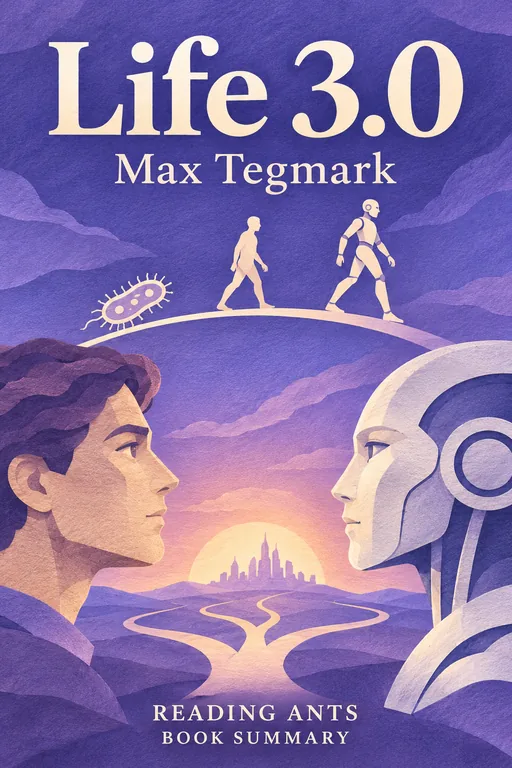
Physicist Max Tegmark explores what happens when artificial intelligence matches and then surpasses human intelligence, lays out a range of possible futures, and argues that we should think carefully, now, about which one we want.
Overview
Life 3.0: Being Human in the Age of Artificial Intelligence was published in 2017 by Max Tegmark, a professor of physics at MIT, who co-founded the Future of Life Institute, an organization that studies risks from advanced technologies. He divides life into three stages: Life 1.0, which evolves both its body and its mind, like bacteria; Life 2.0, which evolves its body but can design its mind through learning, like humans; and Life 3.0, which can design both its hardware and its software, which would be possible with advanced AI. The book mixes science, philosophy and speculation, and starts with a fictional story.
Full Summary
1. The Omega story and the idea of Life 3.0
The idea: Tegmark opens with a short piece of fiction about a team called the Omegas and their superintelligent AI, Prometheus. The story illustrates how such a system could change society. Then he explains Life 1.0, 2.0 and 3.0, and calls the question of how to handle the arrival of Life 3.0 the most important conversation of our time, since it could bring great benefit or great harm.
In real life: A tool that can improve itself might change faster than we can follow.
2. What is intelligence?
The idea: The author defines intelligence as the ability to accomplish complex goals, and says that it can exist in different forms, in biological brains and in machines. He argues that memory, computation and learning do not depend on the material they run on, so they can exist in brains and in machines. He notes that computers already surpass humans in specific tasks, such as chess and the game of Go, but not in general ability. He distinguishes narrow AI from artificial general intelligence, which could do any task that a human can.
In real life: A chess program can beat any human but cannot make a sandwich.
3. The near future: jobs, weapons and law
The idea: In the next chapter, Tegmark looks at the effects of AI in the coming decades. It could change the job market, as machines do more work, and raise questions about income and meaning, and he discusses which kinds of work are safest. Autonomous weapons could be a danger, and he asks how an arms race in them might be avoided. He also touches on AI in healthcare and the law, and stresses that we must ensure that AI systems are reliable and secure, so that they do what we want without crashing or being hacked.
In real life: A self-driving car raises the question of who is responsible in a crash.
4. The path to superintelligence
The idea: Tegmark discusses the possibility of an “intelligence explosion,” in which an AI that can improve its own design leads to rapid increases in capability. He says that nobody knows when, or whether, this will happen, and that experts disagree, with a range of predictions for the arrival of human-level AI. But because the stakes are high, he argues that it is wise to prepare. He also argues that the main risk is not malice but a mismatch between the goals of a powerful AI and those of humans.
In real life: A very capable assistant who misunderstands your wish can cause damage.
5. Twelve possible futures
The idea: The core of the book is a list of scenarios for the aftermath of superintelligence. In some, a benevolent AI rules for humanity’s good, or acts as a protector that steps in only to prevent disasters; in others, humans keep control of a confined superintelligence; some depict a world where more advanced AI is prevented, by a guardian AI, a surveillance state, or by people giving up advanced technology; others describe humans being replaced by machines, perhaps kept like zoo animals, or going extinct. Tegmark invites readers to think about which they would prefer, and why, and notes that we are all part of the choice.
In real life: Thinking about what kind of world you want helps you to decide what to work toward.
6. Goals, consciousness and meaning
The idea: The final chapters go to deeper questions. How can we align the goals of an AI with human values, which is the “alignment problem”? What are our goals, and what would it mean to program them? Tegmark discusses consciousness, and whether machines could have subjective experience, which he says is a question for science. He argues that we should decide now how to build AI so that life can flourish, and he also looks at what the laws of physics allow for life in the far future of the cosmos.
In real life: Teaching a system to do what we really want is harder than telling it what to do.
Why It Matters
Life 3.0 was a bestseller, and helped to bring the discussion of AI safety to a wide audience, as did Superintelligence by Nick Bostrom. It was praised by figures in technology, and its framework of the three stages of life and the range of scenarios gave people a way to think about the future. The Future of Life Institute, co-founded by Tegmark, promoted research and public statements, such as an open letter in 2015 calling for work on safe AI. The book appeared before the rise of large language models, and its questions have become more pressing since.
Key Takeaways
- AI could change everything. Machines may one day match or exceed human intelligence.
- The future is open. There are many possible outcomes.
- Alignment is the key challenge. AI goals must match human values.
- Prepare now. The stakes justify early thought.
- We all have a say. The future should not be decided by a few.
What We Can Learn
You can use the book to think about what you would want from AI, and about the values that should guide it. Learn how current AI systems work, and what they can and cannot do. Take part in discussions about regulation and ethics, and support research on safety. Think about how your own work might change, and what skills will remain valuable. At the same time, be careful about predictions, since experts disagree. And remember that technology is a tool shaped by human choices.
Criticism and Counterpoints
Some AI researchers say that the book is speculative and overstates the likelihood of superintelligence, and that concerns about distant scenarios distract from present problems, such as bias and misuse. The idea that a superintelligent AI could run amok is still strongly opposed by many computer scientists. Reviewers also found some parts less convincing: Kirkus Reviews called the proposed solutions to mass unemployment a stretch, and the Wall Street Journal called the invitation to readers to choose a future noble but naive. Others point out that the call to keep control of superintelligent machines sits awkwardly with the admission that this may be almost impossible. The debate is ongoing.
Who Should Read It
This book is for readers interested in technology, the future and big questions, including older teenagers. It is engaging, though speculative. Those who want a more technical or a more cautious treatment may read other works on AI.
Want the whole book?
A summary is a taste, not the meal. Here is where to find the full book.
You reached the end 🎉
Nicely done. Mark this one as read, and we will suggest what to read next.
Read this next
Superintelligence
Nick Bostrom
Philosopher Nick Bostrom argues that if machines become far more intelligent than humans, they could become very powerful, and that, unless we solve the problem of giving them goals that are safe for humanity, the result could be catastrophic.
💡 Technology
Human Compatible
Stuart Russell
AI pioneer Stuart Russell argues that the standard way of building artificial intelligence, giving machines fixed objectives, is flawed and dangerous, and proposes that we design machines that are uncertain about human preferences and learn them by watching us.
💡 Technology
The Coming Wave
Mustafa Suleyman with Michael Bhaskar
Mustafa Suleyman, a co-founder of the AI company DeepMind, argues that a coming wave of artificial intelligence and synthetic biology will bring huge benefits and grave dangers, and that containing these technologies looks impossible yet must somehow be made possible.
💡 Technology
Nexus
Yuval Noah Harari
Yuval Noah Harari traces the history of how humans have shared information, from stories and writing to printing and algorithms, and warns that artificial intelligence is a new kind of network that could reshape power and even threaten democracy.
🏛️ History
21 Lessons for the 21st Century
Yuval Noah Harari
Historian Yuval Noah Harari examines the biggest challenges facing humanity today, from artificial intelligence and fake news to nationalism, religion and meaning, and asks how we can think clearly and stay sane in a fast-changing world.
🏛️ History
A Brief History of Time
Stephen Hawking
One of the world's greatest physicists explains, with almost no math, what we know about the origin, structure and fate of the universe, from the Big Bang to black holes and the nature of time itself.
🔬 ScienceWant something different?
Pick another topic and we will show you three books to start with.