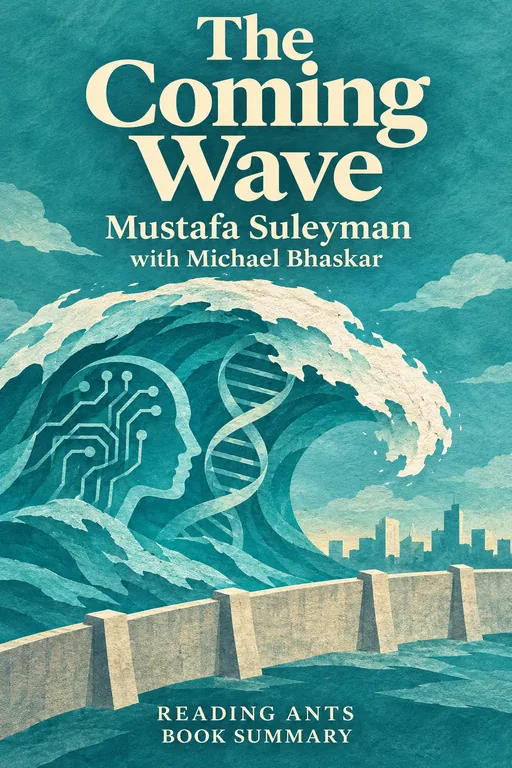
The Coming Wave
Mustafa Suleyman, a co-founder of the AI company DeepMind, argues that a coming wave of artificial intelligence and synthetic biology will bring huge benefits and grave dangers, and that containing these technologies looks impossible yet must somehow be made possible.
Overview
The Coming Wave: Technology, Power, and the Twenty-First Century’s Greatest Dilemma was published in 2023 by Mustafa Suleyman, who co-founded DeepMind in 2010 (it was later acquired by Google) and then the company Inflection AI, working with the writer Michael Bhaskar. Suleyman says that he has spent much of his career building AI, and he argues that two technologies, advanced AI and synthetic biology, are the core of a “coming wave” that will reshape society, with robotics, quantum computing and other technologies growing around them. The book describes this wave, the “containment problem” that it raises, and a set of ten steps that he hopes could make containment possible. It is a mix of memoir, history and argument.
Full Summary
1. A wave, a dilemma and a blind spot
The idea: Suleyman opens by saying that two things underlie the human world, intelligence and life, and that a new wave of technology is giving us the power to engineer both. He says the wave will create wealth on a scale never seen, but that its rapid spread also empowers bad actors and threatens instability and even catastrophe. He tells how he co-founded DeepMind in 2010 with Demis Hassabis and Shane Legg, with the aim of replicating human intelligence, and how his worries grew as the technology advanced. He names the central problem the dilemma: both building these technologies and refusing to build them risk leading toward catastrophe or toward a surveillance dystopia. He also describes “pessimism aversion”, the emotional habit, especially among powerful people, of looking away from frightening evidence. He recalls pitching warnings to a room of tech leaders who shrugged them off, and a seminar on cheap DNA synthesis where the audience refused to accept the risk. The short prologue, the text reveals, was written by an AI.
In real life: Putting off a worrying medical test because the result might be scary is a familiar kind of avoidance.
2. Proliferation and the containment problem
The idea: Part I argues that technology comes in waves, each built around a general-purpose technology such as the steam engine, electricity, the combustion engine or computing. Once a technology works, it gets cheaper and spreads. He shows this with the car: after Henry Ford’s Model T and the assembly line, the share of Americans owning a car rose from about 10 percent in 1915 to 59 percent in 1930. He then turns to the containment problem, meaning the ability to monitor, curb, control and even shut down a technology. Inventors quickly lose control of what their inventions become: Edison’s phonograph, Nobel’s explosives and Gutenberg’s press all went in directions their makers did not expect. Societies have often tried to say no, and the Ottoman Empire delayed the printing press for a long time, but resistance eventually wore down. Nuclear weapons are the partial exception, held back by cost, treaties, fear and luck, and even then the story includes accidents and near misses.
In real life: Once phones became cheap, nearly everyone could have one.
3. The new wave: intelligence, life and more
The idea: Part II describes the wave itself. In AI, he describes the DQN program learning an Atari game in 2012, AlphaGo’s 2016 match against Lee Sedol, deep learning and the rise of large language models such as ChatGPT. He proposes the idea of “artificial capable intelligence”, the point at which AI can achieve complex goals with minimal human oversight, and argues that this near-term milestone matters more than debates about superintelligence. In biology, he describes how we can now read, edit and write DNA, through genome sequencing, CRISPR gene editing and DNA synthesis, and how DeepMind’s AlphaFold showed AI and biology feeding each other. Around these two sit robotics, quantum computing, nanotechnology and new energy sources. The benefits he expects include new medicines, cleaner energy and expert help available to almost anyone.
In real life: A tool that helps scientists design new molecules can speed up medicine and also raise risks.
4. Four features that make it different
The idea: Suleyman says four features make this wave harder to contain than earlier ones. Asymmetry means that small actors can have huge effects; he points to a small Ukrainian drone unit that helped stall a Russian column near Kyiv in 2022. Hyper-evolution means that innovation is speeding up, with the physical world starting to move at digital speed. Omni-use means one technology can serve many ends; an AI built to find medicines was able, when asked to look for poisons, to suggest tens of thousands of toxic molecules in hours. Autonomy means that systems increasingly act and find strategies without human approval, and that their inner workings are often hard to explain. He notes Stuart Russell’s gorilla problem, the worry that a more intelligent entity could end up containing us.
In real life: A tool that anyone can use for good can be misused by a few.
5. Unstoppable incentives
The idea: Why not simply stop? Suleyman lists the forces that push the wave on: rivalry between nations (he says AlphaGo’s win was seen in China as a Sputnik moment for AI), a research culture that rewards openness and publication, huge financial rewards, urgent global needs such as food and climate, and human ego. These reinforce one another, so slowing down goes against the interests of states, companies and researchers alike.
In real life: When every team in a race fears being left behind, no one wants to be the first to slow down.
6. States under strain
The idea: Part III looks at the nation-state, which he sees as the main actor able to contain technology, and which already faces falling trust and rising inequality. The wave will amplify its weaknesses. The 2017 WannaCry attack, built on a stolen tool from a US intelligence agency, is his example of uncontained asymmetry. He warns about cheaper weapons and cyberattacks, deepfakes and misinformation, accidental lab leaks and large job losses. Power could both centralize, boosting authoritarian control and vast new companies, and decentralize, empowering groups to live outside traditional structures.
In real life: A town with a weakened fire service faces a bigger danger when new hazards appear.
7. Catastrophe or dystopia
The idea: Chapter 12 states the dilemma plainly. If the wave is uncontained, bad actors could use it for disasters such as an engineered pandemic, and he uses the Aum Shinrikyo cult’s 1990s attacks to show that a determined group can cause harm even with limited means. But the most secure-seeming answer, total surveillance and control, leads to dystopia. Halting technology is no way out either, because stagnation would bring its own collapse. He says humanity must walk a narrow path between these poles.
In real life: Too much freedom may let harmful actors act, and too much control may end freedom.
8. Ten steps toward containment
The idea: Part IV argues that regulation alone is not enough, and that containment is not possible in the present world. He offers ten steps, arranged as concentric circles, to change those conditions: technical safety research, with an Apollo-style program; audits; choke points that slow development, such as export controls on advanced chips; makers, including critics who should build; businesses that balance profit and purpose; governments that build their own expertise and regulate; alliances and treaties; a culture that learns openly from failure, as aviation does; popular movements; and, tenth, the narrow path itself, meaning coherence among all the measures. No single step is enough, and he calls containment a never-ending effort. He says the moment to start is now.
In real life: Several layers of safeguards are stronger than one.
Why It Matters
The Coming Wave was published in 2023, soon after ChatGPT and GPT-4 made generative AI a public topic, and it came from someone who helped build the field. Its warnings about misuse, and its insistence that regulation is necessary but not enough, joined the debate over how to govern AI and biotechnology. The concept of the “containment problem” gave a name to the challenge of controlling powerful technologies. The book touches on the superintelligence debate, citing Stuart Russell, but argues that nearer-term capabilities and political and social questions deserve more attention. It also raised the question of whether containment is possible at all, and what role companies and governments should play.
Key Takeaways
- Technology spreads. History shows that useful technologies proliferate and are hard to hold back.
- A new wave is coming. AI and synthetic biology, with robotics and other fields around them, may transform life.
- The benefits are great. Medicine, energy and expert help could improve.
- Four features raise the risk. Asymmetry, hyper-evolution, omni-use and autonomy make this wave harder to contain.
- Pessimism aversion is a trap. Looking away from alarming evidence prevents action.
- Containment needs many measures. Ten steps, from technical safety to treaties and public pressure, must work together.
What We Can Learn
You can use the book to think about how powerful technologies should be developed and governed, and about the role that ordinary citizens can play. Learn about AI and biotechnology, and follow the debates about regulation. Support transparency and safety in companies. Consider careers in safety and policy, if you are interested. Be careful of both hype and fear, and look for balanced information. And remember that the future of technology depends on the decisions of many people, and that public pressure can help to shape them.
Criticism and Counterpoints
The author himself expects some readers to find the book overblown, and he admits that he is biased as an AI insider. Skeptics may say that its picture of near-inevitable proliferation and catastrophe is alarmist, and that it gives too little weight to the ability of societies to regulate technologies, as they partly did with nuclear weapons, which the book itself calls a partial exception. Others may argue that, coming from a founder of AI companies, the call for regulation could serve established firms, and the book itself notes that critics of the EU’s AI Act say big tech helped draft it and watered it down. The synthetic biology scenarios are, by the author’s own account, extrapolations from trends, and experts may disagree about how easy a dangerous pathogen would be to create. The ten steps are broad, and Suleyman calls them necessary groundwork, not a complete map or final answers. Many prominent readers quoted at the front of the book praise it as a sobering wake-up call.
Who Should Read It
This book is for general readers who want to understand the debate about AI and biotechnology and their governance, including older teenagers. It is clear and written for non-specialists. Those who want technical details or a more skeptical view should read other works on the topic.
Want the whole book?
A summary is a taste, not the meal. Here is where to find the full book.
You reached the end 🎉
Nicely done. Mark this one as read, and we will suggest what to read next.
Read this next
Superintelligence
Nick Bostrom
Philosopher Nick Bostrom argues that if machines become far more intelligent than humans, they could become very powerful, and that, unless we solve the problem of giving them goals that are safe for humanity, the result could be catastrophic.
💡 Technology
Human Compatible
Stuart Russell
AI pioneer Stuart Russell argues that the standard way of building artificial intelligence, giving machines fixed objectives, is flawed and dangerous, and proposes that we design machines that are uncertain about human preferences and learn them by watching us.
💡 Technology
Life 3.0
Max Tegmark
Physicist Max Tegmark explores what happens when artificial intelligence matches and then surpasses human intelligence, lays out a range of possible futures, and argues that we should think carefully, now, about which one we want.
🔬 Science
Nexus
Yuval Noah Harari
Yuval Noah Harari traces the history of how humans have shared information, from stories and writing to printing and algorithms, and warns that artificial intelligence is a new kind of network that could reshape power and even threaten democracy.
🏛️ History
Co-Intelligence
Ethan Mollick
Wharton professor Ethan Mollick offers a practical guide to working with generative AI as a kind of "co-intelligence," explaining what it does well and badly, and giving four rules for using it effectively and responsibly in work, study and life.
💡 Technology
The Innovators
Walter Isaacson
Walter Isaacson tells the history of the digital revolution through the people who invented the computer, the internet and the web, and argues that innovation is mostly the product of collaboration, not the work of lone geniuses.
💡 TechnologyWant something different?
Pick another topic and we will show you three books to start with.