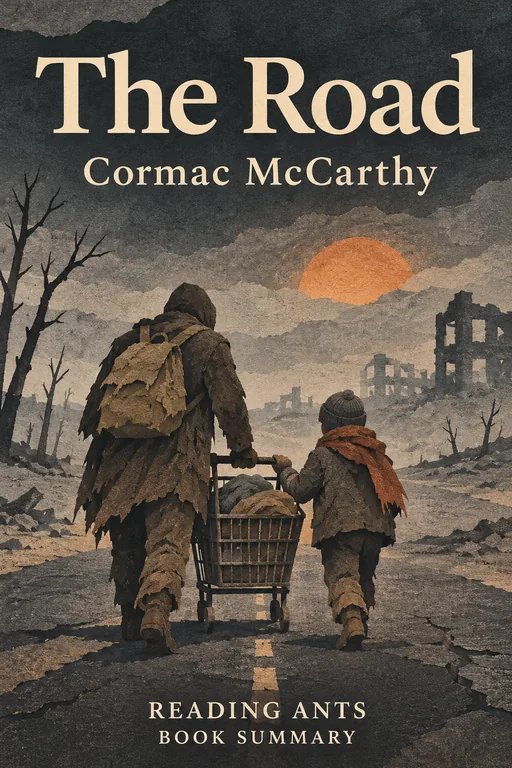
The Road
A father and his young son walk through a burned, ash-covered America after an unexplained catastrophe, struggling to stay alive and to stay good in a world where hope has almost died.
Overview
The Road, by the American writer Cormac McCarthy, was published in 2006 and won the Pulitzer Prize for Fiction in 2007. Some years before the story begins, an unnamed disaster destroyed most life on Earth. The sky is gray with ash, the land is dead, and what few humans remain are starving. A man and his son, whose names we never learn, are traveling south along a road toward the coast, hoping for warmth and safety. They push a shopping cart with their few belongings, avoiding “bad guys,” some of whom have turned to cannibalism. Written in spare, poetic prose, with almost no punctuation, it is a devastating story of love between a parent and child.
Main Characters
- The man: the father, desperate to protect his son.
- The boy: his young son, born after the disaster, who retains compassion.
- The mother: the boy’s mother, who appears only in memories.
- Ely: an old man they meet on the road.
- The thief: a man who steals their belongings.
- The roadmen: cannibals and bandits.
- The family at the end: a man, woman and children who adopt the boy.
Full Summary
Walking South
The story opens with the father and son waking in the woods. The man has a cough, and a pistol with two bullets. The boy’s mother killed herself years ago, believing that the future held only violence, and the father could not persuade her to stay. They have a map and a destination: the sea, where the man hopes it will be warmer. They push a shopping cart with blankets, food and a few belongings, and they speak of “carrying the fire,” a way for the boy to understand that they must remain good people even when the world has become cruel.
Dangers on the Road
On their journey they scavenge abandoned houses, finding scraps of food. In a farmhouse, the man discovers a cellar where people are being held captive by cannibals, kept alive to be eaten. He and the boy flee in terror, and later narrowly avoid a gang of men. The boy cries when the man refuses to help others, insisting that they must share what they have, and the man struggles between protecting his son and the boy’s compassion.
The Bunker
Later, they find a bunker hidden under the ground, stocked with food and supplies, left by a family preparing for the end. For a few days, they feast and rest, washing and sleeping in beds. But the man fears that the bunker may be discovered, and they leave. On the road after that, they meet an old man, Ely, who says he has been walking for a very long time. The boy begs to share food with him, and the father reluctantly agrees.
The Thief
Near the coast, the man catches a thief who has stolen their cart and belongings. He forces the thief at gunpoint to strip naked and leaves him with nothing. The boy is horrified and begs his father to go back and help. The man refuses, but the boy insists, and they leave some clothes and food on the road. This is a test of their humanity.
The Sea
When they finally reach the coast, the ocean is gray and empty, with no ships and no warmth. The man’s cough has worsened, and he is clearly dying. After leaving their first camp on the beach, the man is wounded by an arrow shot by a stranger in a coastal town. He gives the boy the pistol and tries to teach him to go on, telling him to keep “carrying the fire.” He dies on the beach.
A New Family
After three days with his father’s body, the boy meets a man who has been following them. The boy asks the man whether he is carrying the fire, and when the man says yes, the boy goes with them. The man’s family, a woman and two children, welcome the boy and care for him. The woman talks with him about God, and he feels that he can still talk to his father. The novel ends with a description of mountain streams, with brook trout, that once existed and cannot be brought back.
Why It Matters
The Road won the Pulitzer Prize for Fiction in 2007 and was a bestseller after being chosen for Oprah’s Book Club. It was adapted into a 2009 film starring Viggo Mortensen. McCarthy, already one of America’s greatest living novelists, dedicated the book to his young son, John, and has said that the idea came to him while looking out over a city with his son.
The novel is widely praised as one of the most moving stories about parenthood and one of the most haunting visions of a post-apocalyptic world. It turns the usual survival story into a meditation on moral goodness, asking what it means to “carry the fire” when all else is gone. It has become one of the defining novels of the twenty-first century.
Key Takeaways
- Love can survive the end of the world. The bond between father and son keeps them alive.
- Goodness must be chosen. The boy insists on helping others despite the danger.
- Hope is fragile but essential. Even in despair, the man keeps moving.
- Parents protect and teach. The father’s task is to preserve his son’s humanity.
- Memory preserves what is lost. The world that disappeared lives in dreams and words.
What We Can Learn
The novel reminds us that our values matter most when they are hardest to keep. The boy’s compassion, even toward strangers who might harm them, shows that kindness is a choice.
It also highlights the importance of the people we love. The man’s whole life becomes devoted to his son, and it gives him strength. Treasuring family and friends, and being present for them, is among the most meaningful things we can do.
Finally, it makes us appreciate the natural world and the small comforts of everyday life, such as food, warmth and sunshine.
Criticism and Counterpoints
Some readers find the novel too bleak, with endless suffering and little explanation of what caused the disaster. McCarthy’s spare style, lacking quotation marks and apostrophes, and the many repetitions can be difficult.
Others criticize the portrayal of the mother, who is shown only as someone who gave up. A few have questioned whether the father’s rigid protectiveness is truly heroic, or whether the boy’s compassion is wiser. Supporters point to the ending as a quiet message of hope.
Who Should Read It
This short novel suits mature readers who can handle extremely dark material. It is not an easy read, but it is deeply moving. Parents may find it especially powerful, though many readers say it is the saddest book they have ever read.
Want the whole book?
A summary is a taste, not the meal. Here is where to find the full book.
You reached the end 🎉
Nicely done. Mark this one as read, and we will suggest what to read next.
Read this next
Blood Meridian
Cormac McCarthy
A fourteen-year-old runaway known only as "the kid" joins a gang of scalp hunters on the border of Texas and Mexico in the late 1840s, a gang led by Glanton and dominated by Judge Holden, in a story of unrelenting violence.
✨ Modern Fiction
No Country for Old Men
Cormac McCarthy
When a Texas welder named Llewelyn Moss finds two million dollars at the scene of a drug deal gone bad and takes it, a relentless killer, Anton Chigurh, pursues him, while an aging sheriff, Ed Tom Bell, struggles to understand a world that has changed.
✨ Modern Fiction
Station Eleven
Emily St. John Mandel
After a flu kills most of humanity, a traveling troupe of actors and musicians carries Shakespeare and music through the empty land, and the lives of the survivors turn out to be linked.
🚀 Sci-Fi & Fantasy
The Stand
Stephen King
After a deadly flu kills nearly everyone, the survivors split into two camps, led by a kindly old woman in Colorado and a dark man in Las Vegas, and prepare for a final stand between good and evil.
🚀 Sci-Fi & Fantasy
Hatchet
Gary Paulsen
After a plane crash leaves him alone in the Canadian wilderness with only a hatchet, a thirteen-year-old boy must learn to survive, and grows from a frightened city kid into a patient, resourceful young man.
🧸 Children's Books
The Kite Runner
Khaled Hosseini
A wealthy boy in Kabul betrays his loyal best friend on the day of a kite tournament, and decades later, after fleeing to America, he returns to a Taliban-ruled Afghanistan to try to make things right.
✨ Modern FictionWant something different?
Pick another topic and we will show you three books to start with.