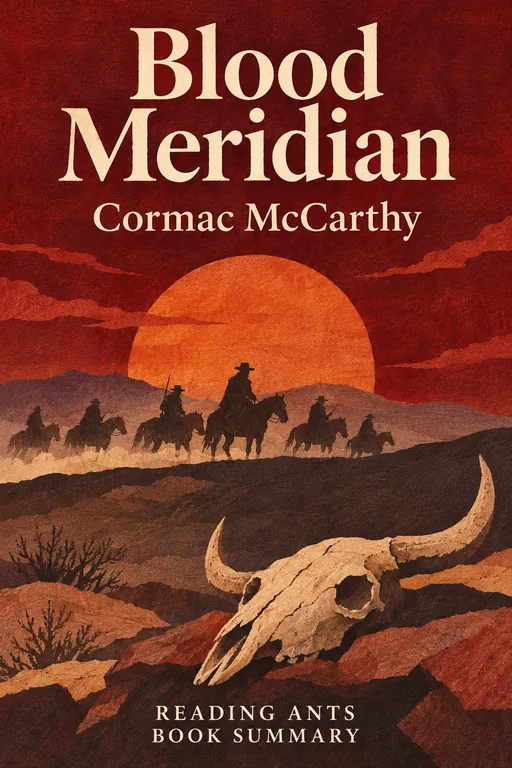
Blood Meridian
A fourteen-year-old runaway known only as "the kid" joins a gang of scalp hunters on the border of Texas and Mexico in the late 1840s, a gang led by Glanton and dominated by Judge Holden, in a story of unrelenting violence.
Overview
Blood Meridian, or The Evening Redness in the West is a novel by Cormac McCarthy, published in 1985. It is loosely based on the true story of the Glanton gang, a group of American mercenaries hired to kill Apaches, who turned to killing anyone for the scalp bounty. The novel was not a commercial success at first, but gradually became recognized as one of the greatest American novels. It is written in a dense, biblical style, with long sentences, rich descriptions of landscape, and without quotation marks. It combines brutal realism with philosophical reflection on war and fate.
Main Characters
- The kid: the nameless protagonist, a teenager who is violent and quiet, and whose moral character is ambiguous.
- Judge Holden: a huge, hairless, learned and terrifying figure who claims that war is the ultimate form of human activity.
- John Joel Glanton: the leader of the scalp-hunting gang.
- Toadvine and Tobin: members of the gang, a rough man and an ex-priest.
- The Apaches, Comanches and Mexicans: victims of the gang’s violence.
Full Summary
The Kid
The novel opens with the kid’s birth in Tennessee in 1833. His mother died giving birth, and his father is a drunk schoolteacher. At fourteen, he runs away, and he drifts to Texas around 1847. He gets into fights, is involved in a failed filibustering expedition into Mexico, which is wiped out by Comanches, and he ends up in prison in Chihuahua. There he finds Toadvine, a man he had crossed paths with earlier in Texas, who arranges for the two of them, with another prisoner, to be released into Glanton’s gang of scalp hunters.
The Glanton Gang
The kid joins the Glanton gang, hired by the governor of Chihuahua to kill Apaches for a bounty of a hundred dollars per scalp. Under Captain Glanton and with Judge Holden as a sinister adviser, the gang rides through the desert, and kills indiscriminately, including peaceful Indians and Mexican villagers, as the scalps of all look much the same. They are armed with rifles and pistols and their savagery is described in detail. The kid takes part in some of the killing, but at times shows signs of compassion.
The Judge
Holden is the most powerful personality in the book. He is educated, speaks many languages, sketches plants and animals in a notebook and then destroys the objects he records. He gives speeches in which he says that war is the truest form of the exercise of will, and that those who deny it are weak. He seems to be a figure of pure power, and almost supernatural. He seems to take a special interest in the kid, and also a hostility to him.
The Slaughter
As the gang continues west, the violence increases. They kill a group of peaceful Tigua people, and then travel to Tucson. The gang takes over a ferry at the Colorado River, killing the owner, and run it, robbing travelers. Eventually, the local Yuma people attack and massacre most of the gang, including Glanton. The kid is injured but escapes with Toadvine, and the judge and Tobin also survive.
Flight
The kid escapes with Toadvine to a place called Alamo Mucho, where they meet Tobin, and the judge soon joins them, naked and unarmed. Tobin repeatedly urges the kid to shoot the judge, but the kid does not, and the judge remains a menace to him. For years, he wanders, working at various jobs. He keeps a Bible, and carries a sense of guilt.
The Meeting
In 1878, nearly thirty years later, the kid, now a man known as “the man,” meets the judge in a saloon in Fort Griffin, Texas. The judge tells him that he has been a poor soldier, because he showed mercy, and that the world is a place where only the strong prevail. The judge follows him to an outhouse and shuts them in together, and what happens there remains unclear; the judge is later seen dancing naked, saying that he will never die. The novel ends with the judge, a figure of eternal war, and a final image of a man digging holes in the plain.
Why It Matters
Blood Meridian is regarded by many critics as a masterpiece, and the critic Harold Bloom called it the ultimate western and compared it to Melville’s Moby-Dick. In a 2006 New York Times poll of the best American fiction of the previous quarter-century it was a runner-up, and it has been admired by many writers. It is seen as a counter-narrative to the romantic myth of the West.
Its themes, of the nature of violence, the human wish for war and the limits of civilization, have prompted extensive scholarly work.
Key Takeaways
- Violence is part of history. The book strips the West of romance.
- Power and cruelty can be charismatic. The judge is hypnotic.
- Moral choices are rare. The kid’s mercy is a failure in the judge’s eyes.
- Nature is indifferent. The landscape is vast and impersonal.
- Evil can be ordinary. The gang’s killers are mostly ordinary men.
What We Can Learn
The novel forces us to face how violence has been part of the history of conquest, and how myths can conceal it. It invites us to question stories that glorify war and expansion.
It also raises questions about moral responsibility, and how people become complicit in cruelty. The kid’s partial participation is a warning.
Finally, it shows the power of literature to depict horror without turning away.
Reading it can also show us how language can make horror vivid without excusing it, and why serious literature sometimes asks readers to look at what they would prefer not to see.
Criticism and Counterpoints
Many readers find the book unbearably violent, with scenes of mutilation and killing that are described in great detail, and some consider it nihilistic or gratuitous. The style, with its dense, archaic language and the lack of quotation marks, can also be demanding, and its characters are not easy to like.
Critics also note that the portrayal of Native Americans and Mexicans, though mostly as victims, gives them little voice. Others argue that the book glamorizes the judge. Some find the ending obscure. Still, it is considered a major achievement.
Who Should Read It
This book is for mature readers only. It contains extremely graphic violence, including against children. It is not for everyone, and readers should be prepared.
It is often read in university courses, where it is discussed alongside the history of the Texas-Mexico border.
Want the whole book?
A summary is a taste, not the meal. Here is where to find the full book.
You reached the end 🎉
Nicely done. Mark this one as read, and we will suggest what to read next.
Read this next
The Road
Cormac McCarthy
A father and his young son walk through a burned, ash-covered America after an unexplained catastrophe, struggling to stay alive and to stay good in a world where hope has almost died.
✨ Modern Fiction
No Country for Old Men
Cormac McCarthy
When a Texas welder named Llewelyn Moss finds two million dollars at the scene of a drug deal gone bad and takes it, a relentless killer, Anton Chigurh, pursues him, while an aging sheriff, Ed Tom Bell, struggles to understand a world that has changed.
✨ Modern Fiction
Moby-Dick
Herman Melville
A young sailor joins a whaling voyage and discovers that its captain is obsessed with hunting down the giant white whale that bit off his leg, a quest for revenge that leads the whole crew to destruction.
📜 Classics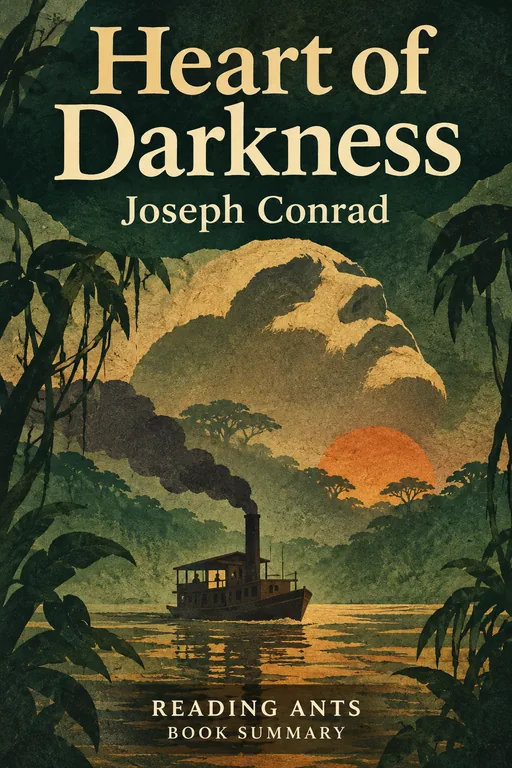
Heart of Darkness
Joseph Conrad
A sailor named Marlow tells his friends of a journey up the Congo River to find a mysterious ivory trader named Kurtz, and of the horror and moral darkness he finds at the end of it.
📜 Classics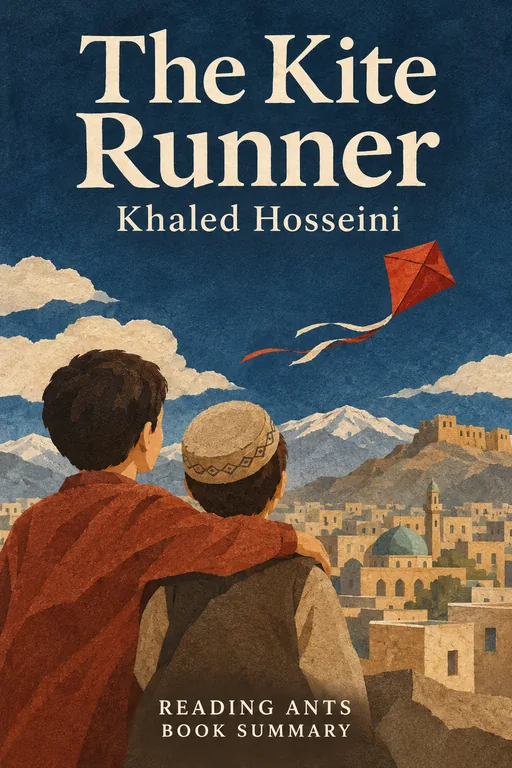
The Kite Runner
Khaled Hosseini
A wealthy boy in Kabul betrays his loyal best friend on the day of a kite tournament, and decades later, after fleeing to America, he returns to a Taliban-ruled Afghanistan to try to make things right.
✨ Modern Fiction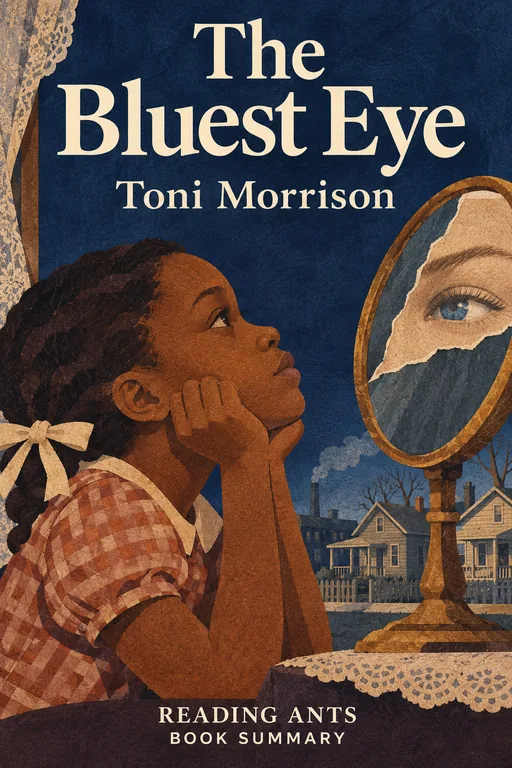
The Bluest Eye
Toni Morrison
In 1940s Ohio, a poor Black girl named Pecola Breedlove, who believes that she is ugly, prays for blue eyes, and the community's failure to protect her leads to tragedy.
✨ Modern FictionWant something different?
Pick another topic and we will show you three books to start with.