 Reading Ants
No Country for Old Men
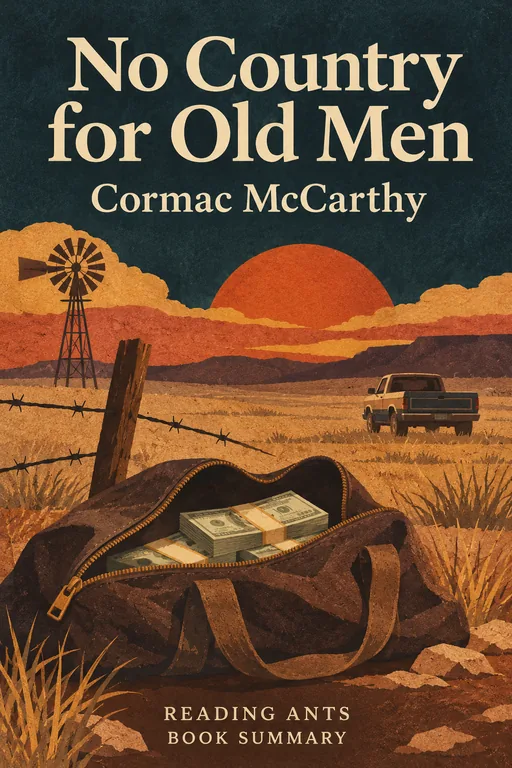
When a Texas welder named Llewelyn Moss finds two million dollars at the scene of a drug deal gone bad and takes it, a relentless killer, Anton Chigurh, pursues him, while an aging sheriff, Ed Tom Bell, struggles to understand a world that has changed.
Overview
No Country for Old Men is a novel by Cormac McCarthy, published in 2005, and it was adapted into the 2007 film directed by Joel and Ethan Coen, which won four Academy Awards, including Best Picture. The story is set in 1980 in the border country of West Texas. It combines chapters about the chase between Moss and Chigurh with italicized reflections by the sheriff, in which he talks about his life, the changes in the nature of crime and his fear of what he cannot understand. The title comes from the first line of a poem by W. B. Yeats, “Sailing to Byzantium.” The book is short, spare and violent.
Main Characters
- Llewelyn Moss: a Vietnam veteran and welder who takes the money.
- Anton Chigurh: a calm, merciless hit man who lives by his own code.
- Sheriff Ed Tom Bell: an older lawman who feels overwhelmed by new kinds of violence.
- Carla Jean Moss: Llewelyn’s young wife.
- Carson Wells: a former Army colonel and a bounty hunter hired to find Moss.
- Wendell: Bell’s deputy.
Full Summary
The Money
Llewelyn Moss is hunting antelope near the Rio Grande when he finds a group of dead men, vehicles full of heroin and a case with more than two million dollars. He takes the money, but, that night, feeling guilty, returns with water for a wounded man, and is spotted. He flees, knowing that he is being hunted. He sends his wife, Carla Jean, to her mother’s house, and goes on the run.
Chigurh
Anton Chigurh, a hired killer, is sent to recover the money. He is a cold, intelligent man who kills with a captive-bolt pistol, a tool used to slaughter cattle, and who decides some victims’ fates by the toss of a coin. He first appears in the book when he kills a deputy who has arrested him. He traces Moss using a transponder hidden in the bag of money. Their duel across Texas is tense and brutal.
Sheriff Bell
Sheriff Ed Tom Bell follows the trail of bodies, talking to the people involved, and trying to find Moss before Chigurh does. Bell, who comes from a family of lawmen, reflects on how crime has changed, and on how young people kill without remorse. He is troubled by his own record in the Second World War, when he abandoned his unit under fire, and is disturbed by thoughts of death and the future. He is a decent man, but he feels overwhelmed.
Bell speaks to older lawmen about how people used to carry guns less often, and about the way that drugs have changed the borderlands. An older relative, Ellis, reminds him that people have always been violent, which challenges Bell’s belief that the world has become uniquely worse. His voice, plain and slow, gives the book its human center and its sorrowful tone.
The Hunt
Moss, who is resourceful, outwits his pursuers for a time. After a violent shootout with Chigurh, he is wounded and crosses the border into Mexico, where he recovers in a hospital. Carson Wells, who is hired to find him, is killed by Chigurh. Moss is killed by the Mexican gang at a motel in El Paso, an event that the novel does not show directly, and that Bell learns of afterwards.
Moss is clever: he hides the case in an air vent, uses a shotgun in a tense fight and spots the tracker that Chigurh uses to follow him. His wits and stubbornness make him a worthy opponent, which only increases the tension of the chase and makes his fate more shocking.
Carla Jean
After Moss’s death, Chigurh goes to Carla Jean, who has returned to bury her mother, and offers her a coin toss. She refuses to call it, and the scene ends before we see what he does, though it is strongly implied that he kills her. He is then injured in a car accident, from which he escapes with a broken arm. His apparent immunity to fate is shown to be limited by chance.
The Dreams
In the last chapter, the sheriff retires. He tells his wife about two dreams. In the first, his father gives him some money, and he loses it. In the second, his dead father passes him in the dark, carrying fire in a horn, and goes ahead to make a fire, and wait for him. The dream gives him some consolation, as he feels that something is waiting ahead, and that hope exists. The book ends with this image of continuity.
Why It Matters
No Country for Old Men brought McCarthy to a larger audience, together with the Coen brothers’ film, which is considered a classic of its kind. It is read both as a thriller and as a meditation on evil, fate and moral change. The figure of Chigurh has become one of the most chilling villains in modern fiction.
The novel’s sparse style, with no quotation marks and few commas, has influenced writers, and its themes link to McCarthy’s other works, such as Blood Meridian and The Road.
Critics often point to Bell’s monologues as the heart of the book, a rare case in which a crime novel pauses to think about aging, conscience and the passing of an older code of conduct.
Key Takeaways
- Greed has consequences. Moss’s decision sets off disaster.
- Evil can be impersonal. Chigurh follows his own logic.
- Chance and choice mix. The coin toss shows how fate can be arbitrary.
- Old values face new challenges. The sheriff feels out of date.
- Hope can survive in dreams. The sheriff finds comfort in a vision.
What We Can Learn
The novel invites us to consider how a single choice can change a life, and that the temptation of easy money can lead to ruin. It encourages us to think before acting.
It also asks how we cope with a world that seems more violent or less understandable than the one we knew, as Bell does. His honesty about his limits can be a model for dealing with change.
Finally, it suggests that we may find meaning in memories, family and small hopes, even when the world seems dark.
Criticism and Counterpoints
Some readers find the novel’s violence excessive, and its tone nihilistic. Others criticize the portrayal of women, who are mostly victims, and of Mexican characters, who are mainly criminals. The book’s style, with its spare language and lack of punctuation, can be hard to follow.
Some find that the second half, with Moss’s death off stage, is anticlimactic, and the sheriff’s reflections slow the pace. Others say that the ending is vague. Still, many consider it a gripping read.
Who Should Read It
This book is for mature readers. It contains graphic violence and bleak views of human nature. It is short and fast-paced, and works well for readers who like crime stories with depth.
Want the whole book?
A summary is a taste, not the meal. Here is where to find the full book.
You reached the end 🎉
Nicely done. Mark this one as read, and we will suggest what to read next.
Read this next
Blood Meridian
Cormac McCarthy
A fourteen-year-old runaway known only as "the kid" joins a gang of scalp hunters on the border of Texas and Mexico in the late 1840s, a gang led by Glanton and dominated by Judge Holden, in a story of unrelenting violence.
✨ Modern Fiction
The Road
Cormac McCarthy
A father and his young son walk through a burned, ash-covered America after an unexplained catastrophe, struggling to stay alive and to stay good in a world where hope has almost died.
✨ Modern Fiction
The Stranger
Albert Camus
An emotionally detached office worker kills a man on an Algerian beach and discovers that society condemns him as much for refusing its expected feelings as for the murder itself.
🌍 World Literature
The Kite Runner
Khaled Hosseini
A wealthy boy in Kabul betrays his loyal best friend on the day of a kite tournament, and decades later, after fleeing to America, he returns to a Taliban-ruled Afghanistan to try to make things right.
✨ Modern Fiction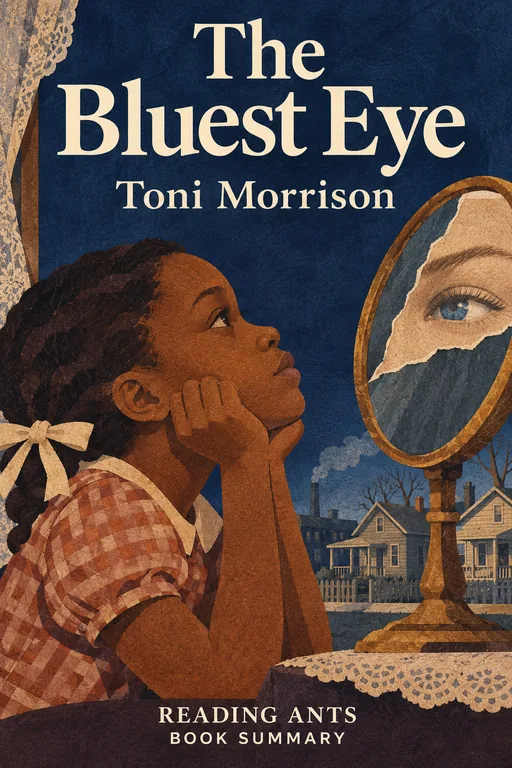
The Bluest Eye
Toni Morrison
In 1940s Ohio, a poor Black girl named Pecola Breedlove, who believes that she is ugly, prays for blue eyes, and the community's failure to protect her leads to tragedy.
✨ Modern Fiction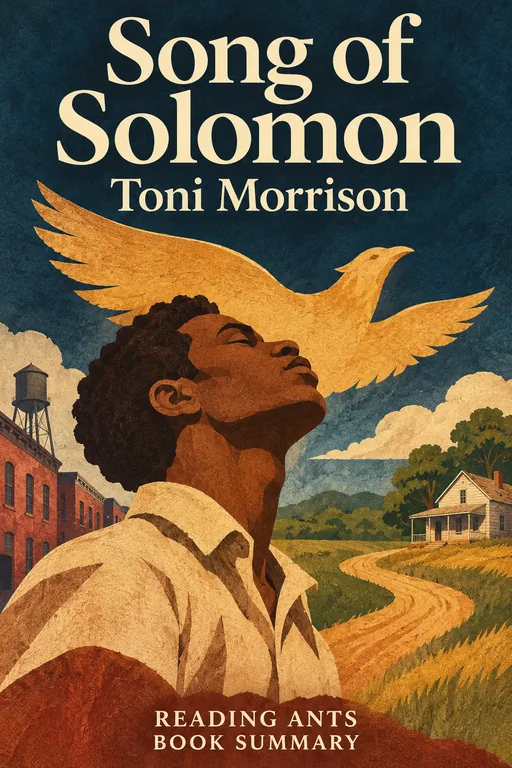
Song of Solomon
Toni Morrison
Macon "Milkman" Dead, a self-absorbed young man from Michigan, goes south in search of a family treasure and finds instead his family's history, and learns to take responsibility and to fly.
✨ Modern FictionWant something different?
Pick another topic and we will show you three books to start with.