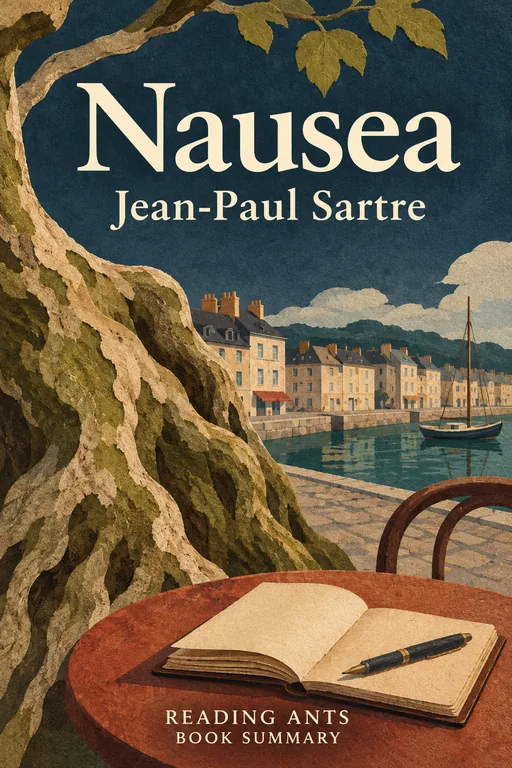
Nausea
Original title: La Nausée
A lonely historian in a French port town is overcome by a sickening awareness that things simply exist, without reason, and he searches for a way to live with this.
Overview
Nausea is a novel by the French philosopher and writer Jean-Paul Sartre, published in 1938. It is written as the diary of Antoine Roquentin, a man in his thirties who lives alone in a provincial French town called Bouville. It is one of the first and most famous works of existentialism, a way of thinking that asks how people can find meaning in a world that does not give it to them. The story has little action, and most of the drama takes place in Roquentin’s mind, as he looks at the world and sees it with a strange, disturbing clarity.
Main Characters
- Antoine Roquentin: the narrator, a solitary researcher who writes a diary.
- The Self-Taught Man: a kind, naive man who is reading all the books in the town library in alphabetical order.
- Anny: Roquentin’s former lover, whom he meets again after years.
- The Cafe Owner and the waitress: familiar background figures in his daily life.
- The Marquis de Rollebon: an eighteenth-century figure about whom Roquentin is writing a biography.
Full Summary
The First Signs
Roquentin keeps a diary because something odd is happening to him. He lives in Bouville on a modest income, working on a biography of the Marquis de Rollebon, a minor figure from history. One day he picks up a pebble on the beach and feels a strange sickness. Ordinary objects, such as a doorknob or a glass of beer, seem to him suddenly threatening and alive.
He calls this feeling the Nausea. He cannot explain it, but he is sure that something has changed in how he sees the world.
Life in Bouville
Roquentin goes about his routine. He eats at a cafe, goes to the library and watches the townspeople, who seem to him sure of their roles and comfortable in their small lives. He feels cut off from them. He sees how they live by habit, and how they assume that life has a purpose.
He is often visited by the Self-Taught Man, who admires him and tells him about his plan to read all the library’s books in alphabetical order, and about his belief in humanity and goodwill. Roquentin finds him both touching and pathetic, and tries to tell him that life is not so tidy. In one scene, the librarian catches the man touching a boy in the library, and he is thrown out and struck, to Roquentin’s horror.
Anny
Roquentin receives a letter from Anny, a woman whom he had loved years before, and he goes to meet her in Paris. He hopes that she will help him. She tells him that she too has lost her sense of “perfect moments,” and that she has changed. The meeting is cold and ends in separation.
She explains that she once tried to live in a series of “perfect moments,” in which everything felt right, and that she has given up on them. Roquentin had hoped that she might understand his Nausea, and that together they could find a way out. Instead, she seems to have found her own way to cope, and she is cold toward him.
He realizes that he cannot rescue himself through love, nor can he find a lasting meaning in the past. He goes back to Bouville more alone than before.
The Root
In a park, Roquentin sits looking at the root of a chestnut tree. Suddenly he understands what the Nausea has been telling him: things exist, without any reason, and there is no necessity behind them. The root is simply there, absurd, excessive and without explanation. The same is true of himself.
This revelation is both terrifying and freeing. All the explanations that people give for their lives, such as roles, habits and ideas, are just coverings over this basic fact.
A Way Out
Roquentin decides to leave Bouville. He gives up his book on Rollebon, since he sees that he was only using the dead man’s past to justify his own existence. Before leaving, he stops at a cafe, where he listens to a recorded jazz song, “Some of These Days.” He realizes that the music, unlike things, has a kind of necessity: each note leads to the next, and it exists in its own world.
He wonders whether he could create something similarly clear and firm, such as a story that might give other people some small sense of meaning. The book ends on this uncertain, hopeful note.
Why It Matters
Nausea is one of the founding works of existentialism, and it helped to make Sartre famous. It turns a philosophical idea, that existence comes before any fixed purpose, into a vivid personal experience. Sartre went on to become one of the most influential thinkers of the twentieth century, and he later won, and refused, the Nobel Prize in Literature. The book influenced many later writers and thinkers, and the word “nausea” has become a shorthand for the sudden realization of life’s strangeness. It is still widely read in schools and universities.
Key Takeaways
- Existence has no built-in meaning. Things and people simply are.
- Habit hides reality. Routines and roles protect us from seeing how strange life is.
- Freedom is frightening. If there is no given purpose, we must make our own.
- The past cannot save us. Roquentin’s history and his old love bring no comfort.
- Creation offers a way forward. Art, such as music, can give form to experience.
What We Can Learn
Nausea encourages us to examine our habits and ask whether we are living by choice or by default. Many of us go through the day without noticing, and the book suggests that a moment of honest attention can be unsettling but valuable.
It also shows that meaning is something we make, not something we find. We can make it through work, relationships, art or helping others. If a time comes when life feels empty, the book offers a reminder that this feeling can be a starting point for change, and not only a sign of failure. If feelings of despair are strong or last a long time, it is important to talk to someone who can help.
Criticism and Counterpoints
Some readers find the novel plotless, gloomy and self-absorbed, and the philosophical passages can be hard to follow. Others argue that Sartre’s view is too pessimistic, or that it ignores the value of relationships and community. Some critics have also noted how Roquentin looks down on ordinary people, and that his attitude can seem arrogant. Sartre himself later said that he thought the book was too focused on one man’s loneliness.
Who Should Read It
This book is for older teens and adults who are curious about philosophy and enjoy reflective fiction. It is fairly short. Readers who want an exciting plot may be disappointed, while those interested in existentialism, or who have ever felt that life is strange, may find it striking.
Want the whole book?
A summary is a taste, not the meal. Here is where to find the full book.
You reached the end 🎉
Nicely done. Mark this one as read, and we will suggest what to read next.
Read this next
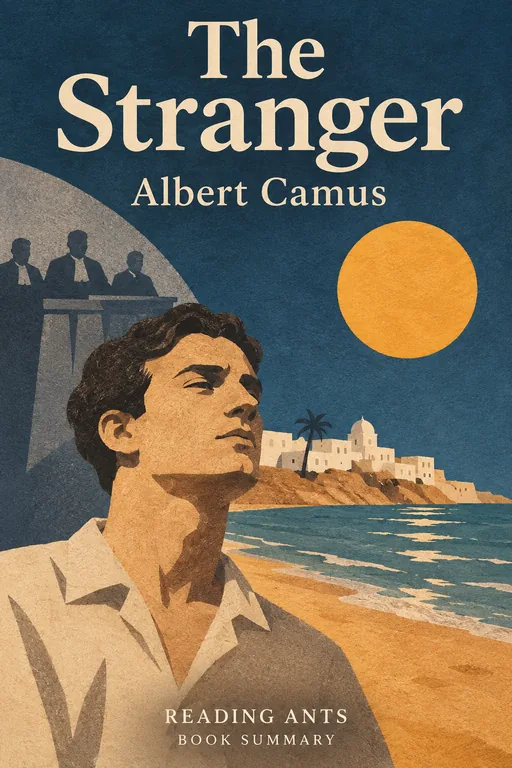
The Stranger
Albert Camus
An emotionally detached office worker kills a man on an Algerian beach and discovers that society condemns him as much for refusing its expected feelings as for the murder itself.
🌍 World Literature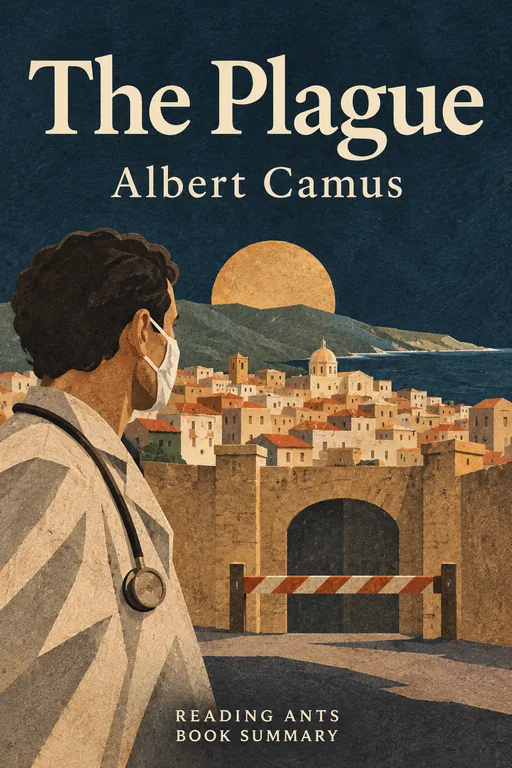
The Plague
Albert Camus
When plague seals an Algerian city off from the world, ordinary people must choose between denial, private escape and the patient shared work of resisting suffering.
🌍 World Literature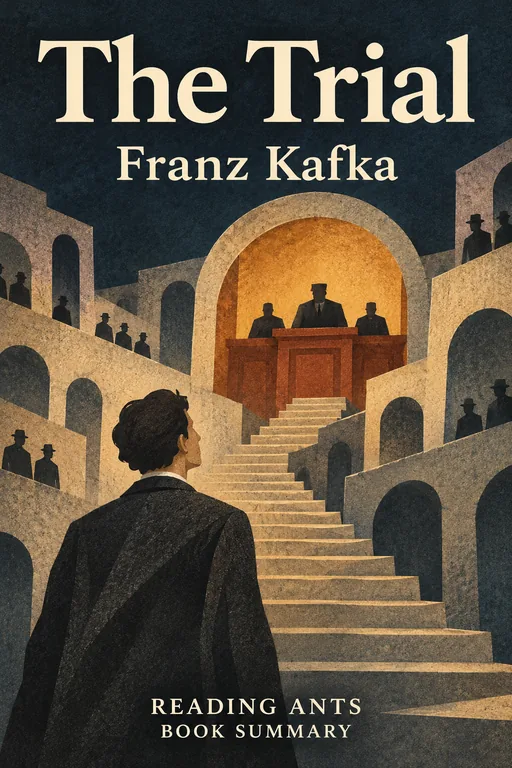
The Trial
Franz Kafka
A respectable senior bank officer is arrested one morning for a crime nobody will name, and is dragged through a vast, senseless legal system that he can neither understand nor escape.
🌍 World Literature
Notes from Underground
Fyodor Dostoevsky
A bitter, lonely former clerk who lives in a squalid underground existence writes an angry confession about his own spite, his contempt for the world and a humiliating episode from his past.
🌍 World Literature
The Metamorphosis
Franz Kafka
A hardworking traveling salesman wakes one morning to find himself transformed into a monstrous insect, and his family's love for him slowly turns to disgust and neglect.
🌍 World Literature
The Little Prince
Antoine de Saint-Exupery
A pilot stranded in the desert meets a small boy from a tiny planet, who teaches him that the most important things in life, like love and friendship, can only be seen with the heart.
🌍 World LiteratureWant something different?
Pick another topic and we will show you three books to start with.