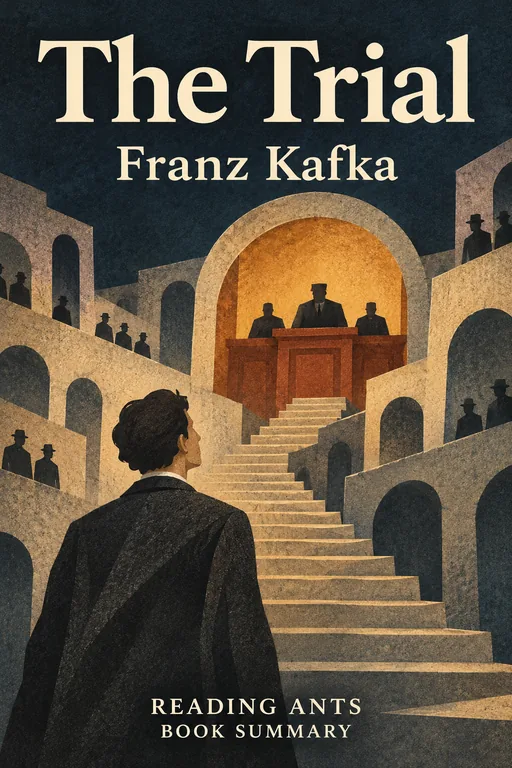
The Trial
Original title: Der Prozess
A respectable senior bank officer is arrested one morning for a crime nobody will name, and is dragged through a vast, senseless legal system that he can neither understand nor escape.
Overview
The Trial was written by Franz Kafka between 1914 and 1915 and left unfinished when he died in 1924. His friend Max Brod, ignoring Kafka’s instructions to burn his papers, edited and published the novel in 1925. Its hero, Josef K., is a thirty-year-old bank officer who lives an orderly life until two strangers arrive in his rented room on his birthday to tell him he is under arrest. They will not say why. He is not locked up; he is free to go to work, but he must appear before a mysterious court. As K. tries to fight the charge, he meets a maze of officials, lawyers and ordinary people who seem to accept the system without question. The novel gave the language the word “Kafkaesque,” for a situation that is bewildering, bureaucratic and nightmarish.
Main Characters
- Josef K.: a self-assured, ambitious senior bank officer, who becomes more and more anxious.
- Fräulein Bürstner: his neighbor in the boarding house.
- Uncle Karl: K.’s concerned uncle, who takes him to a lawyer.
- Dr. Huld: K.’s sickly, long-winded lawyer.
- Leni: Huld’s young nurse, who is attracted to accused men.
- Titorelli: a painter who knows the court’s secrets.
- The priest: a chaplain in the cathedral.
- The court officials: whose faces and authority K. never fully sees.
Full Summary
The Arrest
On the morning of his thirtieth birthday, Josef K. is arrested in his boarding-house room by two guards, who eat his breakfast and will not tell him what he has done. An inspector informs him that he is under arrest, but that he may go about his usual life. K., outraged, believes the whole thing is a misunderstanding or a prank. That evening, he tries to explain it to his neighbor, Fräulein Bürstner, and, in a sudden burst of confused energy, kisses her without her consent.
The First Hearing
The following Sunday, K. is told to appear at a courtroom, which is located in the attic of a crowded tenement building. The room is stuffy and packed with people. K. gives a proud speech, complaining that the whole process is a corrupt conspiracy, but the audience, who appear to belong to the court, seem to be divided. He realizes that everyone there wears a badge, and that he is among men who all belong to the system.
When he returns to the courtroom the next Sunday, he finds it empty, and learns that the court only meets on certain days. A young woman, the wife of a court usher, is fascinated by him, but she is taken away by a student. K. begins to see that the court is a vast, corrupt bureaucracy.
The Lawyer
His uncle, alarmed by the scandal, takes K. to see Dr. Huld, a lawyer who is old and ill in bed. The lawyer talks at length about the court, but does little. During the visit, K. is distracted by the nurse, Leni, who draws him away for a sexual encounter and goes on meeting him in secret. K. dislikes the delays and, frustrated, starts to neglect his job at the bank, because his case begins to occupy every moment. Only after visiting the painter Titorelli, described next, does he decide to dismiss the lawyer.
The Painter
K. visits Titorelli, a painter who knows the judges. Titorelli explains that actual acquittal is almost impossible. K. can hope for “ostensible acquittal,” in which he is freed temporarily, but can be arrested again at any time, or “protraction,” in which the trial goes on indefinitely. K. realizes that the system is designed to wear people down.
The Cathedral
K. is asked to show a visiting Italian client around the cathedral. The client does not appear, but a priest calls K. by name from the pulpit. He reveals that he is the prison chaplain and tells K. that his case is going badly. He tells a parable, “Before the Law,” about a man from the country who is kept waiting his whole life at the door of the Law by a doorkeeper, and who is told, when he is dying, that the door was meant only for him. The priest and K. argue over the meaning of the story, and it remains unresolved.
The Execution
On the eve of his thirty-first birthday, two men in frock coats arrive at K.’s door. They are polite and silent. They lead him through the empty streets to a quarry on the edge of town. There they put him on the ground, and one of them takes out a butcher’s knife and plunges it into his heart. K.’s last words are that it is like a dog’s death, as if the shame will outlive him.
Why It Matters
The Trial is one of the great novels of the twentieth century and an essential work of modernism. Kafka, a German-speaking Jew from Prague who worked in an insurance office, wrote at a time when bureaucracies were growing, and individuals felt more powerless in the face of impersonal systems. The novel is often read as a prophecy of the totalitarian regimes that arose after his death.
The adjective “Kafkaesque” has entered many languages. The novel has influenced writers from Camus to Orwell to Murakami, and has been adapted for film by Orson Welles and for theater and opera. Kafka’s unfinished state, strange logic and dreamlike tone invite endless interpretation.
Key Takeaways
- Systems can be senseless. K. never learns the charge against him.
- Guilt can be internalized. K. begins to feel guilty without knowing why.
- Authority hides itself. The real judges are never seen.
- Resistance may be futile. Every attempt to fight the system fails.
- Waiting wastes lives. The parable shows a man who never enters the door.
What We Can Learn
The novel encourages us to be wary of systems that are impossible to question. Whenever rules are hidden or officials refuse to explain, it is worth asking who benefits and what can be done.
It also shows how anxiety and secrecy wear people down. K. becomes obsessed with his case, neglecting work, friends and his own life. Staying connected to people and routines can protect us in stressful times.
Finally, the parable “Before the Law” suggests we should not wait forever for permission. Sometimes we need to ask whether a door that seems closed was ever locked.
Criticism and Counterpoints
Some readers find The Trial frustrating, since there is no explanation for the arrest and no clear resolution. The book is also unfinished, and Brod arranged the chapters, so some of the order is uncertain. Interpreters have debated endlessly whether it is about guilt, bureaucracy, religion, Kafka’s own relationships or the rise of authoritarianism.
Critics have also noted that the female characters are mostly seductive figures who help K. only in vague ways. Others point out that K. is not an innocent victim, but arrogant and callous, which complicates the sympathy we feel for him. Many readers find the ambiguity exactly what makes it powerful.
Who Should Read It
This novel suits teenagers and adults who enjoy strange, philosophical stories. It is short and not hard to read, but its meaning is elusive. Readers who like clear plots and answers may find it hard going.
Want the whole book?
A summary is a taste, not the meal. Here is where to find the full book.
You reached the end 🎉
Nicely done. Mark this one as read, and we will suggest what to read next.
Read this next
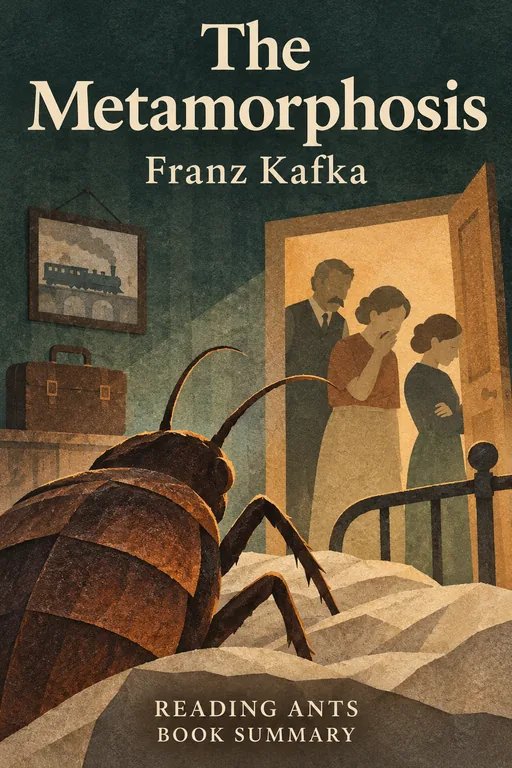
The Metamorphosis
Franz Kafka
A hardworking traveling salesman wakes one morning to find himself transformed into a monstrous insect, and his family's love for him slowly turns to disgust and neglect.
🌍 World Literature
The Stranger
Albert Camus
An emotionally detached office worker kills a man on an Algerian beach and discovers that society condemns him as much for refusing its expected feelings as for the murder itself.
🌍 World Literature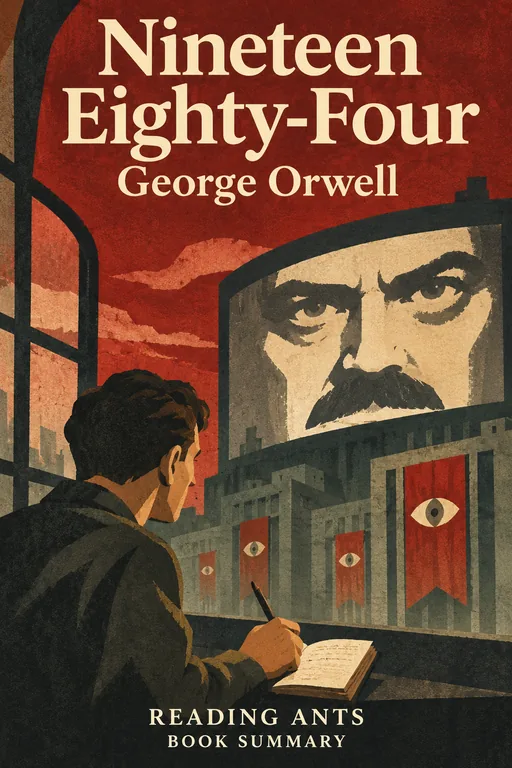
Nineteen Eighty-Four
George Orwell
In a future Britain ruled by an all-seeing Party, one man secretly rebels by keeping a diary and falling in love, and discovers just how completely a totalitarian state can crush the human mind.
📜 Classics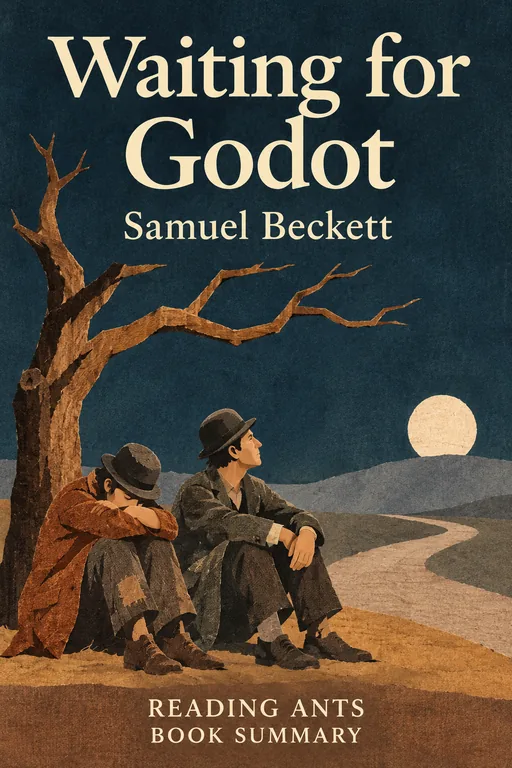
Waiting for Godot
Samuel Beckett
Two tramps wait beside a lonely tree on a country road for a mysterious man named Godot who never arrives, passing the time with games, quarrels and strange encounters in a play about hope, boredom and the meaning of existence.
🎭 Epics, Drama & Poetry
The Little Prince
Antoine de Saint-Exupery
A pilot stranded in the desert meets a small boy from a tiny planet, who teaches him that the most important things in life, like love and friendship, can only be seen with the heart.
🌍 World Literature
Things Fall Apart
Chinua Achebe
Okonkwo, a proud and fearsome leader in an Igbo village in Nigeria, struggles against his own fears and against the arrival of British missionaries and colonial rulers, who change his world forever.
🌍 World LiteratureWant something different?
Pick another topic and we will show you three books to start with.