 Reading Ants
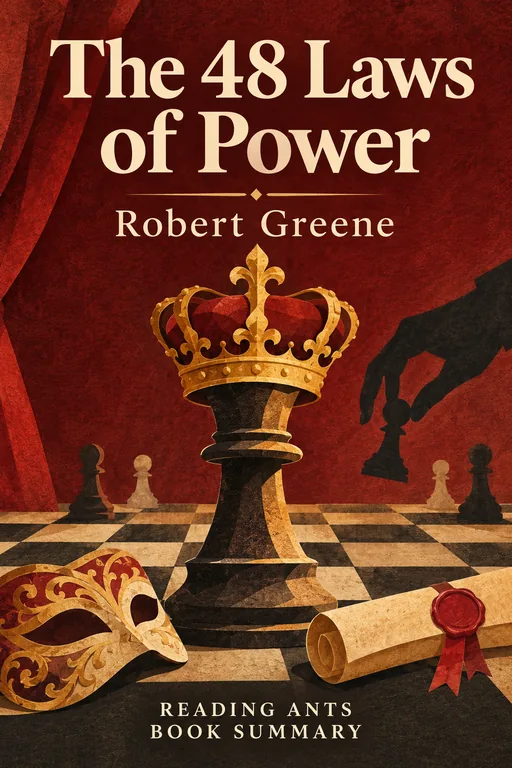
The 48 Laws of Power
Robert Greene distills lessons from history's courtiers, generals, con artists and rulers into 48 laws about how power is gained and kept, in a book that both guides and warns.
Overview
The 48 Laws of Power was written by Robert Greene, an American author who worked in Hollywood and publishing, and first published in 1998. Drawing on writers such as Niccolò Machiavelli, Sun Tzu and Baltasar Gracián, and on stories from the courts of Louis XIV and ancient China and from figures such as con men and diplomats, Greene organizes his advice into 48 laws. Each law has a title, a “Judgment” that sums it up, a discussion of how it works, examples of those who followed it (“Observance of the law”) and those who broke it (“Transgression of the law”). The book is known for its cynical view of human nature and has been controversial, but it has sold more than a million copies.
Full Summary
1. The nature of power
The idea: Greene begins with the argument that power is a game that everyone plays, whether they admit it or not, and that those who pretend to be above it often lose. He claims that behaving honestly and modestly is not always rewarded and that understanding how power operates helps you protect yourself. He compares power to a form of social intelligence, and urges readers to look at situations with detachment, as if they were observers.
In real life: Understanding office politics helps you notice when others are positioning themselves, even if you choose not to play.
2. Guarding your position and reputation
The idea: Several laws deal with how to avoid threats and manage image. One advises never to outshine your superior, because making your boss feel insecure can be dangerous. Another says to conceal your intentions, keeping others guessing. Others are to say less than necessary, since words reveal weaknesses, and to guard your reputation closely, as it is the cornerstone of power. Greene illustrates these with stories of ministers and courtiers whose success or fall depended on such choices.
In real life: A person who talks too much about their plans may give rivals an opportunity to block them.
3. Working with others and taking credit
The idea: Other laws concern relationships. Greene recommends knowing who you are dealing with and not offending the wrong person, and being careful about friends, who may envy you, while using enemies, who have fewer illusions. He advises letting others do the work while taking the credit and keeping people dependent on you. These laws show a hard-nosed view in which cooperation is often a matter of leverage.
In real life: In group projects, someone who consistently takes credit for others’ work may gain short-term advantage but lose trust.
4. Manipulating attention and perception
The idea: Greene devotes laws to creating an impression: courting attention at all costs, creating a sense of mystery, making a spectacle, being unpredictable at times and using symbols and ceremony. He gives examples from rulers and artists who used theatricality and image to gain influence. He suggests that people judge by appearances, and that controlling the narrative is part of power.
In real life: Politicians and brands put much effort into image because first impressions strongly shape opinion.
5. Strategy, timing and ruthlessness
The idea: Another group of laws covers strategy: think ahead, choose your battles, strike when the time is right, and, in some cases, crush an enemy completely so that they cannot return. Others advise using patience, adapting to circumstances and not committing to one plan. Greene draws on military examples to show that wise leaders avoid unnecessary fights and win through timing and positioning.
In real life: Waiting for the right moment to propose an idea can be more effective than acting immediately.
6. The warning and the wider lesson
The idea: Throughout the book, Greene both teaches and warns. By describing the methods used by manipulators, he helps readers recognize and protect themselves from them. In the closing parts, he suggests that mastery of the game includes self-control, and that the most powerful people master their own emotions first. He leaves it to readers to decide how to use the knowledge, though the tone often leans toward cold calculation.
In real life: Knowing common tactics, such as flattery used to gain favor, can help you notice when someone is trying to use them on you.
Why It Matters
The 48 Laws of Power is a cult classic. It has been influential in business, politics and entertainment, and is often cited in popular culture, particularly in hip-hop and among executives. It has sold over 1.2 million copies in the United States alone and remains popular in prisons and among young entrepreneurs. Greene followed it with books on seduction, war and mastery.
The book’s lasting appeal shows the public’s fascination with power and strategy, and it is often read as a guide to how people behave, even by those who reject its ethics.
Because each law is presented with stories from history, the book also works as a collection of anecdotes about courts, battles and con games, and some readers enjoy it mainly as popular history.
Key Takeaways
- Power is a social game. Ignoring it does not make it go away.
- Appearances matter. Reputation and image influence outcomes.
- Self-control is key. Mastering emotions is a basis of strategy.
- Know people’s motives. Understanding others helps you protect yourself.
- Use the lessons with care. They can help understanding, but may harm relationships.
What We Can Learn
The book teaches us to look carefully at motives and incentives. Understanding that people often act in their own interest can help us avoid being naive, and be more thoughtful when we negotiate or work in a group.
It also shows how important reputation and self-control are. Even if we do not want to manipulate, we can learn to manage our impulses, plan ahead and communicate wisely.
Finally, it invites us to reflect on our own values. By seeing a cynical view of power laid out, we can decide what kind of person we want to be.
Criticism and Counterpoints
Many critics condemn the book as amoral and manipulative, encouraging deception and selfishness, and note that it may foster paranoia and distrust. Psychologists and management scholars point out that research shows long-term success in organizations usually depends on trust, cooperation and fairness, not on constant scheming.
Others criticize the way Greene uses history, as selected stories to fit rules, and often without strong sources, and observe that many of his examples ended badly. Some readers say that the laws contradict each other and that the book’s cold view of people is mistaken. It is best read as a study of tactics, to be approached critically.
Who Should Read It
This book suits older teenagers and adults who are interested in history, strategy and psychology. It contains advice that many will find ethically questionable, and it should be read with discussion and a critical eye.
Want the whole book?
A summary is a taste, not the meal. Here is where to find the full book.
You reached the end 🎉
Nicely done. Mark this one as read, and we will suggest what to read next.
Read this next

The Prince
Niccolo Machiavelli
A Renaissance diplomat advises rulers to judge their actions by results rather than morality, arguing that a successful leader must sometimes be cunning and ruthless to win and keep power.
⚖️ Politics & Society
The Art of War
Sun Tzu
The greatest victory is the one won without fighting, achieved through careful planning, knowing both yourself and your opponent, and using deception, flexibility and timing.
🕊️ Philosophy & Religion
Mastery
Robert Greene
Robert Greene studies the lives of great masters, from Leonardo da Vinci and Charles Darwin to modern figures, and draws from them a path to mastery that runs through finding your calling, a long apprenticeship, learning from mentors and developing creative energy.
🌱 Self-Improvement
Influence: The Psychology of Persuasion
Robert B. Cialdini
Psychologist Robert Cialdini identifies six universal principles of persuasion, which explain why people say yes and show how to use them ethically and how to defend against those who misuse them.
🌱 Self-Improvement
Never Split the Difference
Chris Voss
Former FBI hostage negotiator Chris Voss teaches that great negotiation comes not from logic and compromise but from listening, empathy and asking the right questions, so that the other side feels understood and wants to cooperate.
🌱 Self-Improvement
Atomic Habits
James Clear
Big changes in life come not from huge leaps but from tiny habits repeated every day, and you can build good habits (and break bad ones) by designing your life so the right choices are obvious, attractive, easy and satisfying.
🌱 Self-ImprovementWant something different?
Pick another topic and we will show you three books to start with.