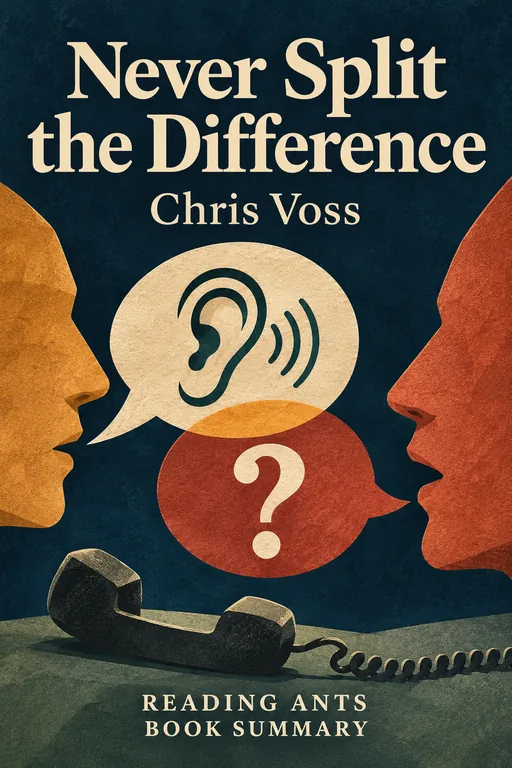
Never Split the Difference
Former FBI hostage negotiator Chris Voss teaches that great negotiation comes not from logic and compromise but from listening, empathy and asking the right questions, so that the other side feels understood and wants to cooperate.
Overview
Never Split the Difference: Negotiating As If Your Life Depended On It was written by Chris Voss, a former lead international kidnapping negotiator for the Federal Bureau of Investigation, with the writer Tahl Raz, and published in 2016. Voss spent decades handling high-stakes cases, from bank robberies to kidnappings abroad, and later taught negotiation at business schools and consulted for companies. He argues that traditional negotiation, based on rational bargaining and finding a middle ground, is flawed because people are not purely rational but driven by emotion. His approach, built from real cases and field-tested tactics, became a bestseller in both law enforcement and business circles.
Full Summary
1. The new rules: emotion over logic
The idea: Voss begins with a story of a bank robbery with hostages in Brooklyn, where the negotiators had to calm an unpredictable situation, to show the importance of understanding emotions. He criticizes the classical model, which treats negotiation as a problem-solving exercise between logical people. Humans, he says, are far less rational than that model assumes, because feelings drive much of what people do, and the best negotiators understand this and use it to build trust. Negotiation, he says, is simply communication with a purpose.
In real life: In an argument over a bill, the person who feels heard first is more likely to be flexible.
2. Be a mirror
The idea: The first tool is mirroring, repeating the last few words, or the key words, of what the other person said, often in the form of a question. This encourages them to continue talking and to elaborate, and gives you more information. Voss pairs it with a calm, warm voice, which he calls the “late-night FM DJ voice,” to lower tension. Mirroring shows interest without disagreement.
In real life: If someone says “We can’t afford that,” replying “Can’t afford that?” invites them to explain.
3. Don’t feel their pain, label it
The idea: The next tool is tactical empathy: understanding the feelings and perspective of the other person and showing that you do. A way to do this is labeling: naming the emotion by saying that it seems the person is worried about something, or that it sounds like they feel a certain way. Labeling negative feelings, Voss says, defuses them, and labeling positive ones reinforces them. He also suggests an “accusation audit,” in which you list all the negative things the other side might think about you, before they say them, to take away their power.
In real life: Saying “You might think I’m being unreasonable” before making a request can make the other person more open.
4. Beware “yes”: master “no”
The idea: Voss argues that people often say “yes” without meaning it, and that “no” is a better beginning of the conversation than “yes,” since it makes people feel safe and in control. He suggests asking questions that invite a no, such as asking whether now is a bad time to talk, or whether an idea would be ridiculous. He also warns about “counterfeit yes,” the kind of agreement that is merely an attempt to end the conversation.
In real life: Someone who says “No, that doesn’t work for me” is engaged and often ready to explain what would.
5. Trigger “that’s right” and use calibrated questions
The idea: The aim is to get the other side to say ”That’s right,” which means they feel you have understood them, a breakthrough that is different from “You’re right,” which is often a brush-off. To reach it, you summarize their situation and feelings. Then you use calibrated questions, open-ended questions starting with “how” or “what,” such as asking how you are supposed to do what they want. This turns the other side into a problem solver and shows them the difficulty without confrontation.
In real life: Responding to a high price with “How can we make this work?” can lead to creative solutions.
6. Bargaining, black swans and getting it done
The idea: In the last chapters, Voss explains how to bargain, using techniques such as anchoring, setting an extreme but reasonable initial position and using the “Ackerman model,” a series of planned offers, rising in smaller and smaller steps toward the target price, that ends on a precise, non-round figure. He also discusses finding “Black Swans,” unknown pieces of information that can change the whole situation, such as a hidden need, which come from careful listening. He stresses preparing, since the best negotiators gather information first.
In real life: Asking questions about what a client really cares about may uncover a priority that is more important than price.
Why It Matters
Never Split the Difference became a major business bestseller and has been used in classrooms and corporate training. It brought hostage negotiation techniques to ordinary workplaces, and the idea of tactical empathy has been adopted by many professionals. Voss’s company and online courses have taught thousands of people.
It has also contributed to discussions of negotiation that put emotions at the center, alongside classic books such as Getting to Yes, and popularized practical phrases and tools.
Readers use its tools in everyday life: asking for a raise, buying a car, settling a dispute with a neighbor or simply calming a tense conversation with a family member.
Key Takeaways
- Listen first. Understanding the other side builds trust.
- Mirror and label. Repeating words and naming emotions defuse tension.
- Let them say no. It creates a feeling of safety and control.
- Ask calibrated questions. “How” and “what” questions invite solutions.
- Seek the hidden facts. Careful listening reveals what drives the other side.
What We Can Learn
The book teaches that most disagreements involve feelings as much as facts. By acknowledging emotions, we can lower defenses and make agreement more likely.
It also shows the power of questions. Asking open questions and listening carefully can reveal information that arguments never would, and helps others feel respected.
Finally, it reminds us to prepare. Whether for a salary talk or a family discussion, thinking in advance about what we want, what the other person may want and what could go wrong makes us calmer and more effective.
Criticism and Counterpoints
Some critics say that Voss’s techniques, drawn from extreme situations, are not always suitable for ordinary negotiations, where relationships and fairness matter, and may seem manipulative if used insincerely. Others note that the book relies on his own stories, which are hard to check, and that there is little scientific testing of the specific tactics.
Negotiation scholars point out that the book dismisses classic approaches too quickly, since many ideas, such as understanding interests, are shared by both. Some also find that the book repeats itself and that it can read like a sales pitch for his courses. Still, many people find the tools useful.
Who Should Read It
This book suits teenagers and adults, especially those who negotiate at work or at home. It is lively and full of stories. Readers should use the tools honestly and with respect for the other person.
Want the whole book?
A summary is a taste, not the meal. Here is where to find the full book.
You reached the end 🎉
Nicely done. Mark this one as read, and we will suggest what to read next.
Read this next
Influence: The Psychology of Persuasion
Robert B. Cialdini
Psychologist Robert Cialdini identifies six universal principles of persuasion, which explain why people say yes and show how to use them ethically and how to defend against those who misuse them.
🌱 Self-Improvement
How to Win Friends and Influence People
Dale Carnegie
People are driven by emotion and the desire to feel important, so the way to get along with them, and win them to your point of view, is to stop criticizing, show genuine interest and appreciation, and see things from their side.
🌱 Self-ImprovementGetting to Yes
Roger Fisher and William Ury
Roger Fisher and William Ury present a method called principled negotiation, which focuses on interests rather than positions, separates people from problems, invents options for mutual gain and insists on fair criteria, so that agreements can be reached without haggling or hostility.
🌱 Self-Improvement
The 48 Laws of Power
Robert Greene
Robert Greene distills lessons from history's courtiers, generals, con artists and rulers into 48 laws about how power is gained and kept, in a book that both guides and warns.
🌱 Self-ImprovementCrucial Conversations
Kerry Patterson and others
Four communication experts show how to handle conversations in which stakes are high, opinions differ and emotions run strong, by keeping dialogue open, making it safe to talk and moving from talk to action.
🌱 Self-Improvement
Atomic Habits
James Clear
Big changes in life come not from huge leaps but from tiny habits repeated every day, and you can build good habits (and break bad ones) by designing your life so the right choices are obvious, attractive, easy and satisfying.
🌱 Self-ImprovementWant something different?
Pick another topic and we will show you three books to start with.