 Reading Ants
Ryan Holiday uses the Stoic philosophy of Marcus Aurelius and others, with stories of famous people, to argue that the obstacles in our path can be turned into advantages, if we respond to them with the right perception, action and will.
Overview
The Obstacle Is the Way: The Timeless Art of Turning Trials into Triumph was published in 2014 by Ryan Holiday, a writer who had worked in marketing, and who became a leading popularizer of Stoicism. The title comes from a line in the Meditations of the Roman emperor Marcus Aurelius, who wrote that the impediment to action advances action, and what stands in the way becomes the way. The book is organized in three parts, perception, action and will, which Holiday calls the three disciplines. Each part is full of examples from history, politics, business and sport, from Ulysses Grant and John D. Rockefeller to Amelia Earhart and Thomas Edison.
Full Summary
1. Perception: see things as they are
The idea: The first discipline is how we see the problem. Holiday says that events are not good or bad by themselves, and that our judgments make them so. He urges readers to stay calm and objective, to see the facts without exaggeration or panic, and to focus on what is in their control. He gives the example of Rockefeller, who learned during the Panic of 1857 to steady himself and see clearly, which shaped how he invested for the rest of his career. The way we perceive an obstacle, he says, can turn it into an opportunity.
In real life: A student who fails a test can see it as proof of stupidity, or as information about what to study.
2. Perception: control your emotions and reframe
The idea: The author recommends steps to manage perception. Pause before reacting, and notice your first emotional response. Step back and look at the bigger picture, and ask whether the thing is really as bad as it feels. Reframe the problem: instead of treating it as a disaster, ask what opportunity it offers. He also urges readers to put a problem in context by seeing it as a small part of a bigger picture, and to look for the opportunity hidden in a bad situation, as Eisenhower urged his generals to do.
In real life: Seeing a setback as one small part of a long life can make it feel more manageable.
3. Action: act with persistence and process
The idea: The second discipline is action. Holiday says that we must do something, not just think. He stresses getting moving, as Amelia Earhart did when she accepted a chance to fly even though it was not her first choice, and persistence, the willingness to keep applying pressure, as Grant and Edison did. He advocates a focus on process, taking the task in front of you and doing it well, and not worrying about the whole mountain. A clear, simple plan for the next action is a way to avoid being overwhelmed.
In real life: Writing one paragraph at a time makes a long essay manageable.
4. Action: use obstacles and iterate
The idea: The author argues that obstacles can be used, and gives examples of people who turned a limitation into a strength. He says that if one approach fails, you should adapt and try another, and he praises the indirect approach, or flank attack, over a head-on assault. Failure is feedback, which tells you what does not work, much as technology startups test a rough first product on customers. He praises the flexibility to change tactics, and the discipline of keeping your goal fixed. He warns against waiting for perfect conditions, and says that action is the best way to learn.
In real life: If one way to solve a math problem fails, you try another method.
5. Will: endure and accept
The idea: The third discipline is will, the inner strength to endure what we cannot change. Holiday describes how, when we have done everything possible, we must accept what happens with grace, a stance he links to amor fati, the love of fate. He says that the will is something we have to build, an inner citadel, and gives the example of Theodore Roosevelt, a sickly boy who worked hard to strengthen his body. He also describes the Stoic habit of thinking ahead about what could go wrong, so that setbacks are less of a shock. Lincoln, who lived with depression, is among those he holds up as models of endurance.
In real life: A calm response to a delay you cannot change saves energy for what you can.
6. Will: perspective, humility and the greater good
The idea: In the last chapters, Holiday ties the will to humility and a sense of service. He says that those who endure best see their work as part of something larger than themselves, and that perseverance is easier when we do not treat setbacks as a surprise but as a part of life. He also urges readers to meditate on their own mortality, so that time is not wasted, and to be ready to start again after a failure. The book ends with the idea that we can see clearly, act correctly, and endure and accept what we must, and that each of us can choose how to meet an obstacle.
In real life: Working for something that matters to others can make hardship easier to bear.
Why It Matters
The Obstacle Is the Way sold widely, was translated into many languages, and became a favorite among athletes and coaches, some of whom passed copies around in locker rooms. It helped drive the modern revival of interest in Stoicism, and was followed by other Stoicism-themed books by Holiday. The book made ancient wisdom accessible with modern stories, and its short title is easy to remember and quote. It encouraged many readers to see difficulties as chances to grow, which is a hopeful and practical message, and it has been read by sports teams and in workplaces.
Key Takeaways
- Perception shapes experience. How you see a problem affects what you can do about it.
- Act, persist and adapt. Take the next step, learn from failure and change tactics.
- Use the obstacle. Look for how a limitation can become an advantage.
- Build will through acceptance. Endure what you cannot change with calm.
- Keep a larger purpose. Humility and service make hardship meaningful.
What We Can Learn
The next time you face a setback, try the three steps: calm down and see the facts, decide on one concrete action, and accept what you cannot control. Ask what the obstacle could teach you, or how it could be used. Build resilience step by step, for example by facing small discomforts on purpose. Share the load with friends, since few people overcome hard things alone. Remember that the stories in the book are selected examples, and that not every obstacle is a hidden gift, so use judgment and seek help when needed.
Criticism and Counterpoints
Critics say that the book’s claim that every obstacle can be turned into an advantage is too optimistic, and can lead to blaming people who face real barriers, such as poverty or discrimination, for not overcoming them. Some readers feel that the stories of famous people are told selectively to fit the theme. Others say that Holiday presents a version of Stoicism that is geared to success and productivity, and that overlooks its ethical and social aspects. Some find the style repetitive, like a series of anecdotes. Still, many readers find it motivating.
Who Should Read It
This book is for readers who want a short, motivational introduction to Stoic ideas, including students and professionals. It is easy to read and full of stories. Those who want more depth can read the original works of the Stoic philosophers, or The Daily Stoic.
Want the whole book?
A summary is a taste, not the meal. Here is where to find the full book.
You reached the end 🎉
Nicely done. Mark this one as read, and we will suggest what to read next.
Read this next
The Daily Stoic
Ryan Holiday and Stephen Hanselman
Ryan Holiday and Stephen Hanselman offer 366 short daily readings, drawn from Stoic philosophers such as Marcus Aurelius, Seneca and Epictetus, with brief commentary, to help readers to practice wisdom, resilience and self-control.
🌱 Self-Improvement
Meditations
Marcus Aurelius
The private notebook of a Roman emperor, reminding himself daily to accept what he cannot control, to act with justice and kindness, and to remember that life is short.
🕊️ Philosophy & Religion
Enchiridion
Epictetus
Epictetus, a former slave turned Stoic teacher, offers a short handbook of advice on staying calm and free by focusing on what we can control, and accepting what we cannot.
🕊️ Philosophy & Religion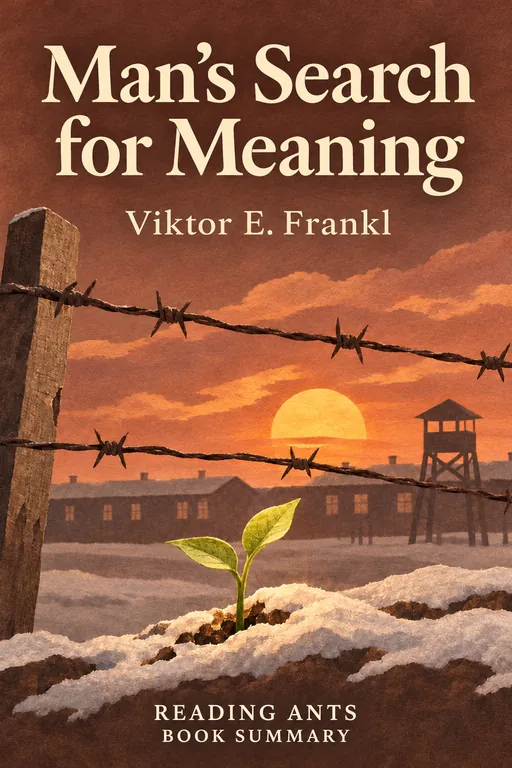
Man's Search for Meaning
Viktor E. Frankl
A psychiatrist who survived the Nazi concentration camps explains that even in the worst suffering, people can choose their attitude, and that finding a reason to live is what gives us the strength to endure.
👤 Real Lives
Grit
Angela Duckworth
Psychologist Angela Duckworth argues that success depends not only on talent but on grit, a combination of passion and long-term perseverance, and shows how people can grow it in themselves and others.
🌱 Self-Improvement
Atomic Habits
James Clear
Big changes in life come not from huge leaps but from tiny habits repeated every day, and you can build good habits (and break bad ones) by designing your life so the right choices are obvious, attractive, easy and satisfying.
🌱 Self-ImprovementWant something different?
Pick another topic and we will show you three books to start with.