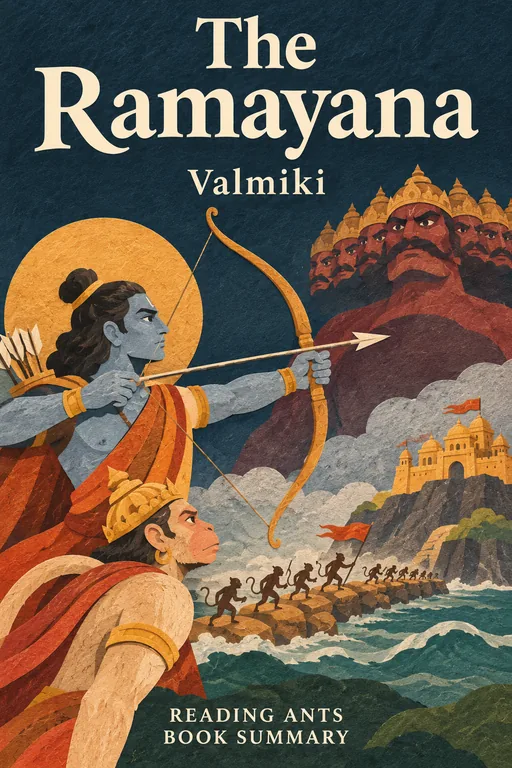
The Ramayana
Original title: रामायण
The virtuous prince Rama is exiled from his kingdom, and when his beloved wife Sita is kidnapped by the demon king Ravana, he rescues her with the help of his loyal brother and an army of monkeys, with the devoted Hanuman as its great hero.
Overview
The Ramayana, meaning “Rama’s Journey,” is one of the two great epics of ancient India, along with the Mahabharata. It is traditionally credited to the sage Valmiki, often called the first poet, and its Sanskrit version contains about twenty-four thousand verses in seven books. It tells the story of Prince Rama of Ayodhya, regarded in Hinduism as an incarnation of the god Vishnu, who embodies dharma, the right way of living. Exiled to the forest for fourteen years, Rama faces his greatest challenge when the ten-headed demon king Ravana carries off his wife, Sita. The epic is beloved across India and Southeast Asia, where it has been retold in countless versions, from Thailand’s Ramakien to Indonesian shadow-puppet plays.
Main Characters
- Rama: the noble, righteous prince of Ayodhya, an incarnation of Vishnu.
- Sita: Rama’s devoted, courageous wife.
- Lakshmana: Rama’s loyal younger brother.
- Hanuman: a powerful, devoted monkey hero.
- Ravana: the ten-headed demon king of Lanka.
- King Dasharatha: Rama’s father, the king of Ayodhya.
- Kaikeyi: one of Dasharatha’s queens, mother of Bharata.
- Bharata: Rama’s half-brother, faithful and humble.
- Sugriva: the king of the monkeys.
- Vibhishana: Ravana’s righteous brother, who joins Rama.
Full Summary
The Prince of Ayodhya
King Dasharatha of Ayodhya has four sons by three queens: Rama, the eldest and most beloved, Bharata, and the twins Lakshmana and Shatrughna. As a young man, Rama travels with a sage to protect his rituals from demons, and Lakshmana goes with him. At a contest held by King Janaka, Rama lifts and breaks a mighty divine bow that no one else can even move, winning the hand of Janaka’s daughter, the beautiful Sita.
Exile
Dasharatha decides to crown Rama as his heir. But Queen Kaikeyi, encouraged by her jealous maid, reminds the king of two wishes he once promised her. She demands that her own son, Bharata, be crowned, and that Rama be sent into exile in the forest for fourteen years. Bound by his promise, the heartbroken king agrees. Rama accepts calmly, out of respect for his father’s word. Sita insists on going with him, and Lakshmana refuses to leave his brother’s side. Soon after they leave, Dasharatha dies of grief.
Bharata, who was away, is horrified. He refuses the throne and goes to the forest to beg Rama to return. Rama refuses to break his father’s promise. Bharata takes Rama’s sandals back to Ayodhya, places them on the throne and rules only as Rama’s representative until his return.
The Golden Deer
Rama, Sita and Lakshmana live peacefully in the forest for years. A demoness, Shurpanakha, falls in love with Rama and attacks Sita when he refuses her, and Lakshmana cuts off her nose. She flees to her brother, Ravana, the powerful ten-headed demon king of the island of Lanka, and urges him to take revenge by stealing Sita.
Ravana sends a demon disguised as a beautiful golden deer. Sita longs for it, and Rama goes to hunt it. When the deer, dying, cries out in Rama’s voice, Sita fears he is in danger and insists that Lakshmana go to help. In many later retellings, Lakshmana draws a protective line around the hut before leaving. Ravana appears disguised as a holy beggar, wins Sita’s trust, then seizes her and carries her off in his flying chariot. A brave old vulture, Jatayu, tries to stop him but is fatally wounded.
The Monkey Army
Rama and Lakshmana search desperately for Sita. They meet Hanuman, a mighty monkey who becomes Rama’s most devoted servant, and they help the monkey prince Sugriva regain his kingdom from his brother. In return, Sugriva sends his monkey armies to search for Sita in every direction.
Hanuman learns that Sita is held in Lanka, across the ocean. With a mighty leap, he jumps across the sea. He finds Sita in a garden, where she has refused all of Ravana’s demands, and gives her Rama’s ring as a sign of hope. Captured, Hanuman lets the demons set his tail on fire, then escapes and uses his burning tail to set fire to Lanka before leaping back.
The War in Lanka
The monkey army builds a great bridge of stones across the ocean to Lanka. Ravana’s righteous brother, Vibhishana, warns Ravana to return Sita, and when Ravana refuses, Vibhishana joins Rama. A fierce war follows. Lakshmana is gravely wounded, and Hanuman flies to the Himalayas to fetch a healing herb. Unable to identify it, he carries back the whole mountain. Finally, Rama faces Ravana in a long, mighty battle and kills him with a divine arrow.
Sita’s Trial
When Sita is rescued, Rama declares that he has done his duty but publicly questions whether she remained faithful while living in Ravana’s palace. Hurt, Sita walks into a fire to prove her purity. The fire god, Agni, carries her out unharmed. Rama, Sita and Lakshmana return to Ayodhya in a flying chariot after fourteen years, and Rama is crowned king, beginning a golden age of justice and peace known as Rama Rajya. Their return is celebrated in many traditions as the origin of Diwali, the festival of lights.
Later Sorrows
In the final book, which some scholars believe was added later, rumors spread in Ayodhya questioning Sita’s purity. To protect his reputation as a just king, Rama sends the pregnant Sita into exile. She lives in the hermitage of the sage Valmiki, where she gives birth to twin sons, Lava and Kusha. Years later, when Rama meets his sons and asks Sita to prove her innocence again, she calls on the earth, her mother, to take her back. The earth opens, and Sita disappears into it. Grief-stricken, Rama eventually returns to his divine form.
Why It Matters
The Ramayana is one of the most influential stories in Asia. In India, it is performed every year in the Ramlila dramas, and its heroes are worshipped in temples. Diwali, one of the world’s most widely celebrated festivals, is associated in many places with Rama’s return to Ayodhya. Versions of the story exist in many Indian languages, including the beloved Hindi Ramcharitmanas of Tulsidas.
The epic spread across Southeast Asia, influencing the cultures of Thailand, Cambodia, Laos, Indonesia and Malaysia, where it appears in temple carvings, dance and puppet theater. A television series in India in the late 1980s drew huge audiences. Rama, Sita and Hanuman are models of virtue, devotion and loyalty for hundreds of millions of people.
Key Takeaways
- Duty and honor matter. Rama accepts exile to keep his father’s promise.
- Loyalty is powerful. Lakshmana, Bharata and Hanuman show selfless devotion.
- Good triumphs over evil. Rama’s victory over Ravana represents the defeat of wrongdoing.
- Pride leads to downfall. Ravana’s arrogance and desire destroy him and his kingdom.
- Faith and love endure trials. Sita remains faithful through captivity.
What We Can Learn
The Ramayana teaches the value of keeping our promises and respecting our families. Rama’s acceptance of exile shows deep commitment to his word, even at great personal cost.
It also celebrates loyalty and friendship. Hanuman’s devotion and Bharata’s humility show that serving others selflessly is a noble path. Being someone others can rely on makes us stronger together.
Finally, Ravana’s downfall warns us about pride and greed. Even great power cannot protect someone who refuses to listen to good advice, as Ravana ignores his brother Vibhishana.
Criticism and Counterpoints
Many modern readers are troubled by Rama’s treatment of Sita: asking her to walk through fire to prove her purity and later sending her into exile because of rumors. Critics argue that this reflects harmful ideas about women’s honor and obedience, while others interpret it as showing the painful conflict between personal love and public duty. Some retellings, such as feminist versions told from Sita’s perspective, explore these issues.
Others note that the epic’s portrayal of demons and forest peoples can be seen as reflecting social prejudices of its time. There are also many different versions of the Ramayana, and scholars debate which parts are original. The epic has also been used in modern political debates in India, which some see as a misuse of a shared cultural treasure.
Who Should Read It
This epic suits readers of many ages, from children enjoying illustrated retellings to adults reading full translations. Abridged versions, such as those by R. K. Narayan or C. Rajagopalachari, are a good starting point. Anyone interested in Indian or Southeast Asian culture will find it essential.
Want the whole book?
A summary is a taste, not the meal. Here is where to find the full book.
You reached the end 🎉
Nicely done. Mark this one as read, and we will suggest what to read next.
Read this next
The Mahabharata
Vyasa
Two branches of a royal family, the five righteous Pandava brothers and their hundred cousins the Kauravas, fight over the throne of an ancient Indian kingdom, leading to a catastrophic war that raises deep questions about duty, justice and the meaning of life.
🎭 Epics, Drama & Poetry
Journey to the West
Wu Cheng'en
A rebellious, magical Monkey King and two monstrous companions protect a gentle Buddhist monk on his long, demon-filled journey from China to India to bring back holy scriptures.
🌍 World Literature
The Odyssey
Homer
After the Trojan War, the clever hero Odysseus struggles for ten years against monsters, gods and temptations to return home to his faithful wife and son, then must win back his house from the men trying to steal it.
🎭 Epics, Drama & Poetry
The Iliad
Homer
During the final year of the Trojan War, the great Greek warrior Achilles withdraws from battle in anger, and only the death of his dearest friend drives him back to fight, leading to terrible loss and a moment of shared human grief with his enemy.
🎭 Epics, Drama & Poetry
The Bhagavad Gita
Vyasa
On the eve of a great battle, the warrior Arjuna despairs, and the god Krishna, serving as his charioteer, teaches him about duty, the soul, selfless action and devotion.
🕊️ Philosophy & Religion
Hamlet
William Shakespeare
A grieving prince of Denmark learns from his father's ghost that his uncle murdered the king to take the throne, and his struggle to decide whether and how to take revenge leads to madness and death.
🎭 Epics, Drama & PoetryWant something different?
Pick another topic and we will show you three books to start with.