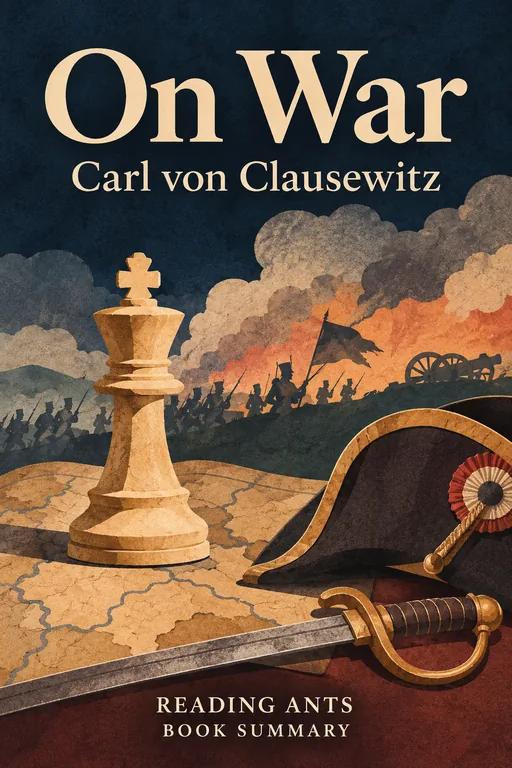
On War
Original title: Vom Kriege
Prussian officer Carl von Clausewitz argues that war is a continuation of politics by other means, that it is dominated by chance, friction and moral forces, and that it can never be reduced to a simple formula.
Overview
On War, in German Vom Kriege, was written by Carl von Clausewitz, a Prussian general who fought in the Napoleonic Wars, and was published after his death in 1831 by his wife. It is an unfinished work of eight books, which he was revising when he died. Clausewitz had seen how Napoleon’s armies overturned the old way of fighting, and wanted to understand the nature of war itself. The book is philosophical and difficult, and remains one of the most influential works on strategy. It is often compared with Sun Tzu’s The Art of War, though it differs in method.
Full Summary
1. What is war?
The idea: Clausewitz begins by defining war as an act of force to compel an opponent to do our will. He describes war in its pure form as tending toward extremes, since each side tries to overcome the other and each reacts to the other’s efforts. But in practice, he says, real war is held back by political aims, by uncertainty and by many frictions, so it is rarely absolute. He compares war to a duel on a large scale.
In real life: A quarrel can escalate as each person responds to the last remark, until someone stops it.
2. War as an instrument of politics
The idea: His most famous statement is that war is the continuation of politics by other means. War is not an independent activity, but a tool to achieve political goals, and should be subordinate to them. The political aim determines how much effort is needed. This means that statesmen and generals alike must understand what kind of war they are entering, and that a commander at the highest level must understand state policy. The political purpose should guide how the war is fought.
In real life: Before starting a fight, you should know what you want to achieve.
3. The trinity: passion, chance and reason
The idea: Clausewitz describes war as a remarkable trinity, composed of primordial violence, hatred and enmity, which belong chiefly to the people; the play of chance and probability, in which the commander and army operate; and its subordination to reason as an instrument of policy, which belongs to the government. All three are present, and a theory of war that ignores one of them would be useless. The balance varies in each war.
In real life: A team match depends on the fans’ emotions, the luck of the game and the coach’s plan.
4. Friction and the fog of war
The idea: In practice, Clausewitz says, everything in war is simple, but the simplest thing is difficult. The accumulation of small difficulties, such as bad weather, poor information, tired troops and misunderstandings, produces friction, which makes real war different from what is on paper. Much of the information that a commander receives is uncertain or false, a condition often called the fog of war. Courage, determination and judgment are needed to overcome it.
In real life: A plan for a school trip can go wrong because of a late bus, rain and a lost permission slip.
5. Moral forces and the genius of the commander
The idea: The author stresses the importance of moral factors, such as morale, courage, discipline and the spirit of the army, which he counts among the most important subjects in war and says cannot be reduced to numbers. He describes the qualities of a great commander, which he calls military genius: a strong mind, determination, the ability to see the situation clearly, a quick sense for what matters, and steadiness under pressure. These cannot be reduced to rules.
In real life: A team that believes in itself may beat a stronger one.
6. Attack, defense and the aim of war
The idea: The book discusses strategy and tactics, and argues that defense is a stronger form of war than attack, but that the aim of war is often to destroy the enemy’s ability to fight. He emphasizes the concept of the center of gravity, the hub of power on which everything depends, as a focus for effort. Clausewitz also recognizes that wars can have limited aims, and that, in these cases, they are not fought to the point of complete defeat.
In real life: Defending a goal is often easier than attacking one, but you must score to win.
Why It Matters
On War has shaped military thinking for nearly two centuries. It is taught in military academies around the world, and its concepts, such as friction, the fog of war, the center of gravity and war as politics, are part of the standard vocabulary of strategy. It has also been read by political scientists and business thinkers. The book’s insistence that war must serve policy has been a lesson for political leaders. Even though it was written in the age of muskets and cannon, its insights about uncertainty, human factors and the relationship between ends and means remain relevant.
Key Takeaways
- War serves political goals. It is a means, not an end.
- Chance and friction dominate. Plans rarely survive contact with reality.
- Moral forces matter. Morale and will are decisive.
- Judgment cannot be replaced by rules. Great leaders adapt to circumstances.
- Defense is strong. Waiting can be an advantage.
What We Can Learn
You can apply some of the book’s ideas outside of war: be clear about your goals before starting a major effort, expect problems and delays, and build flexibility into your plans. Pay attention to morale and motivation in any team. Recognize that you will never have complete information, and learn to make decisions under uncertainty. And remember that force has costs, so consider whether the aim justifies them. The book describes war analytically and does not glorify it; reading it can help to understand why leaders must think seriously before using force.
Criticism and Counterpoints
Critics say that the book is hard to read, unfinished and sometimes self-contradictory, and that people can find in it what they want. Some argue that Clausewitz’s focus on decisive battle and on states does not suit modern conflicts, such as insurgencies, terrorism and cyber conflict, though others say that his theory of the trinity still applies. Military historians such as John Keegan criticized his idea that war is only politics, saying that it overlooks culture. Some readers have misused him to justify total war. Still, most agree on the lasting value of his concepts.
Who Should Read It
This book is for students of strategy, history, politics and leadership, and for those who are curious about the nature of conflict. It is dense and long, and many readers begin with Book One and selections. Those who want an easier start may begin with a summary or commentary.
Want the whole book?
A summary is a taste, not the meal. Here is where to find the full book.
You reached the end 🎉
Nicely done. Mark this one as read, and we will suggest what to read next.
Read this next
The Art of War
Sun Tzu
The greatest victory is the one won without fighting, achieved through careful planning, knowing both yourself and your opponent, and using deception, flexibility and timing.
🕊️ Philosophy & Religion
The Book of Five Rings
Miyamoto Musashi
Miyamoto Musashi, a famous Japanese swordsman, writes at the end of his life a guide to the way of strategy, in which he explains how to win in single combat and in battle, and how to master any art through discipline and awareness.
🕊️ Philosophy & Religion
The Guns of August
Barbara W. Tuchman
Barbara Tuchman gives a gripping account of the first month of the First World War in 1914, showing how plans, pride and misjudgment led the great powers into a conflict that none was able to stop.
🏛️ History
Leviathan
Thomas Hobbes
Thomas Hobbes argues that without a strong government people would live in constant fear and conflict, and that they should therefore agree to give up some of their freedom to a sovereign power that keeps the peace.
🕊️ Philosophy & Religion
The Prince
Niccolo Machiavelli
A Renaissance diplomat advises rulers to judge their actions by results rather than morality, arguing that a successful leader must sometimes be cunning and ruthless to win and keep power.
⚖️ Politics & Society
The Communist Manifesto
Karl Marx and Friedrich Engels
Marx and Engels declare that all history is the history of class struggle, that capitalism has created a working class that will overthrow it, and that communism will end class divisions.
⚖️ Politics & SocietyWant something different?
Pick another topic and we will show you three books to start with.