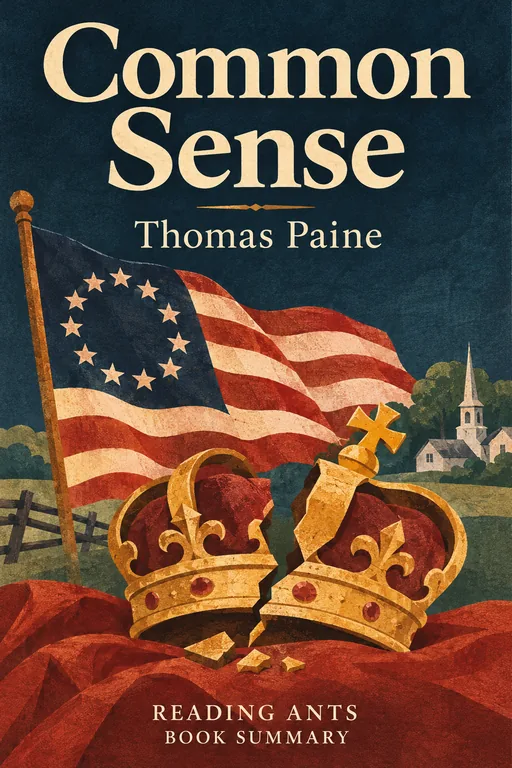
In a short, fiery pamphlet written in plain language, Thomas Paine argued in early 1776 that the American colonies should declare independence from Britain, and that monarchy itself was an unreasonable form of government.
Overview
Common Sense was published anonymously in January 1776 by Thomas Paine, an English-born writer who had arrived in the colonies only about fourteen months earlier, in late 1774. By then, fighting had already begun between British forces and the colonists at Lexington and Concord, but many Americans still hoped for reconciliation with the king. Paine’s pamphlet changed the debate. It spoke to ordinary people, not only to the educated elite, and sold in huge numbers for its time. It helped to prepare public opinion for the Declaration of Independence in July of that year.
Full Summary
1. The origin and purpose of government
The idea: Paine starts by distinguishing society, which is produced by our needs and is a blessing, from government, which is produced by our wickedness and is at best a necessary evil. He imagines a small group of settlers who at first manage their affairs together, and then, as the number grows, elect representatives. The aim of government is freedom and security, and the best form is the simplest one. He criticizes the English constitution as a mixture of monarchy and aristocracy, with only the commons, the elected part, resting on the people.
In real life: A small club can make decisions together, but a large one needs officers to act on its behalf.
2. Against monarchy and hereditary rule
The idea: Paine attacks the idea of kingship. He says that there is no reason for one man to be raised above the rest, and that hereditary succession is absurd, since a king’s descendants may be foolish or unfit. He guesses that the first kings were little better than the chief of a band of robbers, and he calls William the Conqueror an usurper who took England against the will of its people. He argues that the Bible, in the stories of Gideon and of Samuel, shows that God disapproved of kings. The idea that hereditary succession keeps a nation at peace is, he says, false, since England’s own history since the Norman Conquest is full of civil wars and rebellions, including the long struggle between the houses of York and Lancaster.
In real life: Choosing a team captain by birth, instead of ability, would not make sense.
3. Why reconciliation with Britain is wrong
The idea: Paine argues that America should separate from England. He says that the supposed benefits of the connection, such as protection, are false, because Britain protected America for its own interests, and that the connection drags America into European wars. He points out that Europe, not England, is the parent country of America, since settlers had come from many lands, and that the American cause is much larger than a local quarrel. It is, he says, in a great measure the cause of all mankind.
In real life: A young person may grow strong by leaving a home that holds them back.
4. The time is now
The idea: The pamphlet insists that the moment for independence has come. Blood has been shed at Lexington and Concord, and the king has shown by his actions that he is an enemy. Paine says that independence will come sooner or later and that delay will only make it harder, and that the colonies have the strength to win. He urges people to think about the future generations who would inherit their decision. He also warns that fear, prejudice and the hope of patching things up are obstacles to be overcome, since a king who answers petitions with force will be moved only by blows.
In real life: Putting off an important decision can make it harder.
5. A plan for a new government
The idea: Paine sketches ideas for an American government, with annual assemblies in each colony, a Continental Congress with delegates from districts of every colony, and a president chosen by Congress from the delegation of one colony picked by lot, with the turn rotating among all thirteen. He proposes a continental conference, made up of members of Congress, members of the colonial assemblies and representatives chosen by the people, to draft a charter that would fix how Congress and the assemblies are elected and protect freedom, property and religious liberty. He insists that law should be king in America, not a person, and that a nation should begin by writing its charter first and only then choose people to carry it out. He also urges Americans to prepare a refuge for liberty.
In real life: Writing the rules down before beginning helps everyone to know what is expected.
6. America’s strength and the call to action
The idea: The last part argues that America already has enough armed men, and could build a navy from its own timber, tar, iron and rope. Paine compares this with Britain’s large national debt and with a fleet that looked more formidable on paper than in practice, and claims that independence will be a boon for commerce and for liberty. Earlier, in the section on American affairs, he had said that Americans have it in their power to begin the world over again. The pamphlet closes with a list of reasons why a declaration of independence would help, such as making foreign help and mediation possible, and, in later editions, with an appendix and an address to the Quakers.
In real life: A clear picture of what you can do may give you the courage to begin.
Why It Matters
Common Sense is among the most influential pamphlets in history. It turned the debate over independence from a matter for elites into one for ordinary citizens, and gave words to feelings that many held. Contemporaries such as Benjamin Rush noted how sudden and wide its effect was on American opinion, and John Adams admitted that he dreaded its influence. The pamphlet helped to create the climate in which the Declaration of Independence could be adopted. Paine’s plain style, using everyday language and vivid images, became a model for political writing. He went on to write other influential works, including The American Crisis and The Rights of Man. His ideas about republican government and equality have echoed around the world.
Key Takeaways
- Government is a necessary evil. It should be limited and accountable.
- Birth should not rule. Hereditary monarchy is irrational.
- Independence is a choice for the future. The colonies should act now.
- Plain language persuades. Clear writing can change minds.
- Rights belong to humanity. The American cause is a universal one.
What We Can Learn
Paine’s pamphlet shows how clear, direct language can move people to action. When you want to persuade someone, try to explain your point in simple terms, and to appeal to shared values. Think about whether there are institutions or customs, in your school or community, that are accepted only because they are old. Consider the role of ordinary citizens in political change. At the same time, notice that persuasive writing often simplifies, and compare it with other views, such as those of the loyalists, who had their own reasons.
Criticism and Counterpoints
Loyalists and some contemporaries said that Paine was reckless and that his attack on monarchy was too sweeping. Later historians point out that the pamphlet simplified the situation, and that its claims about English government and history were one-sided. Some of his arguments from the Bible have been regarded as weak. The idea that Americans were free of the corruption of the old world overlooked the existence of slavery in the colonies. Paine himself later fell out of favor in America, after he criticized organized religion in another work. Nevertheless, the pamphlet’s effect is widely acknowledged.
Who Should Read It
This book is for readers who like history and persuasive writing, and for students of the American Revolution. It is short, and can be read in an hour. Those who want a balanced view of the period should read it with works from loyalist and other perspectives.
Want the whole book?
A summary is a taste, not the meal. Here is where to find the full book.
You reached the end 🎉
Nicely done. Mark this one as read, and we will suggest what to read next.
Read this next
The Federalist Papers
Alexander Hamilton, James Madison and John Jay
A series of eighty-five essays written in 1787 and 1788 by three of the founders of the United States to persuade the people of New York to approve the new Constitution, explaining how its system of government would work and why it was needed.
⚖️ Politics & Society
1776
David McCullough
David McCullough tells the story of the pivotal year of the American Revolution, when George Washington's poorly equipped army nearly lost everything and then, in a few winter weeks, won two surprising victories.
🏛️ History
A Vindication of the Rights of Woman
Mary Wollstonecraft
Mary Wollstonecraft argues that women are not naturally inferior to men, but appear so because they are denied a proper education, and that society would benefit if women were given the chance to develop their reason and independence.
⚖️ Politics & Society
Civil Disobedience
Henry David Thoreau
Henry David Thoreau argues that a person must follow conscience over the laws of a government that supports injustice, and that withdrawing support, even at the cost of jail, is a duty.
⚖️ Politics & Society
The Social Contract
Jean-Jacques Rousseau
Rousseau asks how people can live together under laws and still be free, and argues that legitimate government rests on an agreement in which citizens obey only the "general will" that they make together.
🕊️ Philosophy & Religion
The Prince
Niccolo Machiavelli
A Renaissance diplomat advises rulers to judge their actions by results rather than morality, arguing that a successful leader must sometimes be cunning and ruthless to win and keep power.
⚖️ Politics & SocietyWant something different?
Pick another topic and we will show you three books to start with.