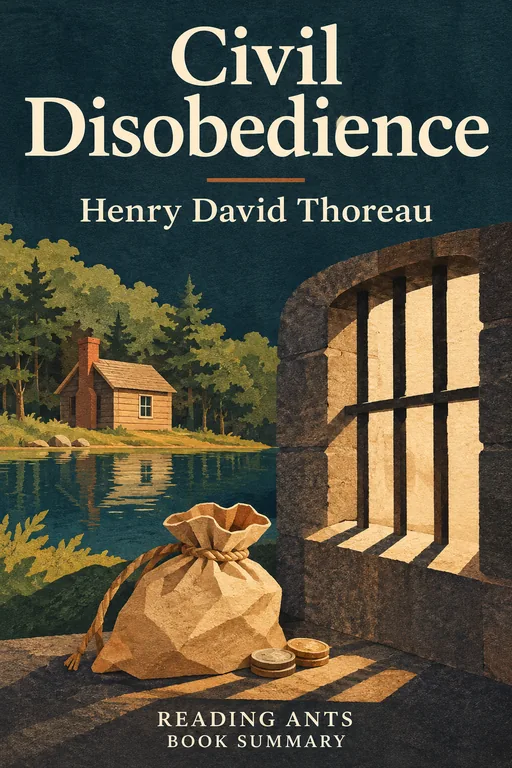
Civil Disobedience
Henry David Thoreau argues that a person must follow conscience over the laws of a government that supports injustice, and that withdrawing support, even at the cost of jail, is a duty.
Overview
Civil Disobedience is an essay by Henry David Thoreau, first published in 1849 under the title “Resistance to Civil Government.” It grew from lectures that he gave in 1848 at the Concord Lyceum, two years after he spent a night in jail in Concord, Massachusetts, for refusing to pay a poll tax. Thoreau, who lived in a cabin by Walden Pond and wrote the book Walden, objected to slavery, and to the war that the United States was waging against Mexico, which he saw as an attempt to extend slave territory. The essay is short, but has had a lasting influence on movements for justice around the world.
Full Summary
1. The best government and the individual conscience
The idea: Thoreau begins with the saying that the best government is the one that governs least, and goes further to say that the best is the one that does not govern at all. He is suspicious of the idea that the majority should rule on every moral question. Citizens should not give up their conscience to lawmakers. The only obligation that he feels, he says, is to do at any time what he thinks is right, and a person’s duty is to follow conscience, not to obey the laws as a machine.
In real life: A student who is told to join in teasing someone should consider whether it is right, not just what everyone does.
2. The state as a machine
The idea: Thoreau criticizes soldiers and officials who serve the state without question, acting as tools like wood and earth. He praises those few who serve with conscience, and who therefore are often treated as enemies by the state. He says that the American government has not the vitality of a single living man, since one man can bend it to his will, and calls it a kind of dummy gun that would split if the people ever used it in earnest against each other, yet which people keep because they want some machinery of government.
In real life: A rule is only as strong as the willingness of people to carry it out.
3. Unjust laws and the duty to resist
The idea: Thoreau asks what to do when a law is unjust. He says that one should not wait for the majority to change it, and that if the law requires you to be an agent of injustice to another, you should break the law. Voting is not enough, he argues, since it is a weak way of expressing a wish. He adds that a minority is powerless when it conforms, but is strong when it refuses to go along and brings the machinery to a halt.
In real life: If many people refuse to follow a bad rule, it can no longer work.
4. Withdrawing support: taxes and jail
The idea: Thoreau explains why he refused to pay his tax. He did not want to pay for a government that allowed slavery and carried on an unjust war. When he was arrested and put in jail for a night, he felt more free than the citizens outside, since the state could only imprison his body. He says that when a government jails people unjustly, jail is where honest people belong. In the cell, he reflects that the state is weak and that it cannot reach his mind.
In real life: A person who stands by their principles at a cost may feel more at peace than one who compromises.
5. The cost and the limits
The idea: He acknowledges that he is not asking for the end of all government, but for a better one, and for recognition of the individual as a higher power from which the state’s authority is derived. He also accepts that he is not responsible for solving every wrong in the world, but he must at least not lend himself to it. He is willing to obey the law in many things and says he has never refused the highway tax, since he wants to be a good neighbor, but he refuses the tax that supports the State as a whole, as a way of withdrawing his allegiance from a government that upholds slavery and war.
In real life: You can support a community in many ways while declining to take part in what you believe is wrong.
6. Toward a more just state
The idea: In the closing pages, Thoreau looks to a state that recognizes the individual as a higher and independent power, and treats him accordingly. He imagines a government that would tolerate a few citizens who live apart from it, and he hopes that such a state will arise. He ends by saying that a state of this kind would prepare the way for a still more perfect and glorious one, which he has imagined but not yet seen anywhere.
In real life: A school that allows students to dissent respectfully will probably be fairer.
Why It Matters
Civil Disobedience is one of the most influential essays in American literature and political thought. Its idea of nonviolent refusal to obey unjust laws inspired Mahatma Gandhi in India and Martin Luther King Jr. in the American civil rights movement, as well as protesters in many countries. The phrase “civil disobedience” has become part of common vocabulary. The essay is also a classic text in discussions about the relationship between the individual and the state, and the limits of obedience. It remains a source of debate on when it is right to break the law.
Key Takeaways
- Conscience comes first. Moral duty can outweigh legal obligation.
- Do not lend yourself to injustice. Withdrawing support is a form of protest.
- Voting is not enough. Action is required for real change.
- A committed minority can have power. Principled refusal can stop the machine.
- Accept the consequences. Thoreau was willing to go to jail.
What We Can Learn
If you think a rule or practice is unfair, ask whether you can voice your concern, and whether there is a peaceful way to refuse to take part. Remember that civil disobedience, in its classic form, is open, nonviolent and accepts the penalty, so that it appeals to the public conscience. Learn about people who have used it, such as Gandhi and King, and notice how they organized and prepared. At the same time, think about the risks, and the importance of a good reason, since breaking laws can have serious consequences. Discuss with trusted adults.
Criticism and Counterpoints
Critics say that Thoreau’s individualism ignores the importance of democratic procedures and the rule of law, and that it could justify anyone’s refusing to obey any law they dislike. He was able to rely on others to pay taxes and keep the roads, and had few responsibilities, which made it easier to take a stand. Some historians note that his protest was largely symbolic, and that the night in jail was short, since someone else paid the tax for him. Others point out that he showed little interest in organizing a larger movement. His defenders say that the essay’s moral force remains.
Who Should Read It
This book is for students, activists and anyone interested in the question of when to obey and when to resist. It is short, powerful and easy to read in one sitting. Those who want a fuller picture should read it along with the writings of those who later used its ideas.
Want the whole book?
A summary is a taste, not the meal. Here is where to find the full book.
You reached the end 🎉
Nicely done. Mark this one as read, and we will suggest what to read next.
Read this next

Walden
Henry David Thoreau
Henry David Thoreau describes the two years he spent living simply in a small cabin by Walden Pond in Massachusetts, and argues that people should simplify their lives, spend time in nature and think for themselves.
🕊️ Philosophy & Religion
Self-Reliance and Other Essays
Ralph Waldo Emerson
Ralph Waldo Emerson urges readers to trust their own minds, to resist conformity and to find a spiritual connection with nature and the universe, in a series of essays that helped to shape American thought.
🕊️ Philosophy & Religion
The Autobiography of Martin Luther King, Jr.
Martin Luther King Jr. and Clayborne Carson
Historian Clayborne Carson assembles Martin Luther King Jr.'s own words from his letters, sermons, speeches and writings into a single life story, from a boyhood in Atlanta to the Memphis strike where he was killed.
👤 Real Lives
Long Walk to Freedom
Nelson Mandela
Nelson Mandela tells his own story, from a village childhood to twenty-seven years in prison to becoming South Africa's first democratically elected president, and shows how patience, courage and forgiveness helped end apartheid.
👤 Real Lives
On Liberty
John Stuart Mill
John Stuart Mill argues that society may limit a person's freedom only to prevent harm to others, and that free thought, free speech and individuality benefit everyone.
🕊️ Philosophy & Religion
The Prince
Niccolo Machiavelli
A Renaissance diplomat advises rulers to judge their actions by results rather than morality, arguing that a successful leader must sometimes be cunning and ruthless to win and keep power.
⚖️ Politics & SocietyWant something different?
Pick another topic and we will show you three books to start with.