 Reading Ants
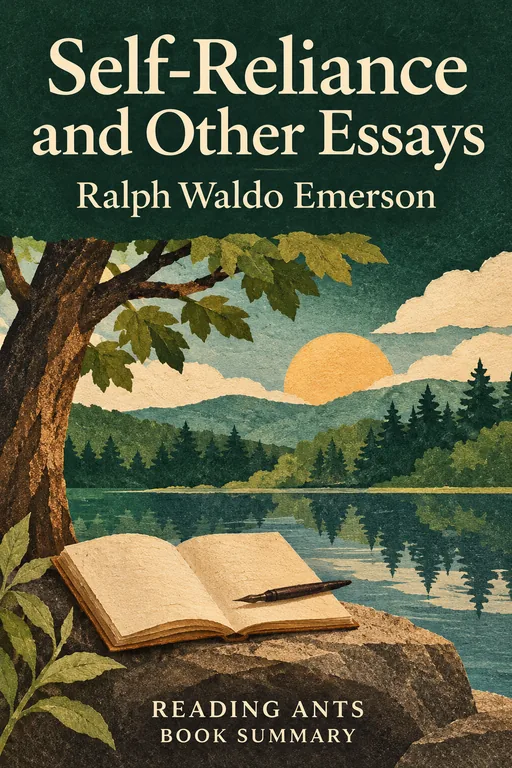
Self-Reliance and Other Essays
Ralph Waldo Emerson urges readers to trust their own minds, to resist conformity and to find a spiritual connection with nature and the universe, in a series of essays that helped to shape American thought.
Overview
Ralph Waldo Emerson was an American essayist, lecturer and poet, and the central voice of the Transcendentalist movement, which flourished in New England in the 1830s and 1840s. Transcendentalists believed that individuals can know truth directly, through intuition, and that nature and the human soul are linked to something divine. The essay “Self-Reliance” appeared in his 1841 collection Essays: First Series, and is often printed with other works, such as “Nature” (1836, a small book), “The American Scholar” (an address of 1837), and essays such as “Compensation” and “The Over-Soul,” so the contents of an edition vary. Emerson’s prose is full of striking phrases and stirring images, and his work was widely read.
Full Summary
1. Trust yourself
The idea: The core of “Self-Reliance” is the call to trust one’s own thought. Emerson says that the mark of genius is to trust the truths that you find in your own mind, and that we should not dismiss our own insights because they are not those of famous authors. Every person has a unique gift, and must work it out. He says that envying others comes from not knowing your own worth, and that copying others destroys the self, since you can only be what you are.
In real life: A student who has an original idea may let it go because it is not found in the textbook, but could be right.
2. Do not conform
The idea: Emerson warns that society tends to work against the individuality of its members, asking for conformity in exchange for comfort. He advises readers to be nonconformists, to follow their own conscience, and not to worry about the opinion of the crowd. He says that a foolish insistence on consistency, simply to appear steady, is unworthy of a great mind, since we should say what we think today, even if it contradicts what we said yesterday.
In real life: Changing your mind after learning something new is a mark of honesty and not weakness.
3. Self-reliance in practice
The idea: Emerson applies the principle to many parts of life, including religion, travel, charity, education and property. He advises people to avoid the traveling that is a way of escaping oneself, saying that wherever we go we take our minds with us. He is critical of reliance on property, institutions and borrowed ideas. He also says that a person of integrity does not need to explain or justify what he does, but acts according to his own nature.
In real life: Moving to a new school will not solve problems that come from inside.
4. Nature as a source of renewal
The idea: In the essay “Nature,” Emerson describes the experience of being in the woods, and feeling at one with the universe, as if he were a transparent eyeball, seeing all and being nothing. He believes that nature is a language through which the spirit speaks, and that attention to it brings joy and insight. He criticizes a materialist view of the world, saying that nature exists to be understood by the mind.
In real life: A quiet walk in a park can clear the mind and bring a sense of perspective.
5. The American scholar and compensation
The idea: In “The American Scholar,” Emerson calls for Americans to throw off dependence on European ideas, and to create a literature of their own. He says that the scholar should learn from nature, from books used carefully and from action. In “Compensation,” he argues, as a moral and spiritual idea, that life has a law of balance: every gift has its price, and every loss has its gain, and that, in the deeper order of things, good and evil bring their own results. He insists that the balance is exact and certain even when it is hidden, so that hardships and defects turn out to be useful to a good person, and wrongdoing carries its own penalty.
In real life: A hard experience may give you strength and wisdom that an easy life would not.
6. The Over-Soul and the unity of life
The idea: In “The Over-Soul,” Emerson writes that behind individual minds there is a single, universal spirit, which he calls the Over-Soul, in which all are united. In moments of insight, we are in contact with it. The same thought lies behind his call to self-reliance: in “Self-Reliance” itself he says that our deepest perceptions come from a larger intelligence, so trusting them means letting it speak through us. He suggests that this view dissolves the barriers between people, and encourages reverence for all.
In real life: Moments of deep connection, in music, prayer or friendship, may feel like touching something larger than yourself.
Why It Matters
Emerson’s essays are a cornerstone of American literature and thought. His call to trust oneself and think independently influenced writers such as Thoreau and Whitman, and generations of readers. His ideas about individualism, nature and the divine in all things shaped American culture, as well as movements in philosophy and religion. The famous lines from “Self-Reliance” are widely quoted. At the same time, his emphasis on the individual has been criticized, and his legacy is debated. Even so, his writings continue to inspire readers who want to live with courage and integrity.
Key Takeaways
- Trust your own mind. Your insights have value.
- Resist conformity. Society pressures people to fit in.
- Nature renews the spirit. Attention to the natural world brings insight.
- Life has a moral balance. Emerson argues that every gift and loss carries a cost or a gain.
- All are connected. A shared spirit underlies individual lives.
What We Can Learn
Try to notice when you hold back an opinion because it is unpopular, and ask whether it is honest. Spend time alone with your thoughts, and in nature, and write down what you notice. Do not copy others’ ideas without examining them. At the same time, be open to learning from books and teachers, and use them as aids to your own thought, as Emerson recommends. Remember that independence is not selfishness: Emerson also wanted people to be generous and to contribute to the world.
Criticism and Counterpoints
Critics say that Emerson’s praise of self-reliance can be naive, since it overlooks the role of community, dependence and social conditions in shaping what individuals can do, and may be used to excuse a lack of concern for others. His style is often more inspirational than logical, and his claims can be vague or contradictory, which he accepted. Some note that his optimism about balance and compensation sounds hollow in the face of real suffering. Others point out that his views on race and on the abolition of slavery changed over time. Many still find the essays stirring.
Who Should Read It
This book is for readers who like inspiring essays and ideas about individuality. The language is old-fashioned, but the essays are short and full of memorable lines. Those who prefer concrete examples or systematic argument may find them elusive, but many readers find them a source of encouragement.
Want the whole book?
A summary is a taste, not the meal. Here is where to find the full book.
You reached the end 🎉
Nicely done. Mark this one as read, and we will suggest what to read next.
Read this next

Walden
Henry David Thoreau
Henry David Thoreau describes the two years he spent living simply in a small cabin by Walden Pond in Massachusetts, and argues that people should simplify their lives, spend time in nature and think for themselves.
🕊️ Philosophy & Religion
Civil Disobedience
Henry David Thoreau
Henry David Thoreau argues that a person must follow conscience over the laws of a government that supports injustice, and that withdrawing support, even at the cost of jail, is a duty.
⚖️ Politics & Society
Essays
Michel de Montaigne
Michel de Montaigne invents the personal essay by exploring, in a curious and honest voice, everything from friendship and death to cannibals and cats, with the aim of understanding himself and the human condition.
🕊️ Philosophy & Religion
The Autobiography of Benjamin Franklin
Benjamin Franklin
Benjamin Franklin tells the story of his rise from a poor Boston boy to a successful printer, inventor and public leader in Philadelphia, and shares his methods of self-improvement.
👤 Real Lives
On Liberty
John Stuart Mill
John Stuart Mill argues that society may limit a person's freedom only to prevent harm to others, and that free thought, free speech and individuality benefit everyone.
🕊️ Philosophy & Religion
The Art of War
Sun Tzu
The greatest victory is the one won without fighting, achieved through careful planning, knowing both yourself and your opponent, and using deception, flexibility and timing.
🕊️ Philosophy & ReligionWant something different?
Pick another topic and we will show you three books to start with.