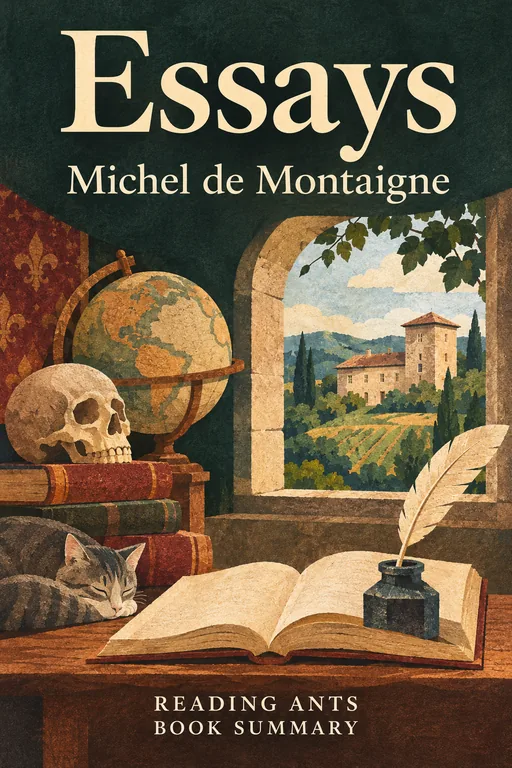
Essays
Original title: Essais
Michel de Montaigne invents the personal essay by exploring, in a curious and honest voice, everything from friendship and death to cannibals and cats, with the aim of understanding himself and the human condition.
Overview
The Essays were written by Michel de Montaigne, a French nobleman and former magistrate, who retired in 1571 to his family estate near Bordeaux to read, think and write. The first two books appeared in 1580, a third followed in 1588, and he went on revising until his death in 1592. The word essai in French means a trial or an attempt, and Montaigne tries out ideas on a topic, with quotations from ancient writers, stories and his own reflections. He wrote in a time of religious wars in France, and the books show a mind that values tolerance, doubt and moderation.
Full Summary
1. Writing about himself
The idea: Montaigne says openly that the subject of his book is himself, and that he is painting his own portrait with all of his faults, so that his family and friends can know him after his death. He believes that every person carries the whole form of the human condition, and so by studying himself honestly, he can learn about others. This was a new idea at the time, and it gives the essays a personal and intimate tone.
In real life: Writing a diary can reveal how our moods and opinions change.
2. Doubt and the limits of knowledge
The idea: In his longest essay, the “Apology for Raymond Sebond,” a defense of a book by the Spanish theologian Raymond Sebond, Montaigne argues for skepticism. He shows that human reason is weak, and that our senses deceive us, that experts disagree, and that people in different cultures believe different things. His motto, in French, is “What do I know?” He does not conclude that nothing can be known, but that we should be modest about our opinions and avoid fanaticism.
In real life: Remembering how often you have been wrong can make you more patient with others.
3. Of cannibals and custom
The idea: Montaigne reflects on reports of the peoples of Brazil, whom Europeans called savages. He says that we call barbaric what is not our custom, and that the Europeans of his time, who tortured and burned people over religion, are in some ways more cruel than the people they call cannibals. He concludes that there is nothing barbarous in those nations, except that each person calls barbarism whatever is not his own practice.
In real life: Habit can make us see our own customs as natural and other people’s as strange.
4. Friendship and loss
The idea: One essay is about his close friend Etienne de La Boetie, who died young, and about the rare kind of friendship in which two souls are joined. Montaigne says that he cannot fully explain why they loved each other, except that the bond was between those two particular people. The loss shaped his later writing, and his sense of the value of friendship. He compares friendship with marriage and with other relationships, which he values less.
In real life: A friend who understands you without long explanations is a rare gift.
5. Death and living well
The idea: Montaigne discusses death at length, and says that to philosophize is to learn to die. After a riding accident in which another rider’s horse crashed into him and his companions thought him dead, he found the experience of nearly dying gentle rather than terrible, and he hoped that real death would feel the same. He concludes that we should not fear death, but live well and take things as they come. He also stresses living in the present and enjoying simple pleasures.
In real life: Remembering that life is limited can help you to appreciate each day.
6. Moderation, nature and everyday life
The idea: In essays across the three books, he writes about daily life: the body, marriage, education, travel, the pleasures of conversation and the importance of enjoying one’s existence. He advises moderation and following nature, and not trying to live by a strict, artificial code. In “Of Solitude,” he says that the greatest thing is to know how to belong to oneself. He also has humor and a love of animals: in the “Apology,” he wonders whether his cat is amused by him as much as he is by the cat.
In real life: Enjoying a meal, a walk or a talk with friends is part of a good life, not a distraction from it.
Why It Matters
Montaigne’s Essays created a new form of literature, the essay, and had a deep effect on writers from Shakespeare and Bacon to Emerson, Nietzsche and Virginia Woolf. His frankness about himself, his curiosity and his skepticism helped to shape the modern sense of the individual. His reflections on cultural difference, tolerance and the limits of knowledge remain fresh. The essays are also a rich source of Renaissance thought and of ancient wisdom, since he quotes freely from Greek and Roman writers. Readers across the centuries have found in him a friend who speaks directly to them.
Key Takeaways
- Know yourself. Honest self-study is a path to understanding others.
- Doubt is healthy. Be modest about what you think you know.
- Custom shapes judgment. Other cultures may be less strange than they seem.
- Friendship is precious. Deep friendship is one of life’s great joys.
- Face death calmly. A good life prepares us for its end.
What We Can Learn
Try writing a short essay about something you care about, without worrying about being perfect, and see what you discover. Practice saying “I’m not sure” when you are not, and listen to people with different views. When you meet an unfamiliar custom, ask what reasons lie behind it. Spend time with a friend in conversation, and appreciate it. Be moderate and enjoy the ordinary pleasures of life. Reading a little of Montaigne at a time is a good way to make it a habit.
Criticism and Counterpoints
Some readers find the essays long, digressive and full of quotations from ancient authors that are hard to follow. Critics point out that Montaigne’s skepticism can seem to lead to conservative conclusions, such as accepting existing laws and customs, since he doubts that we can change things for the better. His views on women and on social rank reflect his time, and some of his reports about other peoples are based on secondhand and biased accounts. Others say that his focus on himself is limited to the viewpoint of a wealthy man. Still, his humane spirit is widely admired.
Who Should Read It
This book is for readers who love reflective writing, and who like to dip into a text at random. It is best read in selections, since the complete work is very long. Those who prefer a systematic argument will find it wandering, but many readers take great pleasure in the company of the author.
Want the whole book?
A summary is a taste, not the meal. Here is where to find the full book.
You reached the end 🎉
Nicely done. Mark this one as read, and we will suggest what to read next.
Read this next
Self-Reliance and Other Essays
Ralph Waldo Emerson
Ralph Waldo Emerson urges readers to trust their own minds, to resist conformity and to find a spiritual connection with nature and the universe, in a series of essays that helped to shape American thought.
🕊️ Philosophy & Religion
Meditations
Marcus Aurelius
The private notebook of a Roman emperor, reminding himself daily to accept what he cannot control, to act with justice and kindness, and to remember that life is short.
🕊️ Philosophy & Religion
Confessions
Augustine of Hippo
Augustine, a bishop in Roman North Africa, tells the story of his restless youth and his conversion to Christianity, in a long prayer addressed to God that is also a deep inquiry into memory, time and the human heart.
🕊️ Philosophy & Religion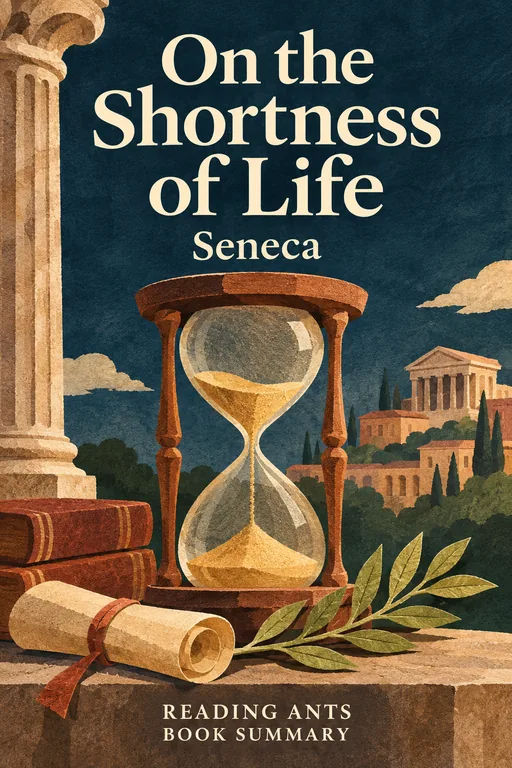
On the Shortness of Life
Seneca
The Roman Stoic Seneca argues that life is not short but wasted, and that we can have plenty of time if we use it for what matters, instead of squandering it on busyness, worry and distraction.
🕊️ Philosophy & Religion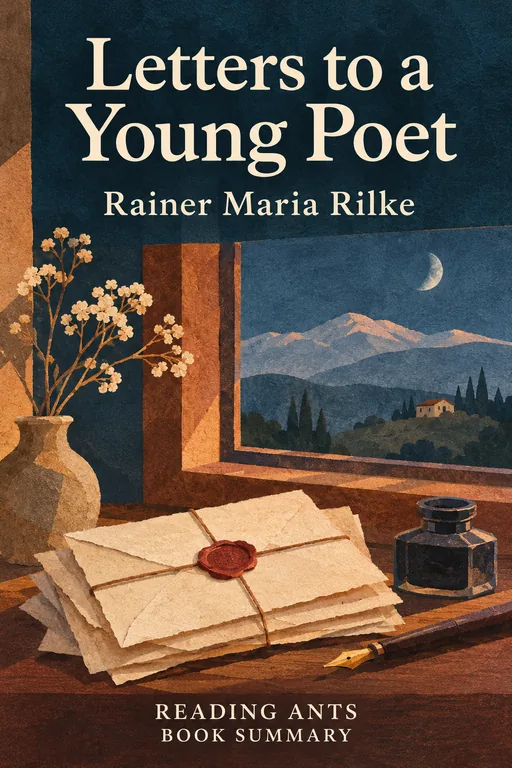
Letters to a Young Poet
Rainer Maria Rilke
In a series of letters to a young aspiring poet, the great Austrian poet Rilke, who wrote in German, gives advice on solitude, patience, love and the inner life of the artist.
🎨 Arts & Creativity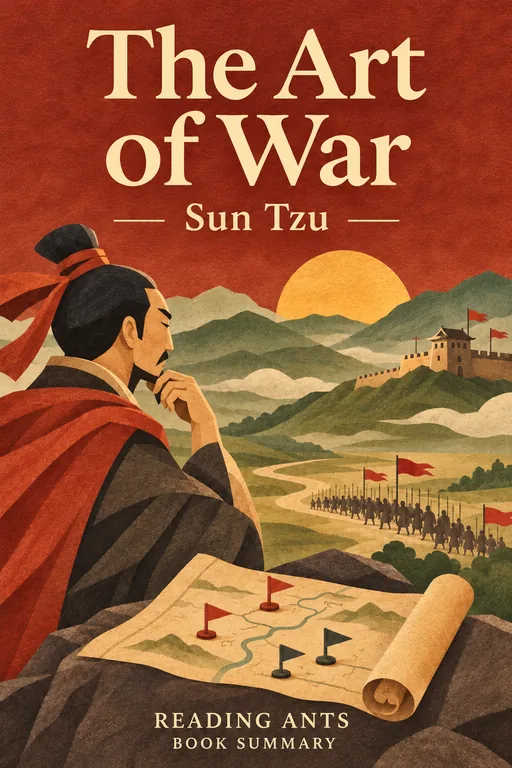
The Art of War
Sun Tzu
The greatest victory is the one won without fighting, achieved through careful planning, knowing both yourself and your opponent, and using deception, flexibility and timing.
🕊️ Philosophy & ReligionWant something different?
Pick another topic and we will show you three books to start with.