 Reading Ants
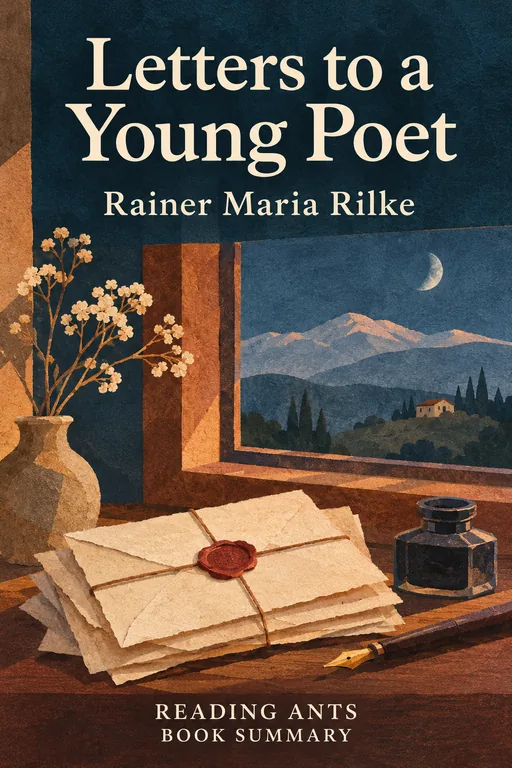
Letters to a Young Poet
Original title: Briefe an einen jungen Dichter
In a series of letters to a young aspiring poet, the great Austrian poet Rilke, who wrote in German, gives advice on solitude, patience, love and the inner life of the artist.
Overview
Letters to a Young Poet is a collection of ten letters written by the Austrian poet Rainer Maria Rilke, who wrote in German, between 1903 and 1908, to a young man named Franz Xaver Kappus, who was a student at a military academy and who had sent Rilke some of his poems. The letters were published in 1929, after Rilke’s death. They are not a manual of poetry, but a series of reflections on how to live as a person who wants to create. They are warm, serious and very personal, and they have been loved by readers around the world.
Full Summary
1. Do not ask others about your work
The idea: Rilke begins by saying that he cannot judge Kappus’s poems, and that no one can really help a young writer by criticism or praise. The only way is to go into oneself, and to ask whether one must write. If the answer is yes, then one should build one’s life around that need.
From the book: He urges the young man to stop looking outward for approval from editors and critics, and to turn instead to the source of his creative drive.
In real life: Before you show your work to others, ask yourself whether you would do it even if no one saw it. That inner reason is a good compass.
2. Solitude is a gift
The idea: Rilke says that solitude is not something to be feared, but something to be embraced. Being alone allows us to know ourselves, and to see the world deeply. He suggests that the young man should not run away from his loneliness, but should treat it as a place to grow.
From the book: In the sixth letter, written near Christmas, he admits that solitude is vast and hard to bear, and that everyone wishes at times to escape it. He urges the young man to turn toward nature, things and his own inner life, and not to seek shallow company just to fill the time.
In real life: Spend some time each week without screens or noise, such as on a walk or in a quiet room. You may find that you hear your own thoughts better.
3. Look to nature and to childhood
The idea: Rilke advises the young poet to look closely at the natural world, and to remember the richness of childhood. He says that these are an endless source of images and feelings. A poet need not travel to find material; the memories of his own life are enough.
From the book: He writes that if his daily life seems poor, the poet should not blame it, but blame himself, for not being able to call forth its riches.
In real life: Keep a small journal of things you notice on your way to school or work, and of memories that come to you. These can become the start of stories or poems.
4. Live the questions
The idea: The young man is eager for answers, but Rilke says that he must learn to be patient with what is unsolved in his heart. He should try to love the questions themselves, and, by living them, he may gradually live into the answers.
From the book: Rilke gives this as advice for the whole of life, and not only for writing. In a later letter, he says that the future enters us from within, and that our task is to be patient, open and trusting.
In real life: If you are worried about what career to choose or who to become, try not to force an answer. Explore, ask and wait, and let things become clear over time.
5. Love and the body
The idea: In his letters, Rilke writes about love as a great task, in which two solitudes protect and respect each other. He believes that love is a path of growth, and that it should not be rushed. He speaks of bodily love as a form of learning, to be approached with respect and not misused as a distraction, and as nothing to be ashamed of.
From the book: He suggests that young people, being impatient, often throw themselves into love and merge with another person before they have found themselves, and that real love requires maturity and self-knowledge.
In real life: In friendships and relationships, it is good to give each other space, and to respect each person’s need to grow.
6. Difficulty and sadness have meaning
The idea: Rilke does not offer easy comfort. He says that sadness and hard times are part of life, and that they are moments of change. He encourages the young man to trust them, and to see that something new is forming inside him.
From the book: In one of his letters, he speaks of sadness and change, and of the need to be patient with oneself and to trust what is slowly happening inside.
In real life: When you feel low, try not to rush it away. Notice what it is telling you, and talk to someone you trust. If sadness is overwhelming, seek help.
Why It Matters
Letters to a Young Poet is among the best-loved books about creativity and the inner life. It has been translated into many languages, and has been read by artists, writers and readers of all kinds. Its advice does not fade with time, since it deals with timeless questions of how to live and work. The letters are often given as gifts and quoted by those who are seeking to find direction. Many writers, artists and teachers see in them a calm and serious view of what it means to devote one’s life to art. Rilke’s own poems, such as the Duino Elegies and the Sonnets to Orpheus, are often read alongside the letters.
Key Takeaways
- Look inward. The source of your work is within you.
- Solitude is valuable. It is a place for growth.
- Be patient with questions. Answers come in time.
- Love is a task of growth. It requires respect and patience.
- Hard times shape us. Sadness can be a stage of change.
What We Can Learn
Rilke’s letters teach us to trust our own inner voice, and not to depend too much on the judgments of others. They suggest that creativity is a way of living, and that it requires attention and patience.
For anyone going through a time of uncertainty, the book offers the reassurance that it is fine not to have all the answers. It encourages us to be gentle with ourselves, and to keep on exploring. Finally, it reminds us that a quiet, thoughtful life, with time for reflection, can be a rich one.
Criticism and Counterpoints
Some readers find Rilke’s advice abstract and old-fashioned, and say that it is aimed at an educated, male, European audience. Some of his remarks on men and women may seem dated today, although he also argues for relationships that are more equal and more human. Others say that the letters are mostly about Rilke himself, and that Kappus, whose side of the correspondence was not included in the original edition, remains a shadowy figure. It has also been pointed out that the advice, to turn inward and be alone, might not suit everyone, or all circumstances.
Who Should Read It
This book is for anyone who is curious about art, creativity and the inner life, including teens and adults. It is short and can be read slowly, a letter at a time. Those who prefer practical advice may find it too philosophical, but those who like thoughtful writing may keep it for life.
Want the whole book?
A summary is a taste, not the meal. Here is where to find the full book.
You reached the end 🎉
Nicely done. Mark this one as read, and we will suggest what to read next.
Read this next
The Prophet
Kahlil Gibran
Before sailing home, a wise exile answers a city's questions about love, work, freedom and death, presenting life as a unity built from apparent opposites.
🌍 World Literature
Gitanjali
Rabindranath Tagore
A collection of devotional poems in which a speaker offers songs to God, in joy, longing and humility, finding the divine in nature, in the poor and in everyday life.
🌍 World Literature
A Room of One's Own
Virginia Woolf
Virginia Woolf argues that a woman needs money and a room of her own, meaning independence and privacy, in order to write fiction, and explains why women writers have been held back through history.
⚖️ Politics & Society
Siddhartha
Hermann Hesse
A gifted young man leaves teachers, wealth and family behind in search of enlightenment, only to discover through love, grief and a river that wisdom must be lived rather than borrowed.
🌍 World Literature
Letters from a Stoic
Seneca
In friendly letters to a younger friend, the Roman Stoic Seneca offers practical advice on how to use time well, face death, handle wealth and misfortune, and train the mind to find peace.
🕊️ Philosophy & Religion
The Story of Art
E. H. Gombrich
Gombrich traces major traditions of Western art by showing how artists inherited visual problems, revised conventions and learned to make images serve changing purposes.
🎨 Arts & CreativityWant something different?
Pick another topic and we will show you three books to start with.