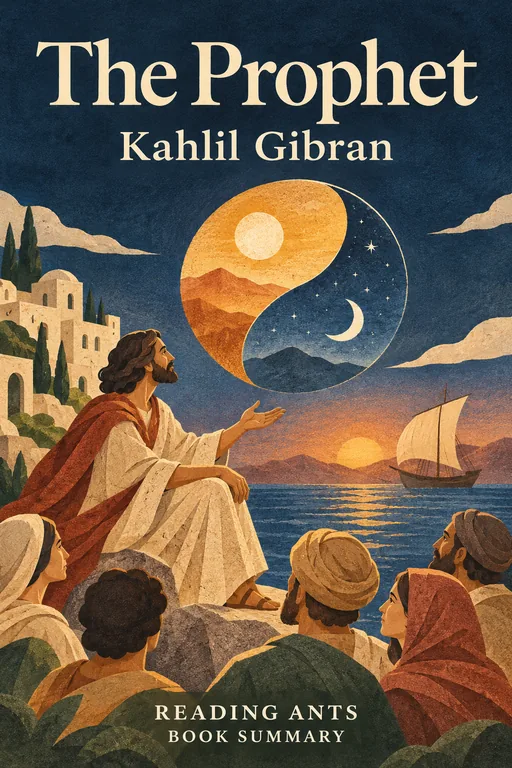
The Prophet
Before sailing home, a wise exile answers a city's questions about love, work, freedom and death, presenting life as a unity built from apparent opposites.
Overview
The Prophet is a short work of poetic philosophy framed as a farewell. Almustafa has lived for twelve years in the city of Orphalese and waits for a ship that will return him to his birthplace. When it arrives, the people gather and ask him to speak about the concerns that shape their lives. His responses cover love, marriage, children, work, law, freedom, pain, friendship, prayer, death and other subjects. Rather than giving practical rules, he uses images and paradoxes to suggest that joy and sorrow, freedom and responsibility, body and spirit belong together. Kahlil Gibran wrote the book in English, drawing broadly on several religious and literary traditions without making it a manual for one faith.
Main Characters
- Almustafa: a prophet and exile whose departure frames the teachings.
- Almitra: a seer who first asks him to speak, beginning with love.
- The people of Orphalese: Workers, parents, officials and others who ask about ordinary human concerns.
- The ship’s sailors: the companions waiting to carry Almustafa home.
Full Summary
The Ship Appears
After twelve years in Orphalese, Almustafa sees the ship that will take him home. He feels joy, but departure also tears at him because the city has become part of his life. As he walks toward the harbor, people leave their fields and workshops to meet him. Almitra asks him not to go without sharing what he has learned.
His farewell therefore becomes a sequence of answers rather than a plot driven by action. The questions come from recognizable social roles, while Almustafa replies in symbolic language. He does not claim that difficult parts of life can be removed; he repeatedly asks listeners to see how seeming opposites depend on each other.
Love, Marriage and Children
Almitra asks about love. Almustafa presents love as both gift and transformation: it brings fulfillment but also exposes and changes those who accept it. Love should not be treated as a possession or reduced to comfort. On marriage, he values closeness while insisting that partners need space to remain distinct.
Parents are told that children have lives and futures of their own. Adults may give care and shelter but should not try to own a child’s mind. These teachings share a concern with non-possession. Loving another person does not erase that person’s independence, whether the relationship is romantic or parental.
Giving, Work and Daily Life
Almustafa describes generous giving as more than transferring objects. Giving from abundance may be easy; giving with trust acknowledges that life itself is shared. He treats work as a way of joining personal effort to the needs of others. Labor without care becomes empty, but work done with attention can express love.
Questions about food, houses and clothing bring spiritual reflection into material life. Human beings depend on other living things and on one another. Homes should offer shelter without becoming prisons built from fear. Comfort can quietly become a master when people organize life entirely around avoiding difficulty.
Law, Freedom and Reason
When asked about crime and punishment, Almustafa resists dividing society into purely innocent and purely guilty people. Harm remains real, yet wrongdoing grows within a shared community. Laws cannot create justice if people honor them only as external restrictions.
Freedom also contains a paradox. People may proudly reject a visible chain while remaining controlled by desires or fears inside themselves. Reason and passion should not destroy each other; reason can guide energy, while passion gives movement to thought. The goal is integration rather than victory of one half of the self over another.
Sorrow, Friendship and Knowledge
Almustafa links joy with sorrow, suggesting that the capacity opened by suffering can also hold delight. This does not mean pain is always good or deserved. His image emphasizes that emotional life cannot be divided into sealed compartments.
Friendship is valued as a relationship with purpose and presence, not merely a place to fill empty time. Teaching and self-knowledge likewise cannot be handed over like objects. A teacher can direct attention, but each learner must recognize truth inwardly. Speech has value, though silence may reveal how much language fails to contain.
Time, Prayer and Death
Later questions turn toward time, goodness, religion and death. Almustafa suggests that people experience moments separately while life itself is larger than their calendars. Prayer should not be reserved only for crisis or requests. Religion is not one activity among others because daily work, pleasure and relationship already express what a person values.
Death is described not as life’s opposite but as part of its movement. At sunset Almustafa boards the ship. He promises in spirit that separation is not final and hints that he may return in another form. The people watch from shore as the vessel disappears, left with teachings that require interpretation rather than obedience to a detailed code.
Why It Matters
The Prophet became one of the most widely recognized works of modern spiritual literature because its brief chapters can speak across religious boundaries. Gibran joins biblical-sounding prose, romantic imagery and philosophical paradox without requiring readers to accept a formal creed. Its subjects are ordinary (work, parenting, friendship, grief), but the language asks readers to see them as parts of a larger spiritual life.
The book’s openness explains both its reach and its limitations. A teaching about love or freedom can fit many personal circumstances, making the work popular at weddings, funerals and moments of transition. Yet broad wisdom can feel profound without resolving difficult practical choices. Its lasting contribution is less a set of answers than a vocabulary for thinking about relationship without ownership and about a life whose joys and sorrows cannot be cleanly separated.
Key Takeaways
- Love does not mean possession. Close relationships flourish when people care deeply while respecting one another’s separate lives.
- Children belong to the future. Parents can guide and protect them but cannot make them copies of themselves.
- Work can express care. Labor gains dignity when it connects personal effort with the needs of a community.
- Freedom includes inner examination. Removing an external rule does not help if fear or appetite still governs a person.
- Life contains apparent opposites. Joy and sorrow, reason and passion, arrival and departure often shape each other.
What We Can Learn
Gibran’s teachings are most useful as prompts for reflection rather than commands. In a relationship, ask whether care has become control. In parenting or mentoring, distinguish offering direction from demanding imitation. At work, look for the human need connected to a task, even when the task itself is ordinary.
The book also encourages balance. Strong feeling needs thoughtful direction, while reason without energy may never become action. When suffering occurs, the claim that sorrow and joy are connected should not be used to dismiss pain or avoid helping. Instead, it can remind us that grief often measures what mattered. The repeated paradoxes invite patience with experiences that cannot be reduced to one simple label.
Criticism and Counterpoints
The language can feel vague, overly solemn or sentimental. Because Almustafa speaks in universal terms, differences of culture, class and power often disappear. Advice about work or freedom may sound very different to someone whose choices are severely constrained.
The book’s spiritual generality also allows readers to interpret it in conflicting ways. That flexibility is part of its appeal, but it makes the work a limited guide to concrete ethical disputes. Readers should test its beautiful claims against experience rather than treating the speaker’s confidence as proof.
Who Should Read It
This short book suits readers who enjoy prose poetry, spiritual reflection and brief chapters that can be read slowly. It can work for teens and adults of many beliefs. Readers seeking a plot, detailed argument or practical step-by-step advice may find it too abstract.
Want the whole book?
A summary is a taste, not the meal. Here is where to find the full book.
You reached the end 🎉
Nicely done. Mark this one as read, and we will suggest what to read next.
Read this next

Tao Te Ching
Laozi
The deepest wisdom is to live in harmony with the Tao, the natural way of the universe, by being humble, gentle and simple, and by acting without force.
🕊️ Philosophy & Religion
Siddhartha
Hermann Hesse
A gifted young man leaves teachers, wealth and family behind in search of enlightenment, only to discover through love, grief and a river that wisdom must be lived rather than borrowed.
🌍 World Literature
The Little Prince
Antoine de Saint-Exupery
A pilot stranded in the desert meets a small boy from a tiny planet, who teaches him that the most important things in life, like love and friendship, can only be seen with the heart.
🌍 World Literature
Meditations
Marcus Aurelius
The private notebook of a Roman emperor, reminding himself daily to accept what he cannot control, to act with justice and kindness, and to remember that life is short.
🕊️ Philosophy & Religion
Things Fall Apart
Chinua Achebe
Okonkwo, a proud and fearsome leader in an Igbo village in Nigeria, struggles against his own fears and against the arrival of British missionaries and colonial rulers, who change his world forever.
🌍 World Literature
One Hundred Years of Solitude
Gabriel Garcia Marquez
Seven generations of the Buendía family live, love, fight and repeat the same mistakes in the magical Colombian town of Macondo, from its founding to its final destruction.
🌍 World LiteratureWant something different?
Pick another topic and we will show you three books to start with.