 Reading Ants
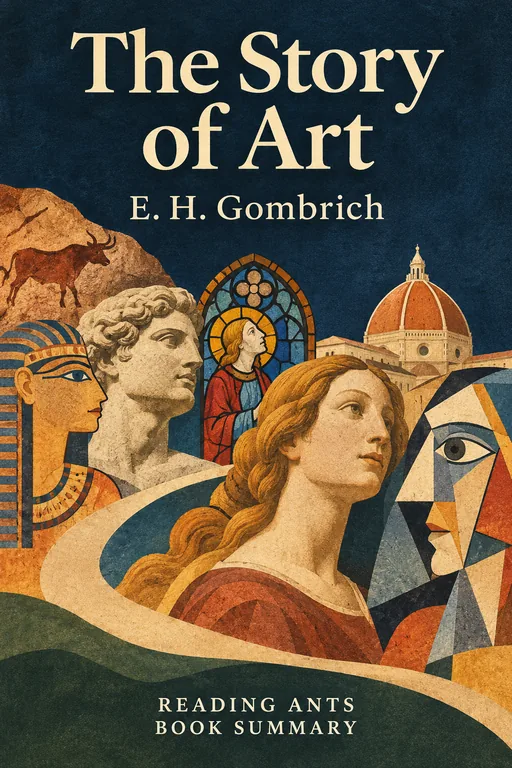
Gombrich traces major traditions of Western art by showing how artists inherited visual problems, revised conventions and learned to make images serve changing purposes.
Overview
The Story of Art is an introductory history of art from prehistoric images and ancient civilizations through the twentieth century. E. H. Gombrich avoids presenting art as a parade of isolated geniuses or a steady march toward realism. Instead, he asks what artists and patrons were trying to accomplish with the materials, conventions and beliefs available to them. Egyptian stability, Greek naturalism, medieval symbolism, Renaissance perspective and modern experimentation become different solutions rather than simple ranks of progress. The book is admired for clarity and close attention to individual works. Its title overstates its scope, however: despite later revisions, it concentrates heavily on European traditions and gives limited attention to women and many cultures outside the West.
Full Summary
1. Images Before “Art”
The idea: Gombrich argues that objects called art served particular purposes before modern museums existed. Prehistoric paintings may have been ritual tools, while Egyptian artists used stable conventions to show each body part from its clearest angle. Their aim was not a snapshot but durable completeness and order.
In real life: When viewing an ancient object, ask where it stood and what people did around it. A ceremonial mask displayed behind glass once moved with a wearer, music and an audience; its museum appearance is only one chapter of its life.
2. Greece and Rome
The idea: Greek artists tested inherited formulas against observation, exploring anatomy, movement and foreshortening while still choosing ideal harmony. Roman patrons adapted these skills for portraits, monuments and public narratives that projected identity and power. Early Christians reused classical techniques for new spiritual purposes.
In real life: A public statue is never only a demonstration of accurate anatomy. Its location, scale, inscription and sponsor help determine whether viewers experience it as memorial, propaganda, civic pride or a target of protest.
3. Medieval Traditions
The idea: Medieval European artists often prioritized symbolic clarity over classical illusion. Architecture, manuscripts and stained glass organized worship and taught stories. Gothic makers added observation and emotion, while Islamic traditions developed influential architecture, calligraphy and ornament that the book covers too briefly.
In real life: A figure made larger than surrounding people may indicate importance rather than failed perspective. Reading visual hierarchy on its own terms prevents a modern expectation of photographic realism from becoming the only standard. Labels and architectural context can confirm that interpretation.
4. Renaissance Discovery
The idea: Italian artists developed mathematical perspective, anatomical study and new treatments of light while recovering classical models. Northern painters pursued oil effects and detailed surfaces. Printing widened image circulation, and successful artists increasingly claimed intellectual status rather than being regarded only as craftspeople.
In real life: Perspective guides viewers toward a chosen position. Photographers, filmmakers and game designers still place horizons and vanishing points to control scale, attention and the feeling of entering a space. Changing that position can make the same scene feel stable or disorienting.
5. Competing Styles
The idea: Religious conflict, courts and art markets created varied audiences from the Reformation through Romanticism. Baroque drama, Dutch domestic scenes, Rococo elegance and Neoclassical restraint answered different demands. Once admired solutions hardened into academic rules, later artists reacted against them.
In real life: Compare works made for a palace, a church and a middle-class home. Differences in size, subject and emotional intensity often make more sense when the patron and original display setting are known. Function helps explain style without reducing artistic choice to economics.
6. Modern Experiments
The idea: Photography changed painting’s old recording role. Impressionists studied transient light; later artists emphasized structure, emotion, dreams or abstraction. Gombrich frames modern styles as experiments with inherited visual problems, not as automatic progress or meaningless rejection.
In real life: Before dismissing an abstract work, inventory its color, rhythm, material and scale, then ask what direct experience those choices create. Compare that experience with a representational work nearby. The exercise may improve understanding even when it does not produce admiration.
Why It Matters
The book has introduced generations of readers to visual analysis because it makes historical change intelligible without requiring specialist vocabulary. Gombrich models a generous question: before calling a work primitive, unrealistic or strange, ask what problem it addresses and what expectations shaped it. That approach can turn museums from rooms of unexplained masterpieces into conversations across time.
Its influence also makes its boundaries important. For many readers, this partial European narrative became “the” story of art. Modern art history has expanded attention to women artists, colonial exchange, Indigenous traditions, material culture and institutions that decide what enters museums. Reading Gombrich critically therefore teaches two lessons at once: how powerful narrative can clarify history, and how selection creates a canon.
Key Takeaways
- Artists inherit problems and conventions. Innovation usually revises a visual language rather than appearing from nowhere.
- Realism is not the only goal. Symbolic clarity, ritual use, emotional force and decoration can matter more than optical accuracy.
- Purpose shapes form. Patronage, religion, politics, technology and display settings affect what art looks like.
- Style is not simple progress. Later work is not automatically better; it answers different needs.
- Every survey is selective. A clear story can still exclude creators, regions and forms that deserve central attention.
What We Can Learn
When viewing unfamiliar art, begin with observation before evaluation. Identify material, scale, repeated shapes, focal points and the setting for which the object was made. Then ask what visual conventions its first audience would have recognized. This process does not require liking every work; it makes judgment better informed.
The book also offers a practical model for creativity. Study previous solutions closely, notice where they no longer serve a purpose and change them with intent. At the same time, readers should build beyond Gombrich’s map. Museum labels, scholarship by specialists from represented cultures and surveys centered on women or global exchange can reveal how much a single narrative leaves outside its frame.
Criticism and Counterpoints
The most serious limitation is scope. The narrative privileges European painting, sculpture and architecture, with little sustained attention to Africa, the Americas, Oceania, much of Asia or global exchange. Women artists are strikingly scarce, and elite objects dominate over vernacular, decorative and functional arts.
Gombrich’s problem-solving model can understate conquest, extraction, labor and institutional power. Its confidence and accessibility may make choices seem neutral when they reflect a mid-twentieth-century canon. Later editions improve some coverage but do not transform the book into a global history.
Who Should Read It
This is an accessible starting point for teens and adults new to art history. Readers who enjoy museums or want to understand changes in European style will benefit most. It should be paired with global and feminist art histories rather than treated as a complete survey.
Want the whole book?
A summary is a taste, not the meal. Here is where to find the full book.
You reached the end 🎉
Nicely done. Mark this one as read, and we will suggest what to read next.
Read this next
Ways of Seeing
John Berger
A short, famous book that shows how what we see in art is shaped by what we know and believe, and by who owns, copies and sells images.
🎨 Arts & Creativity
The Creative Act: A Way of Being
Rick Rubin
Rubin presents creativity as a receptive way of living in which attention, experimentation and disciplined refinement help artists bring possible work into form.
🎨 Arts & Creativity
The Story of Philosophy
Will Durant
Will Durant introduces the major Western philosophers through lively biographies, showing how each thinker's life and times shaped ideas that are still worth asking about.
🕊️ Philosophy & Religion
On Writing: A Memoir of the Craft
Stephen King
Stephen King combines a candid account of becoming a writer with practical advice about reading, drafting, revision and sustaining creative work through difficulty.
🎨 Arts & Creativity
Bird by Bird: Some Instructions on Writing and Life
Anne Lamott
A warm, funny guide to writing, which says that you should start with small steps, allow yourself to write badly, and pay attention to life.
🎨 Arts & Creativity
The Elements of Style
William Strunk Jr. and E. B. White
A compact writing manual advocates standard usage, economical sentences, concrete language and deliberate revision while sometimes presenting contested stylistic preferences as universal rules.
🎨 Arts & CreativityWant something different?
Pick another topic and we will show you three books to start with.