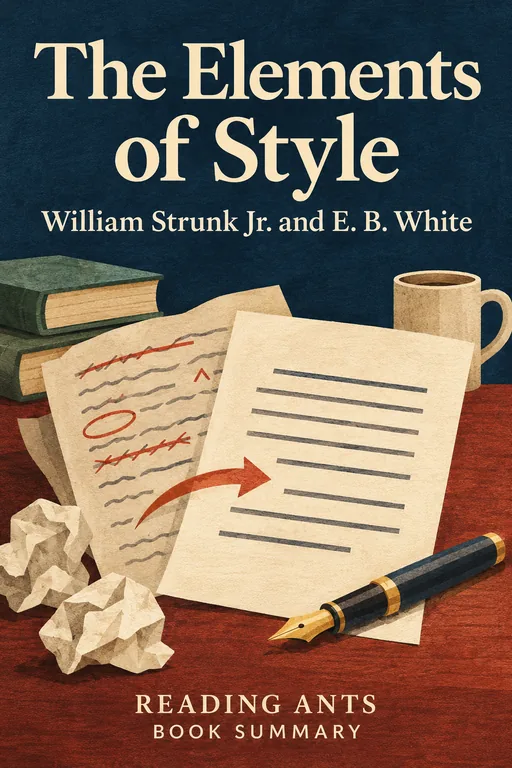
A compact writing manual advocates standard usage, economical sentences, concrete language and deliberate revision while sometimes presenting contested stylistic preferences as universal rules.
Overview
The Elements of Style began as William Strunk Jr.’s privately printed 1918 classroom guide and became famous through E. B. White’s expanded 1959 edition and later revisions. Its brief rules cover punctuation, grammar, composition and style, urging writers to remove needless words, favor active constructions and make paragraph structure visible. The guide’s confidence and memorable examples have influenced generations of students. Yet English usage changes, genres have different needs, and several prescriptions are disputed by linguists and professional editors. The book works best as a revision checklist and historical statement of one clear-prose tradition, not as an infallible account of grammar. Readers should consult the edition in hand because Strunk’s original and Strunk-and-White versions are not identical.
Full Summary
1. Rules of Usage
The idea: The guide reviews punctuation and grammatical conventions such as possessives, commas in a series, parenthetical expressions, independent clauses and agreement. Consistency helps readers recognize structure without stopping to reconstruct a sentence.
In real life: During proofreading, check one category at a time: first sentence boundaries, then commas, then agreement. A focused pass catches patterns more reliably than trying to notice every possible error simultaneously. Record recurring errors so the next complete draft can receive a targeted consistency check.
2. Principles of Composition
The idea: Strunk and White recommend choosing a suitable design, making the paragraph the unit of composition and beginning paragraphs with signals of their purpose. Related words should remain close enough that readers can see their connection.
In real life: Write a five-word margin label beside each paragraph. If several labels repeat or the sequence is illogical, reorder or combine paragraphs before polishing individual sentences. This simple reverse outline quickly exposes structural problems that elegant wording can temporarily hide.
3. Omit Needless Words
The idea: The book’s best-known principle asks every word to contribute. It targets empty introductions, repeated meaning and phrases that replace direct verbs. Concision does not require tiny sentences; it means removing material that performs no useful function.
In real life: Compare “there are many people who believe” with “many people believe.” Search a draft for recurring frames such as “the fact that” and revise them when the shorter form preserves meaning and tone. Keep deliberate repetition when it creates emphasis, rhythm or cohesion.
4. Active and Concrete Language
The idea: Active voice often identifies actors and gives prose energy, while specific nouns and observable details are usually clearer than vague abstraction. The guide does not make passive voice ungrammatical; its strongest advice is to choose structures consciously.
In real life: In “the deadline was missed,” passive voice conceals responsibility, while “the vendor missed the deadline” identifies it. But “the samples were contaminated” may be appropriate when the cause is unknown or the samples deserve emphasis. Revise according to informational focus, not a mechanical ban.
5. Commonly Misused Expressions
The idea: The guide lists words and phrases it considers confused, inflated or unsuitable. Some entries identify genuine distinctions; others enforce preferences that current dictionaries and editors no longer treat as rules. Usage evidence should therefore supplement the book’s authority.
In real life: When a disputed expression appears, check a current dictionary, usage examples and the relevant publication’s style guide. Revise for the actual audience instead of assuming that age makes one handbook’s preference timeless. Distinguish house style from grammatical necessity.
6. An Approach to Style
The idea: White’s later section encourages naturalness, confidence, clarity and respect for the reader. Writers should avoid imitation, overstatement, fashionable jargon and excessive explanation while developing a voice through sustained practice rather than decorative tricks.
In real life: Identify the draft’s audience and purpose in one sentence. Then remove performances of expertise that obstruct that purpose, but retain technical terms readers need and define them at first use. Natural style still changes appropriately between a personal essay and a safety procedure.
Why It Matters
Few writing guides have placed so many memorable principles in so little space. Its insistence on structure and revision gives beginners concrete actions when “write clearly” would otherwise be vague. The book also influenced classroom and editorial culture far beyond its original Cornell course.
That influence makes critical reading essential. A forceful maxim can improve one sentence and damage another when applied without context. The guide’s real value lies in making writers examine choices. Modern readers can preserve its economy while replacing rigid obedience with evidence from genre, audience, contemporary usage and accessibility.
Key Takeaways
- Structure helps readers navigate. Paragraph purpose and logical order should be visible.
- Concision removes waste, not personality. Necessary qualification, rhythm and context still belong.
- Active voice is a choice, not a law. Use it when the actor matters; use passive forms for a reason.
- Concrete detail improves understanding. Specific language often makes claims easier to test and remember.
- Usage guides require updating. Dictionaries, corpora and current house style can overturn inherited preferences.
What We Can Learn
Use the book in revision rather than allowing its rules to interrupt every drafting decision. Begin with organization, then sentence clarity, then punctuation and usage. For each change, ask what confusion it prevents. If no answer exists, the revision may be preference rather than improvement.
Build a small stack of references: a current dictionary, a style guide appropriate to the field and examples from respected contemporary writing. When authorities disagree, choose consistently for the audience. Clear prose is not always short or plain; legal precision, scientific caution and literary rhythm may require forms the guide discourages.
Criticism and Counterpoints
Linguists and editors have challenged factual explanations and rigid prescriptions in the book. Some condemned constructions are standard English, and passive voice is sometimes misidentified or unfairly blamed. The ideal of one “clean” style can marginalize dialect, rhetorical tradition and purposeful complexity.
The book also predates digital communication and modern accessibility practice. Its rules cannot settle inclusive language, web scanning, localization or specialized documentation. Treating every sentence as a candidate for compression can remove nuance and cadence.
Who Should Read It
This compact guide suits students and writers who want a memorable revision checklist. Use a modern edition and compare disputed advice with current references. Readers studying grammar scientifically or writing in specialized genres will need broader resources.
Want the whole book?
A summary is a taste, not the meal. Here is where to find the full book.
You reached the end 🎉
Nicely done. Mark this one as read, and we will suggest what to read next.
Read this next
On Writing: A Memoir of the Craft
Stephen King
Stephen King combines a candid account of becoming a writer with practical advice about reading, drafting, revision and sustaining creative work through difficulty.
🎨 Arts & Creativity
Bird by Bird: Some Instructions on Writing and Life
Anne Lamott
A warm, funny guide to writing, which says that you should start with small steps, allow yourself to write badly, and pay attention to life.
🎨 Arts & Creativity
The Story of Art
E. H. Gombrich
Gombrich traces major traditions of Western art by showing how artists inherited visual problems, revised conventions and learned to make images serve changing purposes.
🎨 Arts & Creativity
Ways of Seeing
John Berger
A short, famous book that shows how what we see in art is shaped by what we know and believe, and by who owns, copies and sells images.
🎨 Arts & Creativity
The Creative Act: A Way of Being
Rick Rubin
Rubin presents creativity as a receptive way of living in which attention, experimentation and disciplined refinement help artists bring possible work into form.
🎨 Arts & Creativity
Letters to a Young Poet
Rainer Maria Rilke
In a series of letters to a young aspiring poet, the great Austrian poet Rilke, who wrote in German, gives advice on solitude, patience, love and the inner life of the artist.
🎨 Arts & CreativityWant something different?
Pick another topic and we will show you three books to start with.