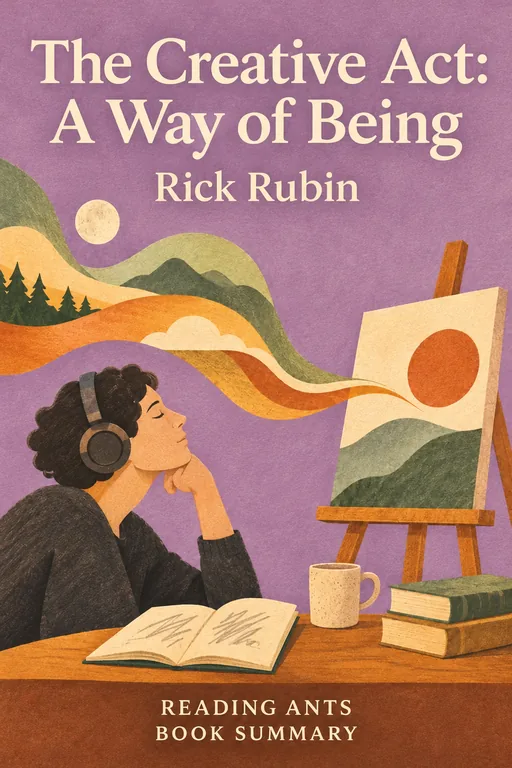
Rubin presents creativity as a receptive way of living in which attention, experimentation and disciplined refinement help artists bring possible work into form.
Overview
The Creative Act collects short reflections from music producer Rick Rubin about making art. Rather than teaching recording technique or recounting famous sessions, Rubin describes the artist as someone who notices signals in the surrounding world, gathers material, experiments without premature judgment and later edits with rigor. The work moves between practical advice and spiritual-sounding claims about consciousness, nature and creative energy. It argues that art’s deepest purpose is not commercial success or audience approval but faithful expression of what the maker perceives. Because the chapters are aphoristic and metaphorical, the book is best approached as a source of prompts rather than a tested universal system. Its advice assumes a degree of time and autonomy that not every creator possesses.
Full Summary
1. The Artist as Receiver
The idea: Rubin describes ideas as possibilities artists learn to notice. Sensitivity to sound, image, emotion and environment matters more than forcing inspiration. The receiver metaphor reduces ego: the maker serves a work by recognizing and developing it, though this is philosophy rather than a literal scientific claim.
In real life: Carry a notebook and record five details each day without deciding whether they are useful. A rhythm overheard on a train or an unusual color combination may become material only weeks later.
2. Preparing the Environment
The idea: Habits and surroundings can make attention easier. Rubin recommends reducing distracting input, noticing personal energy and using rituals that signal readiness. Reading, listening and observing fill a storehouse whose materials may later combine; influence becomes original through selection and transformation.
In real life: Test one modest cue (a cleared desk, headphones or a scheduled offline hour) for a week. Record whether it helps you start and stay engaged. Keep it only if it reliably reduces the effort needed to begin.
3. Seeds and Experiments
The idea: Early ideas are seeds rather than contracts. Collecting fragments and making multiple versions allows discovery before evaluation narrows the field. Constraints can reduce overwhelm, but premature criticism may kill possibilities before their character becomes visible.
In real life: Make three deliberately different sketches, openings or demos in thirty minutes. Change one major assumption in each version. Comparing distinct alternatives often reveals the project’s strongest direction more clearly than polishing the first familiar attempt. Save rejected versions as material, not failures.
4. Craft and Refinement
The idea: Once material exists, the artist changes modes. Editing asks what belongs and what distracts from the central effect. Technical skill expands choices, but virtuosity becomes counterproductive when it draws attention away from the work’s purpose. Favorite details may need removal.
In real life: Duplicate a draft, cut twenty percent from one version and compare the effect with a trusted reader. Ask what became clearer and what essential quality disappeared. The exercise turns attachment into an experiment because no material is permanently lost.
5. Finishing and Releasing
The idea: Perfectionism can disguise fear. A work must move from possibility into a limited finished form. After release, popularity cannot determine worth with certainty, and the artist cannot control every interpretation. The responsibility is to make and offer the most honest available version.
In real life: Define completion before the final stretch: a date, number of revisions and quality checklist. Separate required corrections from optional experiments. A stopping rule makes delay visible and leaves space for the next work.
6. A Continuing Practice
The idea: Completing one work returns the artist to openness. Success and failure become obstacles when every later project must repeat or disprove them. Rubin calls creativity a way of being because attention, selection and shaping extend beyond recognized artistic careers.
In real life: After release, note what helped, what failed and what remains interesting. Wait until immediate praise or disappointment settles, then review the notes. Carry lessons forward without requiring the next project to resemble the last result or repeat its reception.
Why It Matters
The book’s appeal lies in making creative work feel both mysterious and manageable. Rubin respects intuition without saying that creators should wait passively for inspiration. Receptivity is trained through attention, while refinement requires choices, skill and repetition. This balance can help people whose process has become dominated by productivity metrics or fear of judgment.
Its form also mirrors its argument. Short chapters can be opened as prompts rather than followed as a linear course. Rubin’s reputation gives the advice authority, but the book deliberately withholds celebrity anecdotes and technical proof. Readers are asked to test whether the ideas improve their own practice rather than accept them because famous recordings succeeded.
Key Takeaways
- Attention is creative work. Ideas become available when artists notice more carefully.
- Generation and editing need different mindsets. Early judgment can block discovery; later judgment gives form.
- Influence does not cancel originality. Personal selection and transformation make shared material distinct.
- Completion requires accepting limits. A finished version cannot preserve every possibility.
- Results do not define identity. Success and failure are feedback, not permanent judgments about whether someone is an artist.
What We Can Learn
Separate a project into gathering, experimenting, refining and finishing. During gathering, record fragments without requiring immediate usefulness. During experiments, set a small constraint and produce alternatives. During editing, return to the intended effect and remove elements that compete with it. Define a stopping condition so perfectionism cannot extend indefinitely.
Protecting attention may require practical boundaries: scheduled offline time, a prepared workspace or fewer simultaneous projects. But do not turn Rubin’s preferred calm into another rule. Some people create amid noise, collaboration, care work or deadlines. The useful question is not whether a ritual looks artistic, but whether it helps this person do the work available under real conditions.
Criticism and Counterpoints
The spiritual language can feel profound while remaining difficult to test. Claims about universal creative energy or ideas waiting to be received are metaphors, not established facts. The lack of detailed case studies makes it hard to know how Rubin handles conflict, technical limits or failed collaborations.
Advice to ignore commerce and external judgment is easier for creators with financial security, reputation and control over their schedules. Structural barriers, discrimination, disability and care responsibilities receive little attention. Readers may need more concrete craft instruction and community support than the book provides.
Who Should Read It
This suits artists, writers, musicians and other makers seeking reflective prompts rather than a technical manual. Its short chapters work well in small doses. Readers wanting research, detailed exercises or a production memoir may find it too abstract.
Want the whole book?
A summary is a taste, not the meal. Here is where to find the full book.
You reached the end 🎉
Nicely done. Mark this one as read, and we will suggest what to read next.
Read this next
The Artist's Way
Julia Cameron
Julia Cameron offers a twelve-week program, built on morning writing pages and a weekly artist date, to help people to unblock their creativity by recovering confidence, gaining a sense of safety and freeing themselves from fear and criticism.
🌱 Self-ImprovementThe War of Art
Steven Pressfield
Novelist Steven Pressfield names the invisible force that stops us from doing creative and important work, which he calls Resistance, and shows how professionals defeat it by showing up every day and doing the work.
🌱 Self-ImprovementSteal Like an Artist
Austin Kleon
Writer and artist Austin Kleon offers ten short, illustrated lessons in creativity, arguing that no idea is wholly original, that artists learn by copying what they love, and that making things, sharing them and working steadily are the way to find your own voice.
🌱 Self-Improvement
The Story of Art
E. H. Gombrich
Gombrich traces major traditions of Western art by showing how artists inherited visual problems, revised conventions and learned to make images serve changing purposes.
🎨 Arts & Creativity
Ways of Seeing
John Berger
A short, famous book that shows how what we see in art is shaped by what we know and believe, and by who owns, copies and sells images.
🎨 Arts & Creativity
On Writing: A Memoir of the Craft
Stephen King
Stephen King combines a candid account of becoming a writer with practical advice about reading, drafting, revision and sustaining creative work through difficulty.
🎨 Arts & CreativityWant something different?
Pick another topic and we will show you three books to start with.