 Reading Ants
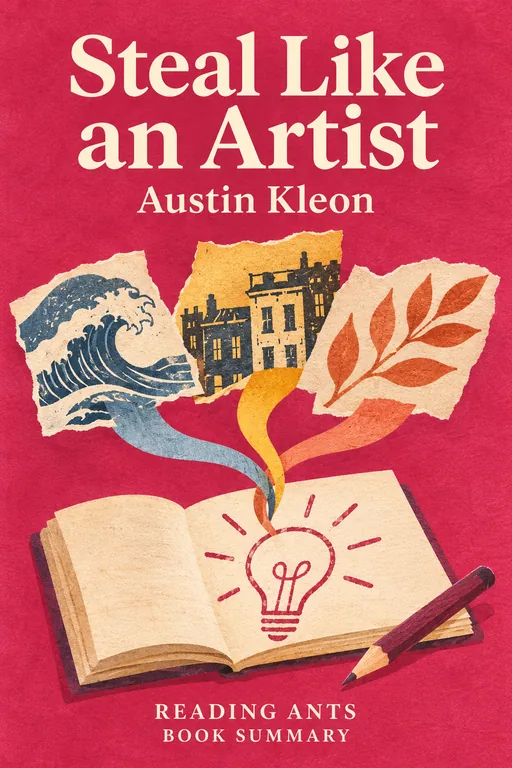
Writer and artist Austin Kleon offers ten short, illustrated lessons in creativity, arguing that no idea is wholly original, that artists learn by copying what they love, and that making things, sharing them and working steadily are the way to find your own voice.
Overview
Steal Like an Artist: 10 Things Nobody Told You About Being Creative was published in 2012 by Austin Kleon, a writer and artist who makes “newspaper blackout poetry,” poems made by blacking out words in newspaper articles. The book grew out of a talk that he gave at a community college, and an earlier blog post, and is very short, with simple drawings. Kleon says it is the advice he would give to his younger self, and that it is meant for everyone who wants to bring more creativity into life and work, whatever they make. Each chapter is a lesson, with a short explanation, examples and quotes from other creators. It became a bestseller, and led to follow-up books.
Full Summary
1. Steal like an artist
The idea: Kleon opens with the question every artist gets asked, where do your ideas come from, and says the honest answer is that artists steal them. Nothing comes from nowhere: all creative work builds on what came before, and every new idea is a mashup or remix of earlier ones. He finds this hopeful, because once we stop trying to be completely original we can embrace influence. You are a remix of your ancestors, he says, and you also have a genealogy of ideas, made from the teachers, friends, music and books you choose. The artist is a collector, not a hoarder, gathering only what he or she truly loves. He suggests studying one thinker you love, then the people that thinker loved, until you have a family tree and can start your own branch. He also urges curiosity, a notebook, and a swipe file of things worth stealing.
In real life: A young musician who learns the songs of several bands will develop a style that is a mix of them.
2. Don’t wait until you know who you are to get started
The idea: Kleon says that if he had waited to know who he was before making things, he would still be figuring himself out. It is in the act of making things that we find out who we are. He names impostor syndrome, the feeling of being a phony, and answers it with the advice to fake it until you make it. He recalls how Patti Smith and Robert Mapplethorpe, in her memoir Just Kids, dressed as artists in a New York park and were taken for artists by a passing couple. Nobody is born with a style, he says, so we learn by copying our heroes, which is practice and not plagiarism, the passing off of someone else’s work as your own. Copy many heroes, and copy the thinking behind their style rather than the surface. The aim is to move from imitation to emulation. Our failure to copy perfectly is where our own voice lives: he cites Kobe Bryant adapting stolen moves to his own body, and a chain of comedians who each tried to be the last and became themselves.
In real life: A young writer who copies a favorite author’s style may develop a voice of their own through the differences.
3. Write the book you want to read
The idea: Kleon recalls that Jurassic Park came out on his tenth birthday and that he typed up his own sequel the next day, which he later realized was fan fiction. He says the usual advice to write what you know leads to dull stories. A better rule is to write what you like, the story you yourself want to read, since we make art out of our love for art. He tells how the musician Bradford Cox, as a boy, recorded his own imagined version of a favorite band’s coming album. His manifesto is to make the art you want to see, start the business you want to run, and do the work you want to see done.
In real life: A student who cannot find a club about a topic might start one.
4. Use your hands
The idea: Kleon argues that computers have robbed us of the feeling that we are making something, since we only type and click. Bodies can tell our brains as much as brains tell bodies, so going through the motions of strumming a guitar or kneading clay can kickstart thinking. His own work improved when he brought analog tools back, making his first book, Newspaper Blackout, from newspaper articles and a marker. The computer, he says, is good for editing and publishing but poor for generating ideas, because it brings out the perfectionist. He keeps two desks, an analog one with nothing electronic and a digital one, and moves between them.
In real life: Sketching an idea on paper can lead to a different result than typing it.
5. Side projects and hobbies are important
The idea: Kleon says the side projects, the things that seemed like mere play, are the ones that take off for him. He recommends keeping several projects going and bouncing between them, calling it productive procrastination, and taking time to be bored. If you have two or three real passions, do not drop any, and let them talk to each other. He describes giving up music to focus on writing, feeling something like phantom limb pain, and finding that playing in a band again improved his writing. A hobby, he says, is something creative that is just for you, with no aim of money or fame: it gives but does not take. He also says not to worry about unity in your work, since what unifies it is that you made it.
In real life: A person who likes drawing and coding may combine the two into an unusual project.
6. The secret: do good work and share it with people
The idea: Kleon gets emails from young people asking how to get discovered. He says most of the world is simply too busy to care about your ideas, which is good, because being unknown gives freedom to experiment, so enjoy your obscurity. His only formula has two steps: do good work, which is hard and means making things every day, and share it, which is now simple because you can put your work on the Internet. He advises wondering at something and inviting others to wonder with you. Bob Ross and Martha Stewart give their secrets away, he notes, and people may reward you for it. You can share a sketch or a glimpse of your process, and if you fear giving secrets away, you can share your dots without connecting them.
In real life: Posting a drawing online each day can lead to meeting others who like the same things.
7 and 8. Geography is no longer our master, and be nice
The idea: Kleon grew up in a cornfield in southern Ohio and now lives in Austin, yet says about 90 percent of his mentors and peers live elsewhere and are people he knows online. So where you live no longer decides whether you can join a creative community. Place still matters, though: at some point you should leave home, because travel makes the world look new, and when the world looks new, our brains work harder. He also thinks bad weather leads to better art, because you stay inside and work. The next chapter is about being nice, since the world is a small town. If you talk about someone online they will find out, so ignore your enemies and say nice things about the people you admire. Follow the best people online, and channel anger into your work, he says, recalling that his wife once told him to stop picking fights on Twitter and make something. He recommends public fan letters, such as a blog post or a work dedicated to a hero, written without expecting a reply.
In real life: A young artist in a small town can learn from artists around the world online. Praising a classmate’s project can start a friendship.
9 and 10. Be boring, and creativity is subtraction
The idea: Kleon calls himself a boring guy with a nine-to-five job and says the romantic image of the wild creative genius is played out, because creativity takes energy. He quotes the French writer Gustave Flaubert, who advised being regular and orderly in your life so that you can be violent and original in your work. A day job, he says, gives money, a connection to the world and a routine, and puts you among people you can learn from. He advises doing the work every day, and describes Jerry Seinfeld’s calendar method of marking each finished day to build a chain you do not want to break. The last lesson is that creativity is subtraction: in an age of information overload, those who get ahead decide what to leave out. Nothing is more paralyzing than limitless possibilities, so place constraints on yourself. His favorite example is Dr. Seuss, who wrote The Cat in the Hat with 236 different words, then won a bet with his editor by writing Green Eggs and Ham with only 50. The book ends with a short to-do list, including starting a swipe file and a blog and taking a nap, and a reminder that there are no rules.
In real life: Writing for twenty minutes every day, around a school or job schedule, adds up. A poem with fewer words may be stronger than a long one.
Why It Matters
Steal Like an Artist became a New York Times bestseller. According to Kleon’s own website, it sold over a million copies and has been translated into more than thirty languages. Its message, that creativity is not about being original from nothing, but about building on others and making things, was liberating for many who felt blocked. The book’s small size and drawings made it approachable. It also had an influence on the culture of sharing work online, and led to a series, including Show Your Work! and Keep Going. Kleon’s blackout poetry also attracted attention.
Key Takeaways
- Nothing is wholly original. Build on what you love.
- Start before you are ready. Making things teaches you who you are.
- Make what you want to see. Your tastes are your strength.
- Share your work. Generosity builds community.
- Limits help creativity. Choose what to leave out.
What We Can Learn
You can start by making a list of the creators you admire, and trying to copy one piece in order to learn how it works. Keep a notebook of ideas and things that inspire you, and a swipe file of things worth learning from. Make something with your hands, and share it with a friend or online. Set aside a small time each day to create. Be kind to others in your field, and give credit. And when you feel stuck, try limiting yourself, with a short time or a few materials. Remember to credit the sources of your inspiration, and never pass off others’ work as your own.
Criticism and Counterpoints
Readers sometimes feel that the book’s advice, though cheerful, is general and short on depth, closer to a set of slogans than a method. The title, “steal,” may mislead a reader into thinking plagiarism is encouraged, though Kleon draws a clear line between learning from others and passing off their work as your own. His advice on day jobs, routines and sharing online also reflects his own situation, and may fit some creative lives better than others. Kleon himself says that your mileage may vary and that readers should take what they can use and leave the rest.
Who Should Read It
This book is for young people, students, artists, writers and anyone who wants to be more creative. It is short, funny and illustrated, and quick to read. Those who want a deeper treatment of the creative process might read other books on the subject.
Want the whole book?
A summary is a taste, not the meal. Here is where to find the full book.
You reached the end 🎉
Nicely done. Mark this one as read, and we will suggest what to read next.
Read this next
The War of Art
Steven Pressfield
Novelist Steven Pressfield names the invisible force that stops us from doing creative and important work, which he calls Resistance, and shows how professionals defeat it by showing up every day and doing the work.
🌱 Self-Improvement
The Artist's Way
Julia Cameron
Julia Cameron offers a twelve-week program, built on morning writing pages and a weekly artist date, to help people to unblock their creativity by recovering confidence, gaining a sense of safety and freeing themselves from fear and criticism.
🌱 Self-Improvement
Bird by Bird: Some Instructions on Writing and Life
Anne Lamott
A warm, funny guide to writing, which says that you should start with small steps, allow yourself to write badly, and pay attention to life.
🎨 Arts & Creativity
Atomic Habits
James Clear
Big changes in life come not from huge leaps but from tiny habits repeated every day, and you can build good habits (and break bad ones) by designing your life so the right choices are obvious, attractive, easy and satisfying.
🌱 Self-Improvement
The 7 Habits of Highly Effective People
Stephen R. Covey
Lasting success in life and work comes not from quick tricks or a charming personality but from good character, built through seven habits that move us from depending on others, to standing on our own, to working well with others.
🌱 Self-Improvement
How to Win Friends and Influence People
Dale Carnegie
People are driven by emotion and the desire to feel important, so the way to get along with them, and win them to your point of view, is to stop criticizing, show genuine interest and appreciation, and see things from their side.
🌱 Self-ImprovementWant something different?
Pick another topic and we will show you three books to start with.