 Reading Ants
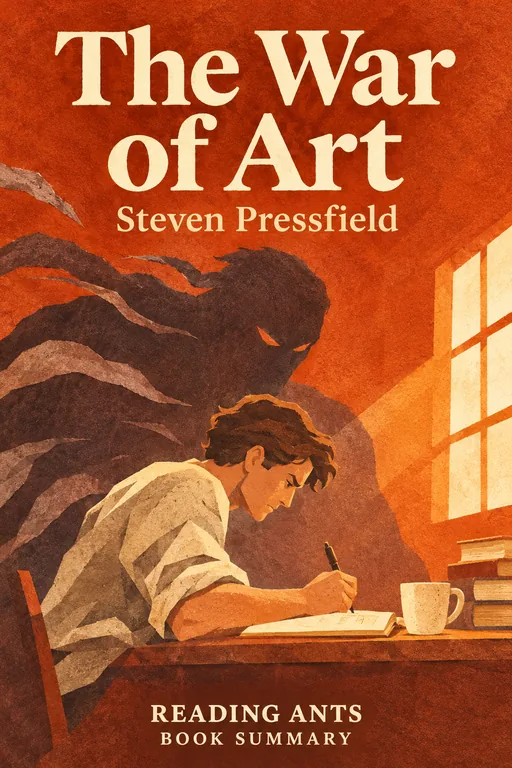
The War of Art
Novelist Steven Pressfield names the invisible force that stops us from doing creative and important work, which he calls Resistance, and shows how professionals defeat it by showing up every day and doing the work.
Overview
The War of Art: Break Through the Blocks and Win Your Inner Creative Battles was published in 2002 by Steven Pressfield, who spent years as a struggling writer, working odd jobs, before he published his novel The Legend of Bagger Vance and others. The book is short, with brief chapters, some only a paragraph. It is divided into three parts: Resistance: Defining the Enemy; Combating Resistance: Turning Pro; and Beyond Resistance: Higher Realms. Pressfield writes in a blunt, humorous, sometimes mystical tone. It is aimed at writers, artists, entrepreneurs and anyone who has a calling that they are putting off.
Full Summary
1. Resistance: the enemy within
The idea: Pressfield says that every creative person faces an invisible force that works against their efforts, which he calls Resistance, with a capital R. It shows up as procrastination, doubt, fear, distraction and excuses, and it is strongest when we are about to do something that matters, in the areas of art, a new business, a diet or a change of life. Resistance, he says, is universal, never sleeps and can never be eliminated, but it can be beaten each day.
In real life: The urge to clean the room instead of starting an essay is a small example.
2. How Resistance disguises itself
The idea: The author lists many forms of Resistance. It may appear as rationalization, with a convincing reason to wait, as procrastination, as the pull of unhealthy drama, as self-doubt, as fear or as criticism of others who are living more fully. He also lists habits such as seeking support from others in place of doing the work. He says that the more important a project is to the growth of your soul, the greater the Resistance will be. The strength of the fear is, paradoxically, a sign of the value of the task.
In real life: Feeling intense dread about a project may be a sign that it matters to you.
3. Turning pro
The idea: The remedy, according to Pressfield, is to become a professional, and not an amateur. A professional shows up every day, no matter what, works for the whole time, and does not wait for inspiration. He says that the pro stays on the job, treats the work as a job and does not take success or failure personally. The amateur, by contrast, is defeated by Resistance. He points out that most of us already behave like professionals at our day jobs, where we do not say that we will go to work only when we feel like it.
In real life: A musician who practices every day, even when tired, is acting as a professional.
4. The rules of the professional
The idea: The author describes the pro’s habits. A professional is patient, acts in the face of fear, masters the technique and is willing to ask for help from the best teachers. He does not take failure or success personally, and does not wait for others to validate him. He argues that we control our effort, not the rewards, and so should do the work and leave the rest. Hardship is accepted as a fact of the job.
In real life: A craftsperson who finishes a table does not wait to be praised.
5. The muse and the unseen world
The idea: In the third part, Pressfield shifts to a more spiritual tone. He proposes that, when we sit down and work, something beyond us helps, which the Greeks called the Muse, and that creative work is a form of attunement to a higher source. He says that sitting down and trying every day lets ideas and insights build up, and that the muse favors those who work like professionals, and not those who wait for inspiration. He describes the process as feeling like receiving help.
In real life: Many writers say that ideas begin to flow after they have been at their desk for a while.
6. Beyond Resistance: territory, hierarchy and the goal
The idea: The last section discusses how the creative life differs from a life lived by social rank. Pressfield contrasts a territory, a place where we do our work for its own sake, with a hierarchy, in which we measure ourselves against others. He urges the reader to work for the love of it, and not for status. He closes by saying that we all have a unique gift, and that to bury it is a loss to the world, and so we owe it to others, as well as to ourselves, to do the work.
In real life: A person who paints for the joy of it is less troubled by comparison.
Why It Matters
The War of Art has become a classic among writers, artists, entrepreneurs and athletes, and has sold widely, largely through word of mouth built up over many years. Its sales rose sharply in 2013, after Pressfield was interviewed on Oprah Winfrey’s Super Soul Sunday, and the book then reached the New York Times advice bestseller list. It gave a name, Resistance, to a common experience, and provided a simple and memorable philosophy: show up, do the work, and do not wait for inspiration. The book has been recommended by coaches, teachers and well-known creators, and is often passed from one person to another. Its tough but encouraging tone has helped many people to finish projects, and it led to follow-up books, such as Turning Pro and Do the Work.
Key Takeaways
- Resistance is real and universal. Every creator faces it.
- Fear signals importance. The more it matters, the more you resist.
- Turn pro. Show up every day and do the work.
- Do not wait for inspiration. It comes after you start.
- Work for the work. Do not measure your worth by comparison.
What We Can Learn
You can use the book to recognize the excuses that you make when you put off an important task, and to name them as Resistance. Set a regular time for your work, even if short, and keep to it. Start before you feel ready, and treat the task as a job. Do not wait to be perfect. Notice when you are comparing yourself with others, and return to your own work. Be patient with yourself on bad days. Remember that the method applies to many areas, such as studying, exercise and a business. And ask for help when you need it.
Criticism and Counterpoints
Some critics say that the book’s picture of Resistance as an almost supernatural enemy is dramatic, and that it does not distinguish between laziness, fear and real obstacles such as time, money or mental illness. Others note that the advice to work through, regardless of feelings, can be hard for people with depression or anxiety, and that the book’s tone is macho and a bit mystical. Some find the repetition and bold claims off-putting. Others say that its advice, to just do it, is simple, and that others have said it before. Many readers, however, find it motivating.
Who Should Read It
This book is for anyone who has a project that they keep putting off, including writers, artists and students. It is short and punchy. Those who prefer a gentler or more research-based approach to procrastination may find it too blunt.
Want the whole book?
A summary is a taste, not the meal. Here is where to find the full book.
You reached the end 🎉
Nicely done. Mark this one as read, and we will suggest what to read next.
Read this next
Steal Like an Artist
Austin Kleon
Writer and artist Austin Kleon offers ten short, illustrated lessons in creativity, arguing that no idea is wholly original, that artists learn by copying what they love, and that making things, sharing them and working steadily are the way to find your own voice.
🌱 Self-Improvement
The Artist's Way
Julia Cameron
Julia Cameron offers a twelve-week program, built on morning writing pages and a weekly artist date, to help people to unblock their creativity by recovering confidence, gaining a sense of safety and freeing themselves from fear and criticism.
🌱 Self-Improvement
Bird by Bird: Some Instructions on Writing and Life
Anne Lamott
A warm, funny guide to writing, which says that you should start with small steps, allow yourself to write badly, and pay attention to life.
🎨 Arts & Creativity
Mastery
Robert Greene
Robert Greene studies the lives of great masters, from Leonardo da Vinci and Charles Darwin to modern figures, and draws from them a path to mastery that runs through finding your calling, a long apprenticeship, learning from mentors and developing creative energy.
🌱 Self-Improvement
Atomic Habits
James Clear
Big changes in life come not from huge leaps but from tiny habits repeated every day, and you can build good habits (and break bad ones) by designing your life so the right choices are obvious, attractive, easy and satisfying.
🌱 Self-Improvement
The 7 Habits of Highly Effective People
Stephen R. Covey
Lasting success in life and work comes not from quick tricks or a charming personality but from good character, built through seven habits that move us from depending on others, to standing on our own, to working well with others.
🌱 Self-ImprovementWant something different?
Pick another topic and we will show you three books to start with.