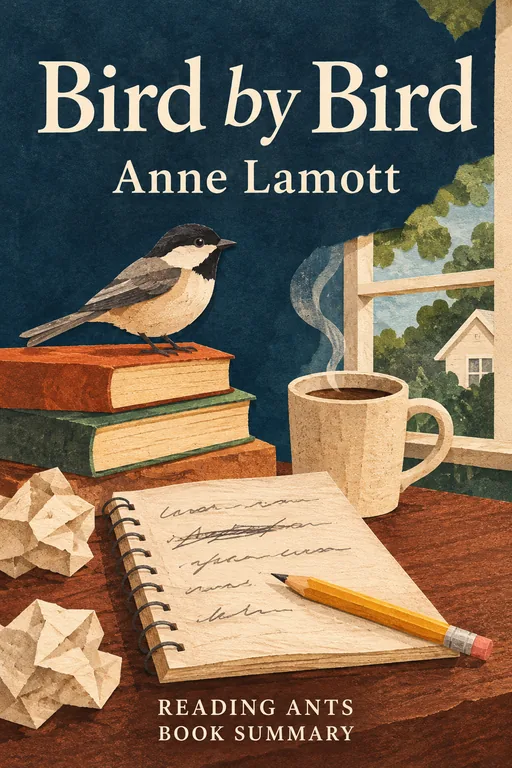
Bird by Bird: Some Instructions on Writing and Life
A warm, funny guide to writing, which says that you should start with small steps, allow yourself to write badly, and pay attention to life.
Overview
Bird by Bird is a book on writing by the American novelist and essayist Anne Lamott, published in 1994. It is part how-to guide and part memoir, and it draws on Lamott’s years of teaching and writing. The title comes from a story about her older brother, who, at the age of ten, was overwhelmed by a school report on birds, and was told by their father to take it “bird by bird.” The book offers practical advice, but it is also about fear, perfectionism and the courage to tell the truth. It has been loved by writers and by many people who do not write at all.
Full Summary
1. Take it bird by bird
The idea: A large task, such as writing a book, can feel impossible if you look at the whole of it. The way to do it is to break it into small pieces and to do only the next one. You do not need to see the whole path, only the next step.
From the book: Lamott tells the story of her older brother, who was ten and had a report on birds due the next day. He had had three months to write it, and he had not started. Their father, a writer, comforts him with the advice that gives the book its title.
In real life: If you have a big school project or a work task, make a list of the smallest steps. Do one today, such as writing a title or the first paragraph.
2. Give yourself permission to write badly
The idea: Lamott says that all good writers write rough first drafts. A first draft is not meant to be good. It is meant to be down on paper, so that you have something to work with. If you try to make it perfect on the first attempt, you will probably not write at all.
From the book: She expects to throw most of a first draft away. She describes how, when she wrote restaurant reviews, she would write a terrible first paragraph, show it to no one, stop for the day and fix it the next morning.
In real life: When you have to write an email or an essay, set a timer and write whatever comes into your head, without stopping to edit. You can fix it afterwards.
3. Short assignments
The idea: To keep from being overwhelmed, give yourself a small, clear task. Lamott keeps a small picture frame, one inch wide, on her desk, which reminds her that she only needs to write what she can see through it, such as a single paragraph.
From the book: She repeats a writer’s remark that writing a novel is like driving at night: you can see only as far as your headlights, but you can make the whole trip that way.
In real life: Instead of “clean the whole house,” try “clear one shelf.” Small goals are easier to start, and starting is the hardest part.
4. Listen, and pay attention
The idea: Writing begins with paying attention to people, places and feelings. Lamott says that good writing starts with looking closely at the world and at people, with respect and with wonder. Good writing is built from such details.
From the book: She says that writers need respect for others and an honest but kind view of themselves, which she calls compassionate detachment, and that this takes regular practice, like training a puppy. She also advises beginners to start with childhood memories, and she asks students to write about school lunches, which can bring up a surprising amount of material.
In real life: For a week, carry a small notebook and write down one thing you notice each day, such as an overheard remark or a smell. You will find it easier to describe the world.
5. Perfectionism and the voices in your head
The idea: The enemy of the writer, says Lamott, is the inner critic, the set of voices that says that your writing is no good and that you have nothing to say. She calls perfectionism the main obstacle between a writer and a rough first draft, and she suggests treating your own work as kindly as you would treat a friend’s.
From the book: She calls the noise in the writer’s head Radio Station KFKD. One speaker blares praise about how special you are, and the other dwells on your mistakes and failures, so that you cannot hear your intuition. She suggests noticing that it is on and quieting it with a ritual, such as a short prayer, and with attention to your breathing. In another chapter, she describes imagining the critical voices as mice in a jar, turning up the volume for a minute and then turning it down.
In real life: When you notice a harsh thought, such as “I’m bad at this,” you can say, “That’s just the voice,” and then do one more small step.
6. Write for your own sake, and share
The idea: Lamott says that writing is a way to understand life, and to give a gift to others. She encourages writers to be honest and to share their work with people who will be kind, even if it is not published. The value of writing is not only in the result.
From the book: She describes writing groups that give their members deadlines and support on bad days, and she says that one honest but gentle reader of your drafts is worth a great deal. She calls jealousy an occupational hazard for writers, and says that talking about it, and using it as material, can help.
In real life: Find a trusted friend or a small group to read your writing, or your drawings or projects, and give each other encouraging and honest feedback.
Why It Matters
Bird by Bird has become a well-loved book on the craft of writing, and many new writers have read it. It stands out because it is encouraging and funny, and because it talks about fear and self-doubt as part of the process. Many readers say that its advice on how to start, and how to be kind to oneself, helped them to finish a project. Its short, story-like chapters make it easy to dip into, and its advice reaches beyond writing to anyone who faces a big, scary task. Lamott’s honest voice makes it advice that is more about life than about rules.
Key Takeaways
- Small steps beat big plans. Do the next small thing.
- Bad drafts are normal. You can only fix what is on the page.
- Pay attention. Details make writing, and life, richer.
- The inner critic is not the boss. Learn to live with it.
- Writing is a gift. It helps you and others.
What We Can Learn
You do not need to be a writer to use this book. The advice about breaking down big tasks, forgiving yourself for imperfect first attempts, and noticing what is around you is useful for anyone who feels stuck. A student facing an essay, a worker with a long report, or a parent with a pile of chores can benefit from the idea of “bird by bird.”
The book also teaches that creativity comes from honesty, and from being willing to be a little messy. If you want to start a creative habit, begin with ten minutes a day. Over time, you will find that your confidence grows, and that you have more to say than you thought.
Criticism and Counterpoints
Some readers find the book too chatty, with stories that wander off the point, and others find that it lacks the structured advice that they want on plot, publishing or style. Lamott’s humor and her references to her own life, including her religious faith, may not appeal to everyone. A few writers say that her advice is more suited to personal, literary writing than to genre fiction or professional writing. The book also dates from the early 1990s, and has little on the digital world.
Who Should Read It
This book is for anyone who writes, or wants to write, as well as for anyone who feels blocked by perfectionism. It is easy to read, in short chapters. Those who want a technical guide to publishing or grammar should look elsewhere, but those who want encouragement will love it.
Want the whole book?
A summary is a taste, not the meal. Here is where to find the full book.
You reached the end 🎉
Nicely done. Mark this one as read, and we will suggest what to read next.
Read this next
On Writing: A Memoir of the Craft
Stephen King
Stephen King combines a candid account of becoming a writer with practical advice about reading, drafting, revision and sustaining creative work through difficulty.
🎨 Arts & Creativity
The Creative Act: A Way of Being
Rick Rubin
Rubin presents creativity as a receptive way of living in which attention, experimentation and disciplined refinement help artists bring possible work into form.
🎨 Arts & Creativity
Daring Greatly
Brene Brown
Researcher Brené Brown argues that vulnerability, the willingness to show up and be seen when outcomes are uncertain, is not weakness but the foundation of courage, connection and creativity.
🌱 Self-Improvement
The Elements of Style
William Strunk Jr. and E. B. White
A compact writing manual advocates standard usage, economical sentences, concrete language and deliberate revision while sometimes presenting contested stylistic preferences as universal rules.
🎨 Arts & Creativity
The Artist's Way
Julia Cameron
Julia Cameron offers a twelve-week program, built on morning writing pages and a weekly artist date, to help people to unblock their creativity by recovering confidence, gaining a sense of safety and freeing themselves from fear and criticism.
🌱 Self-Improvement
The Story of Art
E. H. Gombrich
Gombrich traces major traditions of Western art by showing how artists inherited visual problems, revised conventions and learned to make images serve changing purposes.
🎨 Arts & CreativityWant something different?
Pick another topic and we will show you three books to start with.