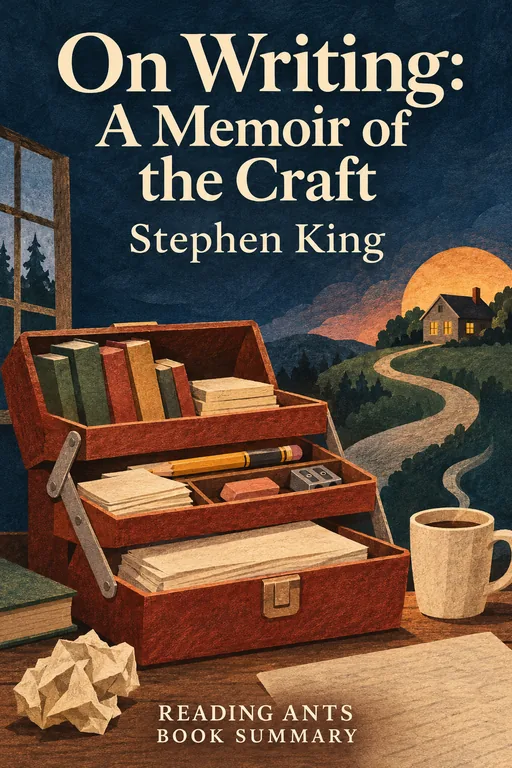
On Writing: A Memoir of the Craft
Stephen King combines a candid account of becoming a writer with practical advice about reading, drafting, revision and sustaining creative work through difficulty.
Overview
On Writing is part memoir, part craft guide and part account of recovery. Stephen King describes childhood experiences, early rejection, marriage, teaching, publication, addiction and sobriety before presenting his approach to fiction. He argues that writers improve through extensive reading, regular writing, command of basic language and honest revision. His practical image is a toolbox: vocabulary and grammar form the common tools, while more complex techniques belong on higher levels. The book closes with King’s return to writing after a van struck and nearly killed him in 1999. His advice is direct and memorable, but it grows from one unusually successful novelist’s process; prescriptions about daily output, plotting or closed-door drafting will not fit every writer, genre or disability.
Full Summary
1. Learning a Writer’s Life
The idea: King recounts childhood illness, early stories, school experiences and repeated rejection. The episodes do not present talent as instant recognition. Writing becomes an identity through reading, making work and sending it into the world often enough to learn from response.
In real life: Keep a submission or project log that records attempts, feedback and lessons, not only acceptances. Review it periodically for patterns you can influence. A growing body of completed work is evidence of practice even when public recognition arrives slowly.
2. Work, Family and Addiction
The idea: King describes low-paid jobs, family life and Tabitha King’s encouragement when he nearly discarded Carrie. Later success did not prevent alcohol and drug addiction. He rejects the myth that intoxication creates good art: survival, relationships and recovery matter more than a romantic image of the suffering writer.
In real life: Preserve abandoned drafts before deleting them and ask a trusted reader what remains alive. If substance use or mental illness threatens health, seek qualified help rather than treating danger as part of a creative identity.
3. Build the Toolbox
The idea: King’s toolbox begins with vocabulary and grammar. He recommends natural words, clear sentence structure, strong nouns and verbs, and restraint with adverbs. Rules provide shared tools, but they cannot replace attention to the effect of a particular sentence.
In real life: During revision, highlight adverbs and elaborate dialogue tags. Keep those that add information unavailable elsewhere, and test whether a stronger verb or clearer context can do the same work. Read both versions aloud before deciding which better fits the intended voice.
4. Read and Write Regularly
The idea: Writers improve by reading widely and writing regularly. Reading reveals possibilities, weaknesses and genre expectations; repeated contact with a draft preserves momentum. King’s daily word count is one method, not a universal measure of seriousness.
In real life: Choose a sustainable weekly target based on time, energy and health. Track sessions, minutes or revised pages if word count does not fit the project, then adjust using several weeks of evidence. Protect continuity without punishing unavoidable interruptions or recovery time.
5. Draft, Rest and Revise
The idea: King favors discovering stories through situations and characters rather than outlining every event. He recommends drafting with privacy, setting the manuscript aside and returning with distance. Revision removes confusion and unnecessary material while clarifying theme that emerged through the story.
In real life: After finishing a draft, schedule a break and note only urgent facts. On return, read the whole work before line editing, identify its central effect and make a revision plan based on patterns rather than the first irritating sentence.
6. Writing After the Accident
The idea: In 1999, a van struck King while he was walking, causing life-threatening injuries and painful rehabilitation. Returning to the desk was difficult, but writing again became part of recovering a life rather than a display of effortless discipline.
In real life: After illness or crisis, reduce goals and rebuild capacity gradually. A short supported session can be meaningful progress, and adaptive equipment or dictation may help. Medical needs and rest take priority over matching a previous routine.
Why It Matters
The book joins craft advice to evidence that writing happens inside an ordinary, vulnerable life. King demystifies bestseller status by emphasizing reading, revision, family support and years of work. His memoir also makes clear that publication does not solve addiction, health or every artistic problem.
Its most durable contribution is permission to take popular storytelling seriously. King values clarity, suspense and reader engagement without treating literary ambition as incompatible with genre fiction. The conversational voice makes technical advice memorable, while the memoir gives readers reasons to understand why these habits matter to him.
Key Takeaways
- Read broadly and practice regularly. Writers build judgment by encountering many effects and producing enough work to test their own.
- Language is a toolbox. Vocabulary and grammar expand choices; display for its own sake weakens communication.
- Drafting and revision are different tasks. Privacy can support discovery, while distance and readers improve later decisions.
- Creative myths can be dangerous. Addiction is not a source of talent and suffering does not validate art.
- A sustainable life supports the work. Health, relationships and adapted routines matter more than heroic productivity.
What We Can Learn
Build a repeatable writing cycle: read, draft on a sustainable schedule, rest the work, reread globally and revise from largest problem to smallest. Seek feedback after the draft can support it, and ask readers specific questions rather than handing them responsibility for the book’s identity.
Treat King’s numeric goals as examples. A parent, disabled writer, student or poet may need very different measures. Consistency can mean returning over months, not writing every day. Use grammar advice to improve intended effects, but learn genre and audience conventions before applying any slogan mechanically.
Criticism and Counterpoints
King’s confidence can turn personal preference into universal law. Discovery writing, aggressive adverb reduction and a closed first draft do not suit every writer. Research-heavy nonfiction, collaboration and complex plotting may require outlines and early feedback.
The memoir emphasizes individual practice more than publishing economics, discrimination, access or community. Its success story may understate luck and market conditions. Readers should combine it with craft books by writers from varied traditions and with guidance specific to their form.
Who Should Read It
This is ideal for aspiring fiction writers and Stephen King readers who enjoy craft mixed with memoir. Mature teens can read it, though addiction and severe injury are discussed. Writers wanting a universal formula should treat its rules as experiments rather than commands.
Want the whole book?
A summary is a taste, not the meal. Here is where to find the full book.
You reached the end 🎉
Nicely done. Mark this one as read, and we will suggest what to read next.
Read this next
Bird by Bird: Some Instructions on Writing and Life
Anne Lamott
A warm, funny guide to writing, which says that you should start with small steps, allow yourself to write badly, and pay attention to life.
🎨 Arts & Creativity
The Elements of Style
William Strunk Jr. and E. B. White
A compact writing manual advocates standard usage, economical sentences, concrete language and deliberate revision while sometimes presenting contested stylistic preferences as universal rules.
🎨 Arts & CreativityThe War of Art
Steven Pressfield
Novelist Steven Pressfield names the invisible force that stops us from doing creative and important work, which he calls Resistance, and shows how professionals defeat it by showing up every day and doing the work.
🌱 Self-Improvement
The Story of Art
E. H. Gombrich
Gombrich traces major traditions of Western art by showing how artists inherited visual problems, revised conventions and learned to make images serve changing purposes.
🎨 Arts & Creativity
Ways of Seeing
John Berger
A short, famous book that shows how what we see in art is shaped by what we know and believe, and by who owns, copies and sells images.
🎨 Arts & Creativity
The Creative Act: A Way of Being
Rick Rubin
Rubin presents creativity as a receptive way of living in which attention, experimentation and disciplined refinement help artists bring possible work into form.
🎨 Arts & CreativityWant something different?
Pick another topic and we will show you three books to start with.