 Reading Ants
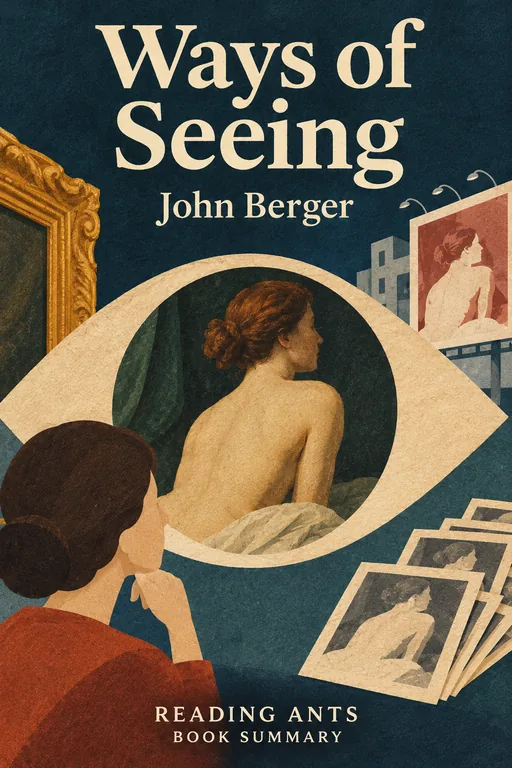
Ways of Seeing
A short, famous book that shows how what we see in art is shaped by what we know and believe, and by who owns, copies and sells images.
Overview
Ways of Seeing is a book by the English art critic John Berger, published in 1972. It is based on a four-part BBC television series of the same name. The book has seven short essays, three of which are made up only of pictures, with no words, so that readers can look and think for themselves. It was designed to be easy to read and to challenge the idea that great art belongs only to experts. Its main theme is that seeing is never neutral: what we see depends on who we are, and on the world around us.
Full Summary
1. Seeing comes before words
The idea: Berger begins by saying that we see before we can speak, and that what we see is shaped by what we know and believe. The way we look at a painting, a landscape or a person is not just a matter of eyes; it is also a matter of our ideas and our history. The same picture can mean different things to different people.
From the book: Berger starts with the simple fact that we notice the world and place ourselves in it, long before we have names for things, and that the relation between what we see and what we know can never be settled.
In real life: Two people can look at the same school photograph. One sees happy memories, while the other sees someone who left them out. What we see depends on our story.
2. Reproduction changes meaning
The idea: In the past, a painting was a unique object, found in a specific place, such as a church or a chapel. With the invention of the camera, art can be copied and seen everywhere. This changes the meaning of the original: it can be seen in a book, on a screen or on a poster, and next to other images or words, and its meaning is multiplied and fragmented.
From the book: Berger says that many of his ideas here come from an essay by the German critic Walter Benjamin about the work of art in the age of mechanical reproduction. He shows how a painting shown on television enters each viewer’s home, where it is surrounded by the family’s own furniture and belongings, and takes on a different meaning in each one.
In real life: When you see a famous painting as a phone wallpaper or on a mug, you experience it very differently from seeing it in a museum. Both experiences are real, but they are different.
3. The mystification of the past
The idea: Berger argues that many learned assumptions about art, such as ideas of beauty, genius and taste, make the past harder to see, and make works of art seem remote from ordinary people. He calls this “mystification,” and he says that it has little to do with difficult vocabulary. In his view, it is the process of explaining away what might otherwise be evident. He suggests that a privileged minority benefits, because it can use the past to justify its own place in society.
From the book: He gives the example of a study of the Dutch painter Frans Hals. Hals was an old, poor man when he painted the governors and governesses of an almshouse, who ran the kind of public charity he himself depended on. But the art historian writes about the harmony of the composition, and avoids the relation between painter and sitters.
In real life: If a museum guide praises a painting’s colors and balance but says nothing about who the people in it were, or who paid for it, visitors may miss the human story that is right there in the picture.
4. Men look, women are looked at
The idea: In the essay on the nude in European painting, Berger says that, for centuries, women were painted as objects of male desire, who knew that they were being looked at. He sums it up by saying that men act and women appear: men look at women, and women watch themselves being looked at. The viewer was assumed to be a man. He distinguishes between being “naked,” as oneself, and being “nude,” seen by others as an object on display and not recognized for oneself.
From the book: He notes that painters often gave a naked woman a mirror and called the picture “Vanity,” which condemned her for something the painter and viewer were enjoying. In his view, the mirror’s real function was to make her join the spectators in treating herself as a sight.
In real life: Many advertisements and social media photos still show people, especially women, posed for others to look at. We can ask who the picture is made for.
5. Oil painting and property
The idea: Berger argues that oil painting developed along with a society that valued owning things. Its special strength is to make objects look tangible, with texture and weight, so that having a thing painted is somewhat like buying it. Many oil paintings showed what their owners had: food, livestock, objects and buildings that were part of their land.
From the book: He looks closely at Holbein’s painting The Ambassadors, in which every surface of fur, silk and metal seems to invite touch, and he asks the reader what the painted objects say about the men’s place in the world.
In real life: A photo of a new car or house on social media works in a similar way. It tells people what we have, and, in doing so, how we want to be seen.
6. Publicity and envy
The idea: In the last essay, Berger says that modern advertising uses the language of art, and it makes people feel that they are not yet what they could be, so that they will buy things. It sells a dream, in which the future is always better than the present.
From the book: He shows how advertisements borrow the language of oil painting, along with references to history and myth. He argues that they are really about the happiness of being envied, which he calls glamour, and that they promise a future in which we will be enviable.
In real life: An advertisement for a new phone is rarely about the phone alone. It is about being cool, or successful, or loved. If we notice that, we can decide whether we agree.
Why It Matters
Ways of Seeing was considered groundbreaking when the television series and the book appeared in 1972, and it changed how many people think about art, images and advertising. It was made partly as a response to Kenneth Clark’s television series Civilisation, which presented a more traditional view of the Western artistic canon. Its picture essays showed that images can be used to make arguments. The book also helped to open up the discussion of how gender, class and money shape the way we see, and it helped shape later ideas about the male gaze, a term the film critic Laura Mulvey introduced in 1975 and feminist writers later used to analyze media. It continues to be widely read.
Key Takeaways
- Seeing is active. What we see is shaped by what we know and believe.
- Images travel and change. Copies and screens alter the meaning of art.
- Art is tied to power and wealth. Who pays for and owns art matters.
- Women have been looked at as objects. Traditional art often assumes a male viewer.
- Advertising uses art’s language. It sells dreams, and creates envy.
What We Can Learn
Berger invites us to look more carefully at the pictures around us, in museums, on screens and in advertisements, and to ask who made them, for whom and why. This habit of questioning is useful in a world full of images.
It also encourages us to trust our own eyes and to feel free to enjoy and question art, without waiting for an expert to tell us what to think. Finally, it reminds us to be careful about how images shape our sense of ourselves, and of what is normal or desirable.
Criticism and Counterpoints
Some critics say that Berger’s argument is too political, and that it reduces art to class and money, ignoring its beauty and its personal power. Others say that his view of the male gaze is too limited, since it deals mostly with European oil painting, with only a brief look at other traditions, and gives little room to women’s own views. Since it was written in 1972, some of the examples feel dated. Still, it remains a stimulating book.
Who Should Read It
This book is for anyone who is curious about art, media and advertising, including students and teenagers. It is short and easy to read, with many pictures. Those who want a detailed history of art may want to use it alongside another book.
Want the whole book?
A summary is a taste, not the meal. Here is where to find the full book.
You reached the end 🎉
Nicely done. Mark this one as read, and we will suggest what to read next.
Read this next
The Story of Art
E. H. Gombrich
Gombrich traces major traditions of Western art by showing how artists inherited visual problems, revised conventions and learned to make images serve changing purposes.
🎨 Arts & Creativity
The Design of Everyday Things
Don Norman
When people struggle to use a door, a stove or a website, the fault usually lies with the design, not the person, and good design makes the right action obvious and mistakes easy to recover from.
💼 Business
Amusing Ourselves to Death
Neil Postman
Neil Postman argues that television has turned serious public discussion into entertainment, so that politics, news, religion and education are shaped by the demand to amuse, and that this threatens our ability to think.
⚖️ Politics & Society
The Creative Act: A Way of Being
Rick Rubin
Rubin presents creativity as a receptive way of living in which attention, experimentation and disciplined refinement help artists bring possible work into form.
🎨 Arts & Creativity
A Room of One's Own
Virginia Woolf
Virginia Woolf argues that a woman needs money and a room of her own, meaning independence and privacy, in order to write fiction, and explains why women writers have been held back through history.
⚖️ Politics & Society
On Writing: A Memoir of the Craft
Stephen King
Stephen King combines a candid account of becoming a writer with practical advice about reading, drafting, revision and sustaining creative work through difficulty.
🎨 Arts & CreativityWant something different?
Pick another topic and we will show you three books to start with.