 Reading Ants
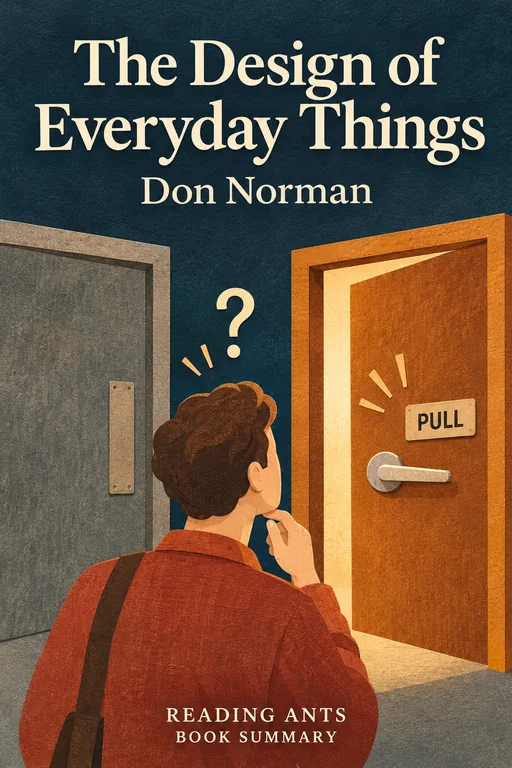
When people struggle to use a door, a stove or a website, the fault usually lies with the design, not the person, and good design makes the right action obvious and mistakes easy to recover from.
Overview
The Design of Everyday Things was written by Don Norman, a cognitive scientist who later worked at Apple, and first published in 1988 under a different title, The Psychology of Everyday Things. A revised edition appeared in 2013. Norman starts with a simple, universal frustration: doors that you push when you should pull, stoves with confusing controls, devices you cannot figure out. He explains why such things happen and what designers can do about it, by drawing on psychology. The book is a classic of design and user experience, and its ideas shape how phones, websites and appliances are made today.
Full Summary
1. Blame the design, not the person
The idea: Norman begins with a bold claim: if people have trouble using something, the design is at fault. We often blame ourselves, thinking we are not smart enough, but most of the time the object was poorly designed. He argues that designers should expect human error and design for it, and that a good design fits how people actually think and behave.
From the book: His famous example is the door that gives no clue about whether to push or pull. A door with a flat plate on one side and a handle on the other tells you without any words.
In real life: If many people pull a door that should be pushed, the problem is the door, not the people.
2. Affordances and signifiers
The idea: An affordance is what an object allows you to do: a chair affords sitting, a button affords pressing. But affordances are useless if people cannot perceive them. So Norman emphasizes signifiers, signals that show where the action should happen, such as a label, a shape or a color. A good signifier makes it obvious what to do and where to do it.
In real life: A flat plate on a door says “push,” while a handle says “pull.”
3. Mapping and feedback
The idea: Mapping is the relationship between controls and the things they control. A good mapping is natural: when you push a lever up, something goes up. Poor mapping causes confusion, like a stove where four knobs are lined up in a row but control burners arranged in a square. Feedback means giving the person an immediate, clear sign that their action worked, such as a click, a light or a sound.
In real life: When you press an elevator button and nothing lights up, you press again, because you’ve received no feedback.
4. Conceptual models
The idea: People form a mental picture of how things work, called a conceptual model. When the model is right, they can use the device and fix problems. When it is wrong, they make mistakes. Designers must therefore provide clues that help users build the right model, for example, through the design of the controls and clear instructions. Norman shows that people often invent explanations that are wrong but seem reasonable.
In real life: Many people think that turning the thermostat higher will heat the house faster, but it only sets the target temperature.
5. Two gulfs and seven stages of action
The idea: Norman describes two gaps between a person and a device. The gulf of execution is the difficulty of figuring out how to do what you want. The gulf of evaluation is the difficulty of understanding what happened afterwards. He describes seven stages of action, from forming a goal, through planning and doing, to checking the result. Good design bridges both gulfs, so that people can see what they can do and what has happened.
In real life: If you press “Save” and nothing tells you whether it worked, the gulf of evaluation is wide.
6. Errors and how to prevent them
The idea: Norman separates two kinds of mistakes. Slips are errors in carrying out an action when the goal was correct, like typing the wrong letter. Mistakes are errors in the goal or plan itself. He argues that errors are natural and that designers should make them hard to commit and easy to detect and reverse, using tools like warnings, confirmations and “forcing functions,” which prevent a dangerous action, such as a car that cannot be started unless the brake is pressed.
In real life: An “undo” button turns a possible disaster into a small inconvenience.
7. Design in the real world
The idea: In the later chapters, Norman looks at why good design is hard. Designers must balance users’ needs with business pressures, deadlines, costs and the tastes of managers and clients. Norman urges designers to watch real people, test their ideas, iterate and involve users from the start, an approach he calls human-centered design. He also reminds us that standards can help, and that good design often becomes invisible.
In real life: A product tested with a few real users is likely to have fewer problems than one that was never tried.
Why It Matters
The Design of Everyday Things is one of the most influential books on design ever written. It helped create the field of user experience, and Norman’s terms, such as “affordance,” “signifier” and “mental model,” are now standard in design courses and in technology companies. A door that confuses people is often called a “Norman door,” after the book.
The book has influenced the way designers think about computers, websites, cars and medical devices, and it has encouraged companies to test products with real people. Its message, that human error is usually a design problem, has shaped safety thinking in fields like aviation and health care.
Key Takeaways
- Design should fit people. Products should work the way people naturally think.
- Make actions visible. Clear signs show what can be done and how.
- Give feedback. Users need to know what happened after an action.
- Expect mistakes. Good design prevents errors or makes them easy to fix.
- Test with real people. Watching users reveals problems designers miss.
What We Can Learn
The book changes how we see the world. After reading it, you notice poorly designed doors, light switches and menus, and you stop blaming yourself. That can make everyday frustrations lighter.
It also offers tips for our own work. When you make a poster, a form or a presentation, think about whether a stranger could understand it at once, and ask someone else to try it.
Finally, the principle of making mistakes easy to correct is useful in daily life. Saving drafts, double-checking important messages and building in small safeguards can prevent bigger problems.
Criticism and Counterpoints
Some critics say that the book’s examples, from the 1980s and 1990s, such as telephones, VCRs and old cars, feel dated, and that the revised edition does not fully fix this. Others find that the book can be repetitive, restating similar points with many examples.
Designers have also argued that Norman’s focus on usability can undervalue beauty, fun or surprise, and that sometimes difficulty is a deliberate choice, as in games. Some say that blaming design for all errors goes too far, since users also need to learn. Norman has responded that good design should reduce, not eliminate, the need to learn.
Who Should Read It
This book suits designers, engineers, students and anyone curious about why things are hard to use. Its examples are easy to follow and need no technical background. Readers who like it may enjoy Norman’s later book, Emotional Design.
Want the whole book?
A summary is a taste, not the meal. Here is where to find the full book.
You reached the end 🎉
Nicely done. Mark this one as read, and we will suggest what to read next.
Read this next
Made to Stick
Chip Heath and Dan Heath
Chip and Dan Heath identify six qualities, summed up as Simple, Unexpected, Concrete, Credible, Emotional and Stories, that make ideas understandable, memorable and able to change behavior.
🧩 Mind & Psychology
Thinking, Fast and Slow
Daniel Kahneman
Our minds run on two systems, a fast, intuitive one and a slow, careful one, and understanding how the fast system fools us can help us make better decisions about money, risk, work and happiness.
🧩 Mind & Psychology
Nudge
Richard H. Thaler and Cass R. Sunstein
Because people are not perfectly rational, the way choices are presented strongly affects what they choose, and designers of choices can gently steer people toward better decisions without taking away their freedom.
🧩 Mind & Psychology
The Lean Startup
Eric Ries
Startups succeed not by following a detailed plan but by quickly testing their ideas with real customers, learning from the results and changing direction when needed.
💼 Business
Good to Great
Jim Collins
Collins argues that sustained corporate improvement comes from disciplined leaders, carefully chosen people, a focused economic concept and cumulative execution rather than dramatic transformation programs.
💼 Business
Built to Last: Successful Habits of Visionary Companies
Jim Collins and Jerry I. Porras
A six-year study of long-lasting, successful companies, which finds that what sets them apart is a strong core purpose, combined with a constant drive to change and improve.
💼 BusinessWant something different?
Pick another topic and we will show you three books to start with.