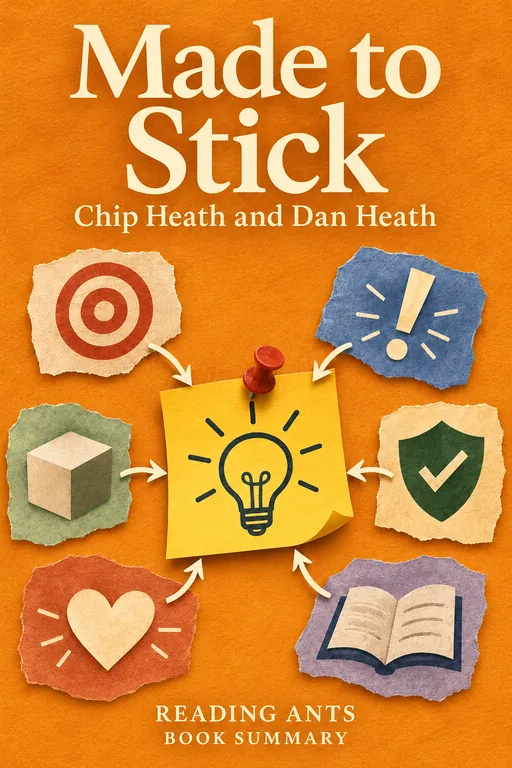
Chip and Dan Heath identify six qualities, summed up as Simple, Unexpected, Concrete, Credible, Emotional and Stories, that make ideas understandable, memorable and able to change behavior.
Overview
Made to Stick: Why Some Ideas Survive and Others Die was published in 2007 by Chip Heath, a professor of organizational behavior at Stanford, and his brother Dan Heath, a consultant and writer. They studied why urban legends, proverbs and certain campaigns spread and stay in the mind, while good ideas in business and education often vanish. They found six common principles, which spell the acronym SUCCESs. The book gives examples from advertising, journalism, health education and politics, and offers advice on how to apply the principles to our own messages.
Full Summary
1. The curse of knowledge
The idea: The Heaths begin with an experiment in which people tapped the rhythm of well-known songs on a table, while others tried to guess the song. The tappers heard the song in their heads and expected the listeners to guess it easily, but the listeners almost always failed. Once we know something, it is hard to imagine not knowing it, which they call the curse of knowledge. This is the reason why experts often communicate badly. The six principles are tools for overcoming it.
In real life: A teacher who knows a subject well may skip steps that a beginner needs.
2. Simple
The idea: The first principle is to find the core of the message, and strip away the rest. A simple idea is not simplistic, but short and profound, like a proverb. They borrow the military idea of “commander’s intent,” a statement of the main goal, such as “take the bridge,” which guides people when plans change. A company whose one core idea is being the low-cost airline can use that one idea to decide what to offer and what to skip, as Southwest Airlines did. Prioritizing is hard, since it means giving up good ideas.
In real life: A club that can state its goal in one sentence will find it easier to attract members.
3. Unexpected
The idea: To get attention, ideas should break patterns. People notice surprises, but must also keep attention, and a surprise alone is not enough. The Heaths warn against gimmicks that are unconnected to the message. They suggest opening gaps in knowledge, by posing a puzzle that the audience wants to resolve. They also tell of a journalism teacher whose students wrote up the details of a school event, and missed that the real news was that school would be canceled.
In real life: A teacher who begins with a mystery question gets more attention than one who starts by reading a list.
4. Concrete
The idea: Abstract language is hard to understand and remember, while concrete images are sticky. They point out that Aesop’s fables have lasted for about 2,500 years because their images, such as sour grapes, are easy to picture, and that people remember concrete nouns better than abstract ones. They suggest using sensory details and examples, so that people can picture the idea, regardless of their background. They describe a nutrition campaign that made the fat in movie popcorn concrete by comparing it to a meal of bacon and eggs, a burger and fries, rather than quoting grams.
In real life: “Walk ten thousand steps” is easier to follow than “be more active.”
5. Credible and Emotional
The idea: People need a reason to believe. The authors say that credibility can come from authority, but also from vivid details, statistics made human, and testable claims, where the audience can verify. For the emotional principle, they say that people care about individuals more than numbers, as a study of donations to a single child shows, and that associations with things people already care about, self-interest and identity can move people more than abstract analysis. A Texas anti-litter campaign, for example, made littering a violation of Texan identity.
In real life: One person’s story of an accident may be more convincing than a table of figures.
6. Stories
The idea: The last principle is that stories inspire action. They provide simulation, in which we mentally rehearse what to do, and inspiration, which gives us the energy to act. The authors describe the stories that employees tell about great service, which convey an organization’s culture, and the story of a man who lost a great deal of weight eating at Subway, which the company used in its advertising. They suggest looking for stories already around you, since good ones are usually found, not invented, and, in organizations, collecting and sharing them. A good story is often a challenge story, a connection story or a creativity story.
In real life: A story about a student who overcame a difficulty can motivate classmates more than a rule.
Why It Matters
Made to Stick became a popular book on communication, appearing on bestseller lists, and was widely read in business, education and nonprofit work. The SUCCESs framework gave people a checklist to improve their messages, and the book’s notion of the curse of knowledge is now well known. It encouraged writers, teachers and managers to think about the audience’s perspective. The authors followed it with Switch, on change, and Decisive. The book appeals to readers because it practices what it teaches, with memorable stories and examples, and is often recommended to anyone who wants an idea to spread.
Key Takeaways
- Knowledge makes communication hard. The curse of knowledge hides what others do not know.
- Keep it simple. Find the core of the message.
- Be surprising and concrete. Catch attention and make ideas visible.
- Give people reasons to believe and care. Credibility and emotion move action.
- Tell stories. They teach and motivate.
What We Can Learn
Before giving a talk or writing a message, ask what the single most important point is, and say it in a sentence. Replace abstract words with concrete examples. Begin with a question or a surprising fact. Use a short true story to show your point. And test your message on someone who knows nothing about the topic, to see if it sticks. Using these steps in a school presentation, a club announcement or a request to your family can make you more convincing.
Criticism and Counterpoints
Readers may wonder whether the SUCCESs checklist is an after-the-fact description that fits many examples but is not a formula, since the book chooses stories that illustrate the model. Persuasion can also be used manipulatively, and the book does not dwell on ethics, although the authors say their goal is to make people care, not to manipulate them. Some may find that the advice is common sense for good writers and teachers. Still, the framework is practical and widely praised for its clarity.
Who Should Read It
This book is for teachers, marketers, managers, students and anyone who wants to communicate clearly. It is entertaining and easy to read. Those who want a research-heavy study of persuasion might also read academic work on memory and attention.
Want the whole book?
A summary is a taste, not the meal. Here is where to find the full book.
You reached the end 🎉
Nicely done. Mark this one as read, and we will suggest what to read next.
Read this next

Switch: How to Change Things When Change Is Hard
Chip Heath and Dan Heath
Brothers Chip and Dan Heath explain that lasting change requires three things, directing the rational "rider," motivating the emotional "elephant" and shaping the path, and they illustrate each with real stories of success.
🧩 Mind & Psychology
Purple Cow
Seth Godin
Seth Godin argues that in a crowded market the safest strategy is to be remarkable, because ordinary products blend in like brown cows, while a purple cow gets noticed and talked about.
💼 Business
Positioning: The Battle for Your Mind
Al Ries and Jack Trout
Al Ries and Jack Trout argue that in a world crowded with messages, the key to marketing is to claim a clear and different place in the minds of customers, not just to improve the product.
💼 Business
The Art of Thinking Clearly
Rolf Dobelli
Swiss author Rolf Dobelli collects about a hundred short chapters on common thinking errors, such as confirmation bias, survivorship bias and the sunk-cost fallacy, to help readers make fewer foolish decisions.
🧩 Mind & Psychology
Thinking, Fast and Slow
Daniel Kahneman
Our minds run on two systems, a fast, intuitive one and a slow, careful one, and understanding how the fast system fools us can help us make better decisions about money, risk, work and happiness.
🧩 Mind & Psychology
Predictably Irrational
Dan Ariely
Behavioral economist Dan Ariely uses entertaining experiments to show that people's decisions are shaped by predictable mental quirks, such as relativity, the lure of "free" and social norms, rather than by cool, rational calculation.
🧩 Mind & PsychologyWant something different?
Pick another topic and we will show you three books to start with.