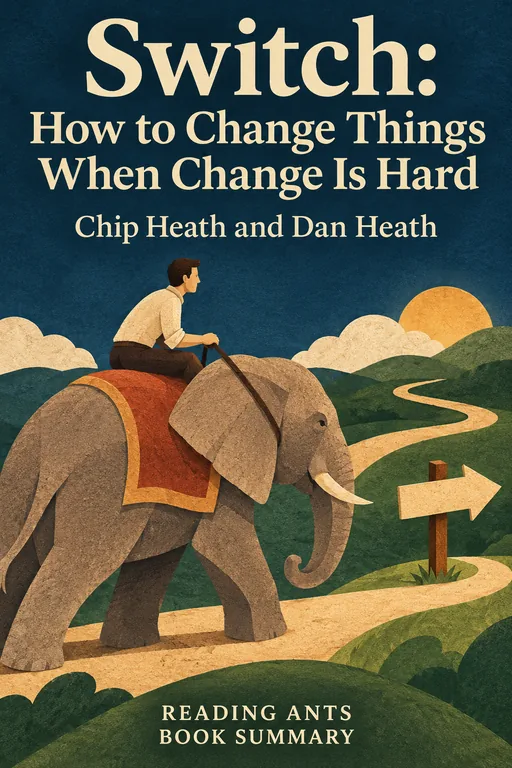
Switch: How to Change Things When Change Is Hard
Brothers Chip and Dan Heath explain that lasting change requires three things, directing the rational "rider," motivating the emotional "elephant" and shaping the path, and they illustrate each with real stories of success.
Overview
Switch: How to Change Things When Change Is Hard was published in 2010 by the brothers Chip Heath, a professor at Stanford, and Dan Heath, who had earlier written Made to Stick. The book builds on the metaphor of the elephant and rider, from the psychologist Jonathan Haidt. The rider is our analytical side, the elephant is our emotional side, and the path is the situation. The authors say that change fails when one of these is neglected, and they offer a three-part framework with examples from business, schools, health care and everyday life.
Full Summary
1. Three surprises about change
The idea: The Heaths start with three surprises: what looks like a people problem is often a situation problem, what looks like laziness is often exhaustion, since self-control wears out like a muscle, and what looks like resistance is often a lack of clarity. They explain that the rider, who can plan and analyze, tends to overthink, while the elephant supplies the energy but can go its own way. If the two disagree, the elephant usually wins. To make change, we must direct the rider, motivate the elephant and shape the path.
In real life: A person who knows that they should exercise but feels no desire has a rider that agrees and an elephant that does not.
2. Direct the rider: find the bright spots
The idea: The authors say that, when facing a problem, we often focus on what is wrong, but it is more useful to look for bright spots, cases where things are working, and try to copy them. They tell the story of a program to reduce child malnutrition in Vietnam, in which the organizer looked for poor families whose children were healthy, and discovered the practices that made the difference, such as feeding children more often and adding foods like shrimp, crabs and sweet potato greens, which others thought unsuitable. These could then be taught to others.
In real life: A therapist might ask a patient when the problem was last a little better, even briefly, and what was different then.
3. Script the critical moves
The idea: Vague goals, such as “eat healthier,” leave the rider confused. The Heaths say that more options, even good ones, can freeze people, and that ambiguity does the same, so the safe choice becomes the old routine. They advise giving clear, specific instructions for the critical moves, not every move. Instead of telling people to eat more healthily, a campaign can tell them to reach for 1 percent milk in the dairy aisle. They say that ambiguity is the enemy of change, and that the rider also needs a destination, a vivid picture of what success will look like soon, such as a teacher telling young pupils that they will be third graders by the end of the year.
In real life: “Walk for twenty minutes after dinner” is clearer than “get fit.”
4. Motivate the elephant: find the feeling
The idea: Change is often driven by feelings, not analysis. The authors argue that, in successful change efforts, the sequence is see, feel, change, not analyze, think, change: people are shown evidence that makes them feel something. They cite a study of corporate change which found that emotional goals, such as serving customers better, inspired people more than financial ones. They say that showing something, not just telling, can touch the elephant, and that sometimes a sense of urgency or even a crisis is needed. The elephant also needs confidence, which can come from shrinking the change or from growing people.
In real life: A vivid demonstration often moves people more than a long report.
5. Shrink the change and grow your people
The idea: Large goals can be overwhelming for the elephant. The Heaths recommend breaking them into small steps that create early victories, for example by asking for only five minutes of housecleaning. In one story, a car wash gave customers a loyalty card with two stamps already filled in, so that they felt part of the way to a free wash. They also say that people often decide by asking who they are and what someone like them would do, so change lasts when it becomes a matter of identity, and that a growth mindset, expecting setbacks and treating failure as learning, keeps the elephant going. Small wins build momentum and confidence.
In real life: Cleaning one drawer is easier to start than cleaning the whole house.
6. Shape the path: change the situation
The idea: Sometimes what looks like a people problem is a situation problem. Changing the environment can make the right behavior easier and the wrong behavior harder. The authors cite the psychologist Lee Ross, who described our tendency to blame character and ignore the situation. They recommend tweaking the environment, building habits, for example by deciding in advance when and where you will act, and rallying the herd, since behavior is contagious, and people look to others in ambiguous situations. A small change in the path can have a big effect. The last chapter adds that leaders should notice and reinforce early progress, because change is a process, not an event.
In real life: In a classic study, students alone in a room reported smoke coming through a vent, but those in a group, looking at one another, often did not.
Why It Matters
Switch was a number-one New York Times bestseller and has been read by managers, teachers, nonprofit leaders and parents. Its simple metaphor is easy to remember, and gives a checklist to diagnose why a change effort is stuck. The book draws on research in psychology and on a variety of real cases, and shows that change does not always require large resources, but a good understanding of people. It follows the authors’ earlier bestseller, Made to Stick. Its stories, from a program that cut child malnutrition in Vietnam to a home-organizing expert who made housework less dreadful, show that ordinary people can bring about change.
Key Takeaways
- Change needs three things. Direct the rider, motivate the elephant and shape the path.
- Look for bright spots. Copy what already works.
- Be specific. Clear instructions beat vague goals.
- Feelings drive action. Make people see and feel the reason.
- Make it easy. Changing the environment can change behavior.
What We Can Learn
When you want to change a habit, ask which of the three is missing: do you know exactly what to do, do you feel motivated, and is the environment helping? Look for times when you have succeeded, and repeat them. Break the goal into a very small first step. Arrange your surroundings so that the good choice is easy, such as putting your running shoes by the door. Share your goal with friends who will encourage you. And be patient: small wins build momentum.
Criticism and Counterpoints
Because the book is built on appealing stories, readers may wonder whether the success stories would generalize, since failures get little attention. The elephant and rider metaphor is a simplification of psychology, and the framework can seem like common sense. Some readers feel it gives limited attention to power and politics, which can block change in organizations and are not solved by good communication alone. Still, many readers have found the framework practical.
Who Should Read It
This book is for anyone trying to change a habit, a team or a community, including managers, teachers and parents. It is easy to read, with lively stories. Those who want a scientific study of behavior change should look to the research literature.
Want the whole book?
A summary is a taste, not the meal. Here is where to find the full book.
You reached the end 🎉
Nicely done. Mark this one as read, and we will suggest what to read next.
Read this next
Made to Stick
Chip Heath and Dan Heath
Chip and Dan Heath identify six qualities, summed up as Simple, Unexpected, Concrete, Credible, Emotional and Stories, that make ideas understandable, memorable and able to change behavior.
🧩 Mind & Psychology
Atomic Habits
James Clear
Big changes in life come not from huge leaps but from tiny habits repeated every day, and you can build good habits (and break bad ones) by designing your life so the right choices are obvious, attractive, easy and satisfying.
🌱 Self-ImprovementTiny Habits
BJ Fogg
Stanford behavior scientist BJ Fogg teaches that lasting change comes not from willpower but from starting with very small behaviors, attaching them to existing routines and celebrating each success to make them stick.
🌱 Self-Improvement
The Righteous Mind
Jonathan Haidt
Jonathan Haidt argues that moral judgments come mainly from intuition and emotion, not reason, that people's moral instincts rest on several foundations that differ across political groups, and that understanding this can help us to disagree without hating each other.
🧩 Mind & Psychology
Drive: The Surprising Truth About What Motivates Us
Daniel H. Pink
Daniel Pink argues that, for creative and complex work, carrots and sticks such as bonuses are less effective than the inner drive provided by autonomy, mastery and purpose, and that businesses and schools should be redesigned around them.
🧩 Mind & Psychology
Thinking, Fast and Slow
Daniel Kahneman
Our minds run on two systems, a fast, intuitive one and a slow, careful one, and understanding how the fast system fools us can help us make better decisions about money, risk, work and happiness.
🧩 Mind & PsychologyWant something different?
Pick another topic and we will show you three books to start with.