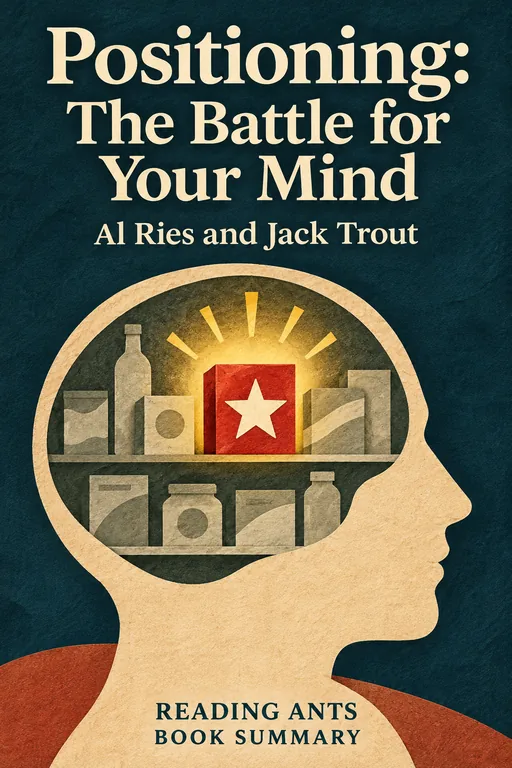
Al Ries and Jack Trout argue that in a world crowded with messages, the key to marketing is to claim a clear and different place in the minds of customers, not just to improve the product.
Overview
Positioning was published in 1981 by two advertising men, Al Ries and Jack Trout. They had written about positioning in a series of articles in the trade magazine Advertising Age in 1972, and the book expanded the idea. They say that the modern world is “over-communicated,” since people are bombarded with ads, brands and information. The mind defends itself by accepting only a small amount, and by sorting things into categories. The authors offer advice on how a product can find a place in that sorting system, and on how to avoid the mistakes that damage a brand.
Full Summary
1. The over-communicated society
The idea: The authors say that the main problem for any company is no longer making a product, but getting through the noise. People are exposed to far more messages than they can take in. To cope, they ignore most of what they see. A company must therefore deliver a simple, focused message, since a complicated one will be lost.
In real life: A student who tries to tell a friend ten reasons to see a film may be less convincing than one who says one clear thing: “it’s the funniest film this year.”
2. The mind works like a ladder
The idea: Ries and Trout say that the mind filters out whatever does not fit what it already knows, and that it can only hold a limited number of brands, which are ranked on a mental “ladder” for each category, such as soft drinks or car rental. The product at the top gets most of the customers’ attention. If a brand is not on the ladder, it is not remembered. To win more customers, a brand must either displace one above it or position itself in relation to the brands already there. The authors note that a truly new product is often easier to explain by saying what it is not, or by comparing it to something familiar.
In real life: If someone asks you for a search engine, a sports shoe or a fast-food chain, you can probably name just two or three, and then your list stops.
3. Be first, or find a new category
The idea: The authors say that the best position is the first one. Being the first to occupy a place in the mind gives a huge advantage, since people remember the first and forget the rest. They point to the way that people remember the first to fly across the Atlantic or land on the moon, and to brands such as Kodak and Xerox, whose early lead gave them lasting positions. If you cannot be first in an existing category, you should create a new category in which you can be first.
From the book: The authors argue that the easy way into a person’s mind is to be first, and that being first usually counts for more than being better.
In real life: A small bakery might not beat the big chain at general bread, but it can be the first and best “sourdough bakery” in its neighborhood.
4. Positioning against the leader
The idea: If you are not the leader, you need to find a gap and use it. The authors treat the leader and the follower as different problems, and they advise a follower to look for an opening, or “hole” (they borrow a French word for it), that the leader has not filled, for example in size, price or the kind of customer, and to be clearly different from the leader. They describe Volkswagen’s “Think small” in this way, and Michelob’s high price as a way to signal quality.
From the book: They also say that a brand may position itself against the leader. They describe Avis accepting its place as the number two car-rental company behind Hertz and building its message around trying harder, and 7Up presenting itself as the “Uncola,” an alternative to the dominant colas. For leaders, the advice is the opposite: reinforce the original idea and strengthen the whole category, rather than only boasting of being number one. The authors also warn that a brand which forgets what made it successful may lose its way.
In real life: A new burger place might say that it uses only fresh, small batches, in contrast to larger chains that prepare in bulk.
5. The power of a name
The idea: Ries and Trout say that the name of a product matters a great deal, because words carry meanings that already exist in people’s minds. They advise names that hint at the main benefit, such as Head & Shoulders or DieHard, and they warn against obscure names, technical codes and, for companies that are not yet famous, initials, because people remember names better than letters. With a good name, the positioning job becomes much easier, and a poor or confusing name makes everything else harder.
In real life: If you start a school club, a name such as “Robot Builders” tells people what it is, while “The Group” tells them nothing.
6. The trap of stretching a brand
The idea: The authors warn against “line extension,” which means putting a well-known brand name on many other products. Their examples include Dial soap moving into deodorants and Life Savers moving into gum. They say that such moves can blur what the brand stands for, and weaken its position, because the company thinks from the inside out while customers see the brand from the outside in. Early sales can also mislead, since shops may simply be stocking the new item. They advise companies to be disciplined and to keep a narrow focus, even though growth seems to demand otherwise. A later chapter on when line extension can work gives rules of thumb, such as giving a truly new or high-potential product its own name.
In real life: A restaurant known for pizza that suddenly adds sushi, tacos and a salad bar may confuse customers about what it does best.
7. Positioning yourself and your career
The idea: In later chapters, the authors argue that the same ideas apply to people and their careers. They advise readers to define themselves with a single clear concept instead of trying to be everything to everyone, and to choose a name that is memorable and not lost in initials. They also encourage trying things and making mistakes, and they urge people to “find a horse to ride,” meaning a thriving company, a capable boss, or good friends in business who can lift a career.
In real life: A classmate who becomes known as the best at explaining math is often the first person others turn to.
8. Positioning a business
The idea: In the closing chapters, the authors suggest that anyone starting a positioning program begin with questions rather than slogans: what position do you already own in the minds of customers, what position do you want, whom must you outgun, and do you have enough money to hold it. They also stress that a company must be honest about its own position, even when its pride gets in the way.
In real life: Before a school club makes a poster, its members could first ask what people already think of the club.
Why It Matters
Positioning is one of the most influential books in marketing. It popularized a word that is now part of everyday business language, and it changed the way that many advertisers think about their work, from describing products to shaping perceptions. Its ideas, such as the mental ladder, being first and avoiding line extension, have been widely read and discussed in marketing for decades. The authors followed the book with other works on marketing. It matters because it makes a clear point: that customers decide on the basis of what they believe, and not just on the facts. For anyone who wants to be heard in a noisy world, that is a helpful and lasting lesson.
Key Takeaways
- The battle is in the mind. What people believe about a product matters as much as what the product is.
- Simple wins. In a noisy world, a short and clear message gets through.
- First is hard to beat. Create a new category if you cannot lead an old one.
- Contrast helps. A smaller player can gain by being clearly different from the leader.
- Do not stretch a name too far. A brand that stands for everything stands for nothing.
What We Can Learn
When you try to explain yourself, a project or an idea, ask what single thing you want people to remember. Practice saying it in one short sentence. Notice how brands try to place themselves in your mind, and ask whether their claim is true. If you are applying for a school place or a job, think about what makes you different from other candidates, and show it with real examples. At the same time, remember that a clever position only helps if the product is good. Positioning can bring people in the door, but quality keeps them there.
Criticism and Counterpoints
Critics say that the book was written for the advertising world of the late twentieth century, when mass media dominated, and that today’s online world, with search and social media, works differently. Some find that the authors state their rules too firmly and lean heavily on well-chosen case examples. The emphasis on perception over product can also be read as a license for empty image-making, or even for misleading customers. Critics also note that brand stretching sometimes works well. The ideas are best used with honesty and a good product behind them.
Who Should Read It
This book is for marketers, small-business owners, founders, designers and anyone who wants to understand how brands shape what we think. It is short, lively and easy to read. Readers who want modern digital marketing methods or research-based advice may want to supplement it with newer books.
Want the whole book?
A summary is a taste, not the meal. Here is where to find the full book.
You reached the end 🎉
Nicely done. Mark this one as read, and we will suggest what to read next.
Read this next

Purple Cow
Seth Godin
Seth Godin argues that in a crowded market the safest strategy is to be remarkable, because ordinary products blend in like brown cows, while a purple cow gets noticed and talked about.
💼 Business
Crossing the Chasm
Geoffrey A. Moore
Geoffrey Moore argues that new technology companies often fail when they try to move from a small group of enthusiasts to the mainstream, and that they can cross this "chasm" by focusing on one narrow market and offering a complete solution.
💼 Business
Influence: The Psychology of Persuasion
Robert B. Cialdini
Psychologist Robert Cialdini identifies six universal principles of persuasion, which explain why people say yes and show how to use them ethically and how to defend against those who misuse them.
🌱 Self-Improvement
Made to Stick
Chip Heath and Dan Heath
Chip and Dan Heath identify six qualities, summed up as Simple, Unexpected, Concrete, Credible, Emotional and Stories, that make ideas understandable, memorable and able to change behavior.
🧩 Mind & Psychology
The Lean Startup
Eric Ries
Startups succeed not by following a detailed plan but by quickly testing their ideas with real customers, learning from the results and changing direction when needed.
💼 Business
Good to Great
Jim Collins
Collins argues that sustained corporate improvement comes from disciplined leaders, carefully chosen people, a focused economic concept and cumulative execution rather than dramatic transformation programs.
💼 BusinessWant something different?
Pick another topic and we will show you three books to start with.