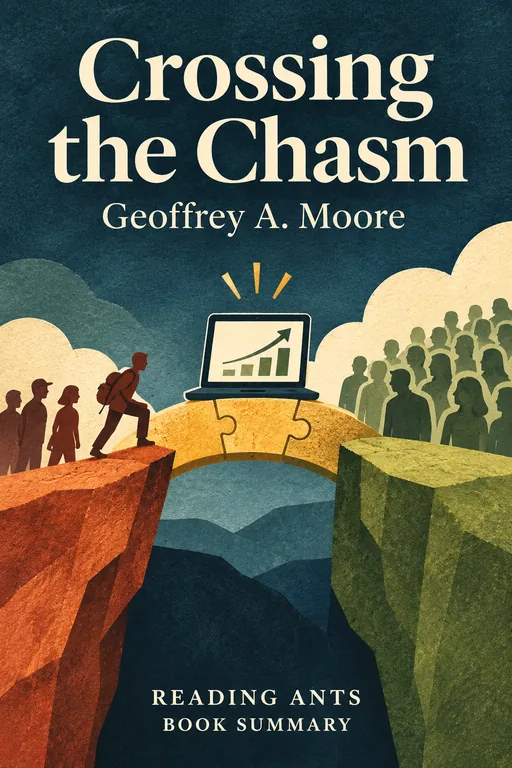
Geoffrey Moore argues that new technology companies often fail when they try to move from a small group of enthusiasts to the mainstream, and that they can cross this "chasm" by focusing on one narrow market and offering a complete solution.
Overview
Crossing the Chasm was first published in 1991 by Geoffrey A. Moore, a consultant who advised technology companies. It builds on an older idea, the technology adoption life cycle, which grew out of the diffusion-of-innovations research of Everett Rogers and sorts customers by how quickly they take up new products. Moore’s key claim is that there is a deep gap between the first, adventurous buyers and the larger, more careful mainstream. Many young companies fall into that gap and do not recover. The book is a guide to marketing and sales for high-tech products, but its lessons are used much more widely, for any new idea that needs to spread.
Full Summary
1. The technology adoption life cycle
The idea: Moore starts with a model that sorts people into five groups according to how they respond to new products. The innovators, who love new technology for its own sake, come first. Next are the early adopters, or visionaries, who want to use a new product to get a big advantage. The early majority, who are pragmatic, wait for proof that a product works. Then come the late majority, who are wary, and finally the laggards, who avoid change. (Moore’s own labels for these groups are technology enthusiasts, visionaries, pragmatists, conservatives and skeptics.)
In real life: When a new phone app appears, a few friends try it on the first day. Most wait until many people they know are using it.
2. The chasm
The idea: Moore’s big insight is that the early adopters and the early majority are very different, and the usual marketing methods that win the first group do not work for the second. Visionaries will take a risk on an unfinished product. Pragmatists want a reliable product, backed by other satisfied customers. There is therefore a gap, or chasm, between the two groups. Many companies enjoy early success, and then stall.
In real life: A game that excites a small group of testers might still be too confusing or too buggy for a family that just wants it to work.
3. Pick one narrow target
The idea: To cross, a company should not try to please everyone. Moore recommends choosing a single, specific market segment, a “beachhead,” where it can become the leader. A focused group can give the company a loyal customer base and a reputation, so that the group’s word of mouth begins to reach others.
From the book: Moore compares this to a landing on a beach during a military invasion, where the force first takes a small area and uses it as a base for the next step.
In real life: A new learning app might start by focusing on high-school chemistry teachers, and become the best tool for them, before moving into other subjects.
4. Offer the whole product
The idea: Pragmatic buyers do not want just the core of the product, but everything needed to make it work well, including training, support, add-ons and links to other tools. Moore calls this the “whole product.” Companies must make sure the whole package is ready for their target market, often by working with partners, even if that means building things that do not scale.
In real life: A fancy electric bicycle is useful only if there are also chargers, repair shops and safe places to park.
5. Position the product clearly
The idea: Customers in the mainstream compare products and look for the safe, well-known choice. A company needs a clear message that says who the product is for, what it does better than the alternatives, and why it is the sensible choice. Moore advises placing the product in a category that buyers already understand, and comparing it with familiar alternatives, so that it is easy for them to buy.
In real life: A bakery that says “the best gluten-free bread in town” is easier to remember than one that says “good baked goods.”
6. Sales, pricing and growth after the chasm
The idea: Once a company has won one segment, it can move on to the next, and so on, like a row of bowling pins. Moore uses this bowling-alley image for the way success in one segment helps win the next, and he explores the later stage of explosive growth, which he calls the tornado, in a follow-up book, Inside the Tornado. Moore also discusses how to choose the most suitable sales channels and pricing for a product that is crossing the chasm, since these choices are part of how a company reaches its target customers.
In real life: A club that has become popular at one school can next try the school nearby, using its first members as examples.
Why It Matters
Crossing the Chasm became a standard book in the technology industry. It gave managers and founders a shared vocabulary, with terms such as “early adopters,” “pragmatists” and “whole product” now used in many companies and business schools. One director of Stanford’s entrepreneurship program has called it the bible of entrepreneurial marketing, and Inc. magazine listed it among the top ten marketing books of all time. Moore later wrote follow-up books, including one about what happens when a market takes off, and a revised edition of this book was published afterward. Its core lesson, to focus on a small market before trying to win a big one, has influenced the way many start-ups plan their first customers. It also reminds us that people respond differently to new ideas, which is useful for anyone trying to change habits or share an invention.
Key Takeaways
- Customers differ. People adopt new things at different speeds, and each group wants something different.
- The chasm is real. Early enthusiasts do not automatically lead to the mainstream.
- Focus beats breadth. Win one narrow market first, and use that success to grow.
- Sell a complete solution. The mainstream wants a product that works well from the first day.
- Be clear about who you are for. A strong, simple position makes it easier for buyers to say yes.
What We Can Learn
If you are trying to start something, whether a club, a business or a campaign, resist the urge to speak to everybody. Choose a small group you understand well, and make the idea work perfectly for them. Ask what they need around your idea to make it truly useful, not only what is at the center. Notice that different people need different messages. Friends who love experiments may like a rough version, while others wait for evidence. The idea also helps in your own life: when you adopt a new tool or habit, think about which kind of adopter you are and why.
Criticism and Counterpoints
Critics say that the book is based on a model that simplifies real markets. The line between groups is not always sharp, and some products grow without a clear chasm. Others point out that the examples come mainly from business-to-business technology companies in the 1980s and 1990s, and that modern online products spread in different ways, for example through social networks. The advice to focus on a niche can also be misapplied: a niche needs customers with a compelling reason to buy, who can refer one another, and not just a small size. It may also be risky to commit too narrowly. Some scholars have questioned the evidence for the chasm itself. The book is best used as a thinking tool, not as a rule.
Who Should Read It
This book is for founders, product managers, marketers and anyone launching a new idea or product. It is clear and well organized, but it can be technical in places. Readers who are interested in creative or social projects can still learn from it, while those looking for modern online marketing tactics may need a more recent book.
Want the whole book?
A summary is a taste, not the meal. Here is where to find the full book.
You reached the end 🎉
Nicely done. Mark this one as read, and we will suggest what to read next.
Read this next

The Lean Startup
Eric Ries
Startups succeed not by following a detailed plan but by quickly testing their ideas with real customers, learning from the results and changing direction when needed.
💼 Business
Zero to One
Peter Thiel with Blake Masters
The most valuable companies create something new from nothing, and Peter Thiel argues that this means aiming for a monopoly in a small, specific market rather than competing with everyone in a crowded one.
💼 Business
Purple Cow
Seth Godin
Seth Godin argues that in a crowded market the safest strategy is to be remarkable, because ordinary products blend in like brown cows, while a purple cow gets noticed and talked about.
💼 Business
Positioning: The Battle for Your Mind
Al Ries and Jack Trout
Al Ries and Jack Trout argue that in a world crowded with messages, the key to marketing is to claim a clear and different place in the minds of customers, not just to improve the product.
💼 Business
The Innovator's Dilemma
Clayton M. Christensen
Great companies often fail not because they manage badly, but because they do everything right: they listen to their best customers and invest in the best products, and so they miss the cheaper, simpler technology that eventually replaces them.
💼 Business
Good to Great
Jim Collins
Collins argues that sustained corporate improvement comes from disciplined leaders, carefully chosen people, a focused economic concept and cumulative execution rather than dramatic transformation programs.
💼 BusinessWant something different?
Pick another topic and we will show you three books to start with.