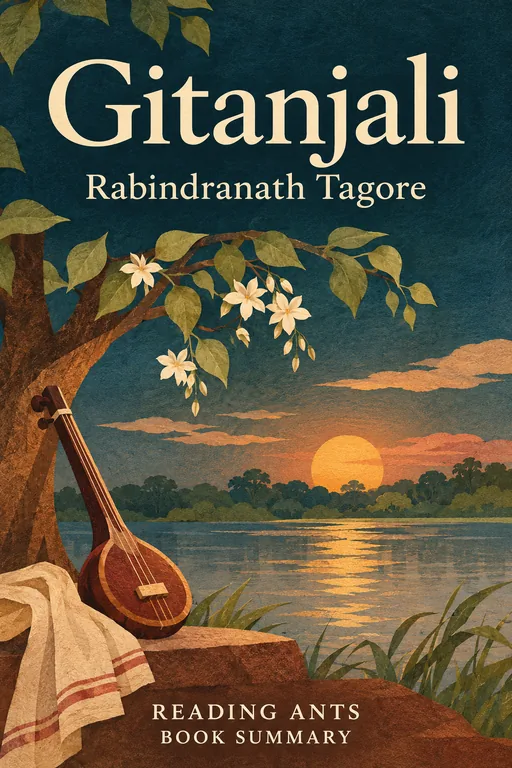
Gitanjali
Original title: গীতাঞ্জলি
A collection of devotional poems in which a speaker offers songs to God, in joy, longing and humility, finding the divine in nature, in the poor and in everyday life.
Overview
Gitanjali is a collection of poems by the Bengali writer Rabindranath Tagore. The Bengali Gitanjali appeared in 1910. The title means “song offerings.” In 1912, Tagore published Gitanjali: Song Offerings, an English prose volume of 103 poems that he drew from several Bengali collections, only some of them from the 1910 book, with an introduction by the Irish poet W. B. Yeats. In 1913 he became the first non-European to win the Nobel Prize in Literature, an award for his literary achievement as a whole, to which this English volume contributed greatly. This summary follows the English volume and groups its poems by theme, not in their actual order. The poems are short and musical, and they speak to God as a friend, a king and a beloved. The book asks what it means to give oneself to something greater.
Main Characters
- The speaker: a humble singer, who offers songs and prayers.
- The Divine (the Lord, the Beloved): a presence addressed as a friend, a master and a lover.
- The poor and the laborers: the people among whom the speaker says God is found.
- The child: a figure of simple, natural joy.
Full Summary
The Gift of Song
The poems begin with the singer’s wonder that God has made him, a fragile vessel, and that he has been given a song to sing. He feels that his life is a reed pipe that God fills with music. The joy of the singing is so great that he forgets himself, and he calls God “friend” in a way that he would not dare to do in everyday life.
At the same time, he knows that his songs are small compared with the vastness of the divine. He offers them with love, and not with pride.
Pride and Humility
Many poems deal with the danger of pride, in the form of wealth, rank, learning or religious show. The speaker says that the ornaments and robes that we wear get in the way of meeting God, as they create a barrier. He asks to be freed from the self that sits at the center of his thoughts.
In one image, the singer goes begging from door to door, and a king’s golden chariot appears. The singer hopes for a rich gift, but the king asks him for something instead, and he gives only a single grain of corn. Later he finds that it has turned to gold, and he wishes that he had given more. The lesson is that the divine may appear in unexpected ways, and that we should give freely.
God Among the Poor
One poem asks where God is to be found, and answers that it is not in temples or in rituals that are far removed from life, but with the farmer who tills the hard ground and the road-maker who breaks the stones. The speaker invites the reader to put aside the rosary and come out into the dust, to join those who work.
This theme reflects Tagore’s own concern for the poor of Bengal, and his belief that religion must be tied to service.
Nature and Life
The poems are full of images of the natural world: the monsoon clouds, the river, the dawn, the flowers and the wind. For the speaker, the world is a living expression of God’s joy, and to be part of nature is to share in that joy. He sees himself as connected with every leaf, and with the great flow of life.
He also speaks of children, whose play and laughter are close to the heart of the world. A child at play on the seashore is a favorite image for freedom from worry.
Death and the Journey
Several poems speak of death, which the speaker sees as a friend and a doorway. He imagines the moment when he will leave the world and meet his master, and he hopes that he will be ready. He is not afraid, but he is aware that he is a traveler on a long road.
Death is not the end of love, but the way in which the singer will give his final offering.
Freedom
The theme of freedom comes through in many poems, including poem 35, one of the most famous, which imagines a world where the mind is without fear, the head is held high and knowledge is free. It expresses a hope that the speaker’s country, and all people, may be free from fear and narrowness.
The English volume closes with a poem in which all of the singer’s songs flow together into one salutation. It ends on a note of longing and trust, as the singer’s life of song comes to its close.
Why It Matters
Gitanjali brought Indian literature to the attention of the world, and made Tagore a global figure. Yeats wrote that the poems had moved him deeply, and the Nobel committee honored the book’s religious sensibility and beauty. In India and Bangladesh, Tagore is a national poet, and his songs are still sung. He wrote the national anthems of both countries. The poems are a fine example of how spirituality and poetry can be joined, and they are often read at weddings, funerals and celebrations. Tagore was also a painter, composer, educator and reformer, who founded a school in which students learned outdoors, and Gitanjali is the best-known sign of his wide and generous mind.
Key Takeaways
- Humility opens the door. Pride separates us from what is greatest.
- The divine is found in everyday life. In work, in nature and in the poor.
- Joy is a form of prayer. The singer sings out of delight.
- Death is part of life’s journey. It can be met with calm.
- Freedom needs courage and knowledge. A free mind is without fear.
What We Can Learn
The poems encourage us to slow down, to notice the beauty of the world and to be grateful. They remind us that real greatness is found in simplicity and service, and not in show.
The poems also invite us to question whether religion or ideals are lived out in how we treat others, and to find meaning in work and in the company of ordinary people. Finally, they offer a gentle way of thinking about death, as something natural, and about life as a gift.
Criticism and Counterpoints
Some critics say that the English version, which is in prose and which Tagore made himself, loses much of the music of the Bengali songs, and that it can seem vague or too sweet. Others find that the poems are repetitive, with the same images of the boat, the road and the lamp. Some readers feel that the religious language is not for them. It has also been said that the reputation of the book in the West was shaped by a taste for the “mystic East.”
Who Should Read It
This book is for readers who enjoy short, gentle poems and who are interested in spirituality, whether or not they follow a religion. It can be read a few poems at a time. Those who prefer story-driven books may find it quiet.
Want the whole book?
A summary is a taste, not the meal. Here is where to find the full book.
You reached the end 🎉
Nicely done. Mark this one as read, and we will suggest what to read next.
Read this next
The Prophet
Kahlil Gibran
Before sailing home, a wise exile answers a city's questions about love, work, freedom and death, presenting life as a unity built from apparent opposites.
🌍 World Literature
The Bhagavad Gita
Vyasa
On the eve of a great battle, the warrior Arjuna despairs, and the god Krishna, serving as his charioteer, teaches him about duty, the soul, selfless action and devotion.
🕊️ Philosophy & Religion
Masnavi
Rumi
Rumi's long Persian poem uses stories, jokes and parables to teach that the soul is separated from its source and is happiest when it returns to it through love.
🎭 Epics, Drama & Poetry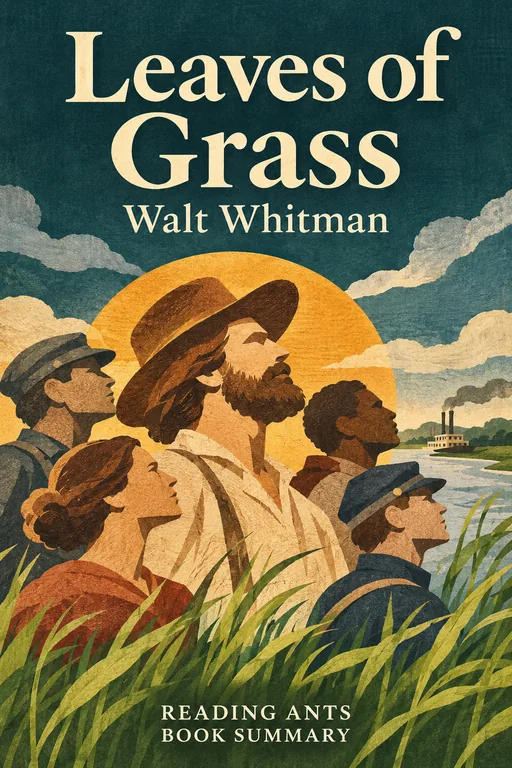
Leaves of Grass
Walt Whitman
Walt Whitman's lifelong book of free-verse poems celebrates the self, the body, democracy, nature and ordinary Americans, in a bold new voice that changed poetry.
🎭 Epics, Drama & Poetry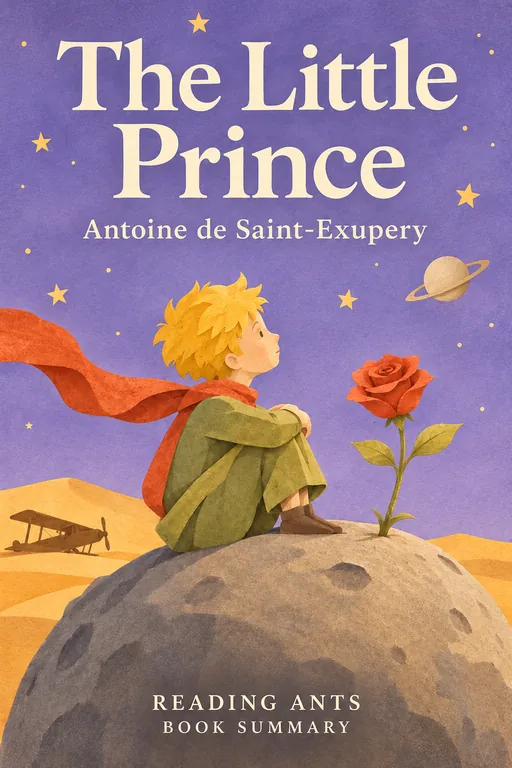
The Little Prince
Antoine de Saint-Exupery
A pilot stranded in the desert meets a small boy from a tiny planet, who teaches him that the most important things in life, like love and friendship, can only be seen with the heart.
🌍 World Literature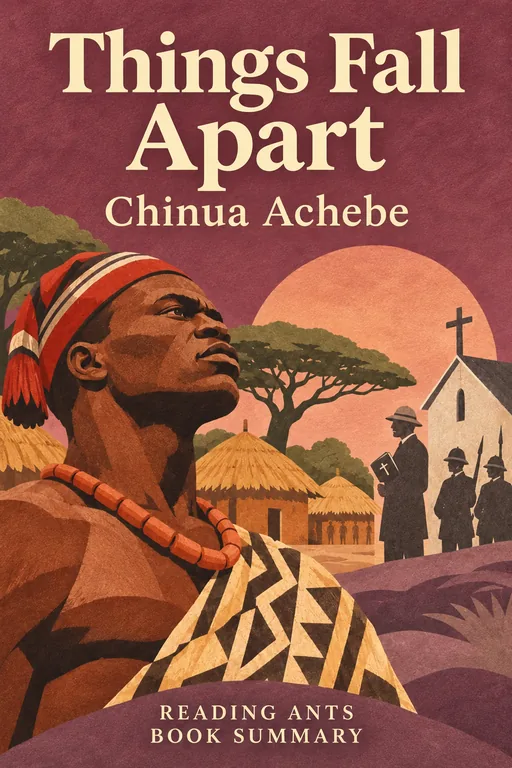
Things Fall Apart
Chinua Achebe
Okonkwo, a proud and fearsome leader in an Igbo village in Nigeria, struggles against his own fears and against the arrival of British missionaries and colonial rulers, who change his world forever.
🌍 World LiteratureWant something different?
Pick another topic and we will show you three books to start with.