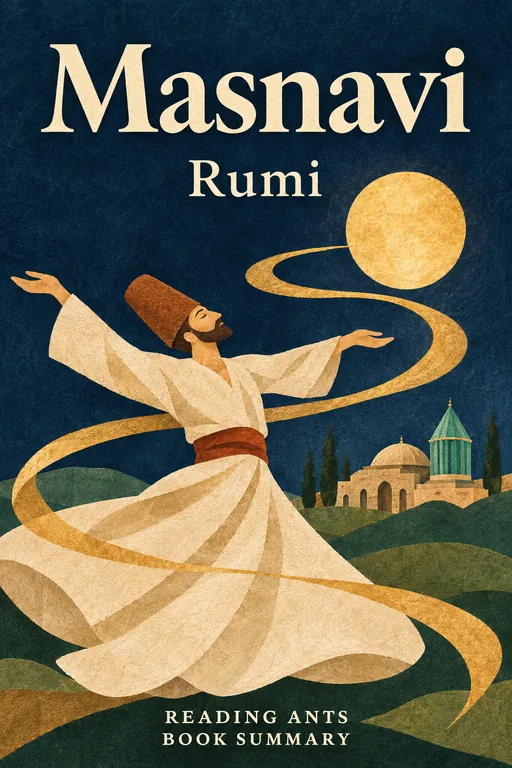
Masnavi
Original title: مثنوی معنوی
Rumi's long Persian poem uses stories, jokes and parables to teach that the soul is separated from its source and is happiest when it returns to it through love.
Overview
The Masnavi (also spelled Mathnawi) is a long poem in six books, written in Persian by Jalal ad-Din Rumi, a thirteenth-century scholar, teacher and Sufi mystic, in the years before his death in 1273. It has about twenty-five thousand couplets, and is often called the “Quran in Persian” by admirers, as a way of showing how much it is revered. Rumi lived in Konya, in what is now Turkey, after his family fled the Mongol invasions from the east. The poem is not a single story but a stream of tales within tales, mixed with teaching, anecdote and prayer. Its stories come from many sources, including folk tales, the Quran, history and everyday life, and are meant to guide the reader’s heart.
Main Characters
The poem has no single hero. The speaker is Rumi, the teacher, who talks to a disciple. The tales are populated by kings, slaves, merchants, fools, lovers and animals, such as the Parrot who speaks like a human, the Elephant in the dark room, the Reed that cries for the reed bed, and the Lion and the Hare who outwits him. The figure of the Beloved appears throughout and stands for God, whom the lover seeks.
Full Summary
The Song of the Reed
The poem begins with the famous opening about a reed flute. The reed has been cut from the reed bed, and it cries out in its song about separation. It says that whoever is parted from the source longs to return, and its music is the sound of that longing. This image sets the book’s main theme: the soul is a stranger in the world and is moved by a deep desire to go home, and love is the fire that burns away what stands between the lover and the Beloved.
The Merchant and the Parrot
In one tale, a merchant has a parrot in a cage, and before leaving for India, he asks what gift he should bring. The parrot asks him to tell the parrots of India that he is caged and longing for freedom. When the merchant does so, one of the free parrots falls from the tree as if dead. On his return, the merchant tells his own bird, who also falls to the bottom of the cage, seeming dead. The merchant, grieved, takes the bird out, and it flies away. The tale suggests that the way to freedom is to die to the self.
The Elephant in the Dark
Another famous story tells of people who bring an elephant into a dark room, and each touches a different part. The one who feels the trunk says that it is like a water pipe, the one who feels the ear says that it is a fan, the leg a pillar, and the back a throne. Each is sure that he knows the truth, but they differ. Rumi says that if they had a candle, they would agree. The lesson is that limited views lead to conflict, and that wisdom is a light, not an argument.
Humor and Rough Wisdom
Rumi often tells earthy or comic tales to make serious points. A fool prays for a better donkey, a thief is caught, a man becomes angry at a mouse, and a woman pretends to be a spirit. These stories are brought down to ordinary life, and show that the spiritual and daily worlds are not separate. The humor keeps the book human, and shows that spiritual teaching need not be solemn.
Love and the Ego
A recurring idea is that the greatest obstacle to love is the ego, the “lower self,” which behaves like a stubborn animal. Rumi describes the lover’s path as one of burning and surrender, in which pride is melted and the heart becomes clear like a polished mirror. He suggests that the spirit of love matters more than outward forms, a theme that many readers take as a universal outlook, although Rumi writes within the Islamic tradition. These teachings link to the whirling dance of the Mevlevi order, founded by his followers.
Return to the Source
The later books continue the same themes, with stories of kings and slaves, saints and sinners, and prayer for guidance. The poem has no clear end, and in the sixth book it breaks off, as if the work were not finished at Rumi’s death. The effect is that of a conversation that continues, with the reader invited to find his or her own way to the Beloved.
Why It Matters
The Masnavi is one of the most important works of Persian literature and of Sufi mysticism. Its poems have been memorized, recited and commented on for centuries across Iran, Turkey, Central Asia and South Asia. In recent decades, Rumi has become one of the best-selling poets in the United States, though many of the popular versions are free adaptations of his shorter lyrics, and not the Masnavi itself.
The poem is a rich source of stories that have become part of world folklore, and its teaching on love, humility and tolerance still draws readers from many faiths.
Key Takeaways
- The soul longs for home. The reed’s song is a cry of separation.
- Love transforms. It burns away pride and fear.
- Truth is bigger than any one view. The elephant story shows partial knowledge.
- Freedom comes through letting go. The parrot learns to die to the self.
- Humor and wisdom go together. Rumi’s tales are playful and deep.
What We Can Learn
The poem teaches humility about what we know. When people argue fiercely about big questions, the elephant in the dark reminds us that each person may hold only a piece of the truth.
It also encourages us to look at our own ego. The stories ask what we hold on to, such as pride, anger or fear, and whether letting go might make us freer.
Finally, it shows that teaching through stories can reach hearts as well as minds, and that laughter can lead to insight.
Criticism and Counterpoints
Some readers find the poem rambling and difficult, since stories are interrupted by digressions and the connections are not always clear. Its religious background, with many references to the Quran and Sufi ideas, can be a barrier to those who do not know them, and it requires notes.
Scholars also caution that popular English versions often remove the Islamic setting of Rumi’s poetry, which misrepresents his work. Some of the tales contain attitudes toward women or crude humor that modern readers dislike. Translations vary greatly in accuracy and style.
Who Should Read It
This poem suits teenagers and adults interested in spirituality and literature. Readers can begin with selected stories in a good translation and a guide, and take the book slowly, a few pages at a time.
Want the whole book?
A summary is a taste, not the meal. Here is where to find the full book.
You reached the end 🎉
Nicely done. Mark this one as read, and we will suggest what to read next.
Read this next
Rubaiyat of Omar Khayyam
Omar Khayyam
In short four-line poems, a Persian scholar-poet reflects on how brief life is, how little we can know about God or the future, and why we should enjoy the present moment.
🎭 Epics, Drama & Poetry
The Bhagavad Gita
Vyasa
On the eve of a great battle, the warrior Arjuna despairs, and the god Krishna, serving as his charioteer, teaches him about duty, the soul, selfless action and devotion.
🕊️ Philosophy & Religion
The Dhammapada
Buddhist tradition
This short collection of verses attributed to the Buddha teaches that happiness and suffering come from the mind, and that kindness, self-discipline and mindfulness lead to peace.
🕊️ Philosophy & Religion
Aesop's Fables
Aesop
A collection of very short stories, mostly about talking animals, each teaching a simple lesson about life, such as slow and steady wins the race, and don't cry wolf.
🧸 Children's Books
The Odyssey
Homer
After the Trojan War, the clever hero Odysseus struggles for ten years against monsters, gods and temptations to return home to his faithful wife and son, then must win back his house from the men trying to steal it.
🎭 Epics, Drama & Poetry
Hamlet
William Shakespeare
A grieving prince of Denmark learns from his father's ghost that his uncle murdered the king to take the throne, and his struggle to decide whether and how to take revenge leads to madness and death.
🎭 Epics, Drama & PoetryWant something different?
Pick another topic and we will show you three books to start with.