 Reading Ants
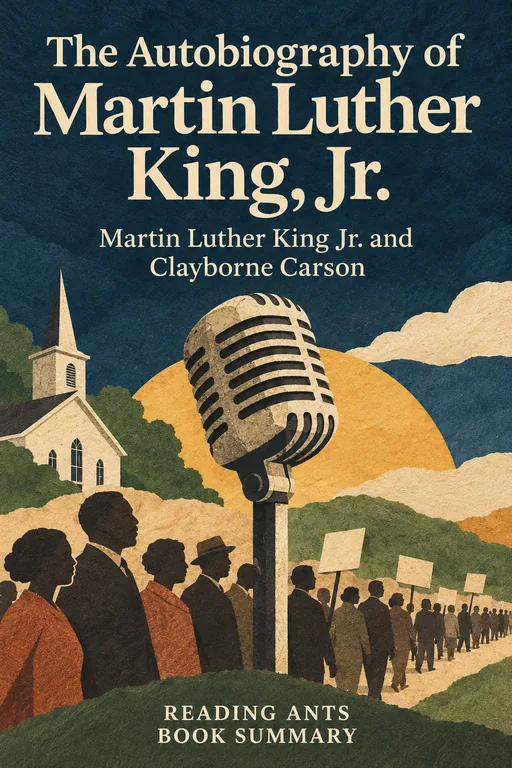
The Autobiography of Martin Luther King, Jr.
Historian Clayborne Carson assembles Martin Luther King Jr.'s own words from his letters, sermons, speeches and writings into a single life story, from a boyhood in Atlanta to the Memphis strike where he was killed.
Overview
The Autobiography of Martin Luther King, Jr. was published in 1998 and edited by Clayborne Carson, a historian who directed a project to publish King’s papers. King never wrote a full autobiography, so Carson arranged passages from his many writings in order, so that they form a continuous account. The result reads as though King were telling his own story, though it is a compilation made after his death. It covers his family background, his education, his religious beliefs and the civil rights movement, in which he was a leading figure.
Full Summary
Growing Up in Atlanta
King was born in 1929 in Atlanta, Georgia, the son of a Baptist minister and grandson of another. He grew up in a close and religious family, in a segregated city, and recalls the pain of being told that he could no longer play with a white friend, and of seeing signs that separated places for white and Black people. He was a quick student, skipped grades and entered Morehouse College at fifteen. At Morehouse, he came under the influence of teachers, including the college president Benjamin Mays and the professor George Kelsey, who showed him that religion could be intellectually serious as well as emotionally satisfying, and he began to read about civil disobedience.
Seminary and the Ideas of Nonviolence
King studied theology at Crozer Theological Seminary in Pennsylvania, and then earned a doctorate at Boston University. He read widely in philosophy and the Christian tradition, and was impressed by the example of Mahatma Gandhi, who used nonviolent resistance in India. He decided that love and nonviolence could be the means of social change. In Boston, he met Coretta Scott, a gifted singer, and they married in Alabama and began a family. He accepted a position as pastor of Dexter Avenue Baptist Church in Montgomery, Alabama.
The Montgomery Bus Boycott
In December 1955, Rosa Parks, a Black seamstress who was also an experienced activist, was arrested for refusing to give up her seat on a city bus, and local leaders organized a boycott. King, a young newcomer, was chosen to lead it. For more than a year, thousands of Black residents walked or shared rides rather than ride the buses. King was arrested, and his home was bombed, but he urged calm and nonviolence. In the end, the Supreme Court, in a case called Browder v. Gayle, ruled that segregation on buses was unconstitutional, and the boycott succeeded.
Birmingham and Washington
King helped to found the Southern Christian Leadership Conference to coordinate protests. In the spring of 1963, he joined a campaign in Birmingham, Alabama, a city with a violent history of segregation. He was arrested and wrote a long letter from jail, explaining why people could not wait for justice. Later that year, in August, a quarter of a million people gathered in Washington, D.C., for a march, where King gave a speech about his dream that one day all Americans would live together in equality.
Selma and Beyond
The movement continued, and in 1964, Congress passed the Civil Rights Act, and King received the Nobel Peace Prize. In 1965, he took part in a campaign for voting rights in Selma, Alabama, where marchers led by John Lewis and Hosea Williams were attacked by police on a bridge on March 7, which King did not lead; he later joined the successful march to Montgomery. The events helped to win passage of the Voting Rights Act. Afterwards, King turned to problems of poverty and housing in northern cities, and he spoke out against the Vietnam War, which cost him some support. He began planning a campaign for the poor of all races.
Memphis
In the spring of 1968, King went to Memphis, Tennessee, more than once to support a strike by sanitation workers, even as his organization prepared the Poor People’s Campaign. He returned on April 3 and gave a speech there in which he spoke of having seen the mountaintop, and of his hope that the people would reach a promised land, even if he might not be with them. The next day, April 4, he was shot and killed on the balcony of his motel. His own account stops there, and the work of the movement was left unfinished.
Why It Matters
King was one of the most important leaders of the twentieth century, and this book makes his thoughts accessible by letting him speak in his own words. It shows his development, from a young preacher to a leader of a national movement, and gives a picture of the doubts and fears behind the public figure. His philosophy of nonviolence and his insistence that justice requires action influenced movements around the world. The book is also valuable as an introduction to the civil rights movement. Carson’s editing helps readers to see the unity of King’s ideas, and invites them to read the original sources.
Key Takeaways
- Nonviolence is active. It is a way of confronting injustice without hatred.
- Faith can drive change. King’s religious convictions shaped his actions.
- Justice cannot wait. Delay often means denial.
- Leaders feel fear. King describes his doubts and his reliance on others.
- The struggle continues. The work of equality requires each generation’s effort.
What We Can Learn
King’s example encourages us to resist injustice with courage and without cruelty. You can begin by treating everyone with respect, and by speaking up when you see unfair treatment. Learn about the history of your community and the people who worked to change it. Practice listening to those with whom you disagree, and look for ways to cooperate for common goals. It also reminds us to read primary sources: letters, speeches and papers, which show us people as they were. As you read, consider how his words apply to today’s world.
Criticism and Counterpoints
Because the book was assembled by an editor from many sources, it is not a true autobiography, and some reviewers point out that no one can know how King would have told his own story had he lived. Others note that it reflects King’s public and intellectual voice more than his private one, since he wrote little about his inner life, and that, being told from his point of view, it cannot fully show the forces and rival voices that stood against or beside him. Controversies such as questions about his personal life, or the borrowed passages later found in his academic writing, are not what the book is about. Reviewers also said that it reveals nothing startlingly new. Still, it is valued as a clear introduction.
Who Should Read It
This book is for students and readers who want to hear King’s voice, and to understand his life and ideas. It is easy to read in short sections, and rich in history. Those who want a critical biography, with analysis of King’s complexities, should read other works as well.
Want the whole book?
A summary is a taste, not the meal. Here is where to find the full book.
You reached the end 🎉
Nicely done. Mark this one as read, and we will suggest what to read next.
Read this next
Long Walk to Freedom
Nelson Mandela
Nelson Mandela tells his own story, from a village childhood to twenty-seven years in prison to becoming South Africa's first democratically elected president, and shows how patience, courage and forgiveness helped end apartheid.
👤 Real Lives
The Warmth of Other Suns
Isabel Wilkerson
Isabel Wilkerson tells the story of the Great Migration, in which about six million Black Americans left the South for cities in the North and West, through the lives of three people who made the journey.
🏛️ History
The Souls of Black Folk
W. E. B. Du Bois
In fourteen eloquent essays, W. E. B. Du Bois examines the lives, struggles and hopes of Black Americans at the start of the twentieth century, and argues that the great problem of the age is the color line.
⚖️ Politics & Society
Up from Slavery
Booker T. Washington
Booker T. Washington tells how he rose from an enslaved childhood in Virginia to found the Tuskegee Institute in Alabama, and explains his belief that education, hard work and practical skills offered the best path to progress for Black Americans.
👤 Real Lives
The New Jim Crow
Michelle Alexander
Civil rights lawyer Michelle Alexander argues that the American criminal justice system, especially the War on Drugs, has functioned as a system of racial control that labels many Black men as criminals and strips them of rights, much as Jim Crow laws once did.
⚖️ Politics & Society
Man's Search for Meaning
Viktor E. Frankl
A psychiatrist who survived the Nazi concentration camps explains that even in the worst suffering, people can choose their attitude, and that finding a reason to live is what gives us the strength to endure.
👤 Real LivesWant something different?
Pick another topic and we will show you three books to start with.