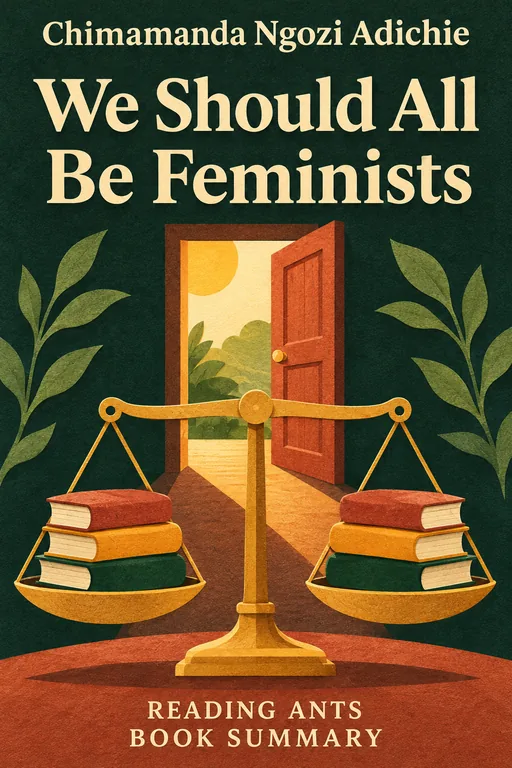
We Should All Be Feminists
In a short essay adapted from a talk, the Nigerian novelist Chimamanda Ngozi Adichie explains what feminism means to her and why people of every gender should work to end sexism.
Overview
We Should All Be Feminists is an essay by the Nigerian writer Chimamanda Ngozi Adichie, published as a small book in 2014. It is adapted from a talk she gave in December 2012 at a TEDx event in London, which was widely viewed online. Adichie, known for novels such as Half of a Yellow Sun and Americanah, speaks in a warm, direct, often funny voice about her own experiences growing up in Nigeria and living in the United States. She explains why she calls herself a feminist, answers common objections and describes how expectations about gender harm both women and men. The book is only about fifty pages long and can be read in less than an hour.
Full Summary
1. The word “feminist”
The idea: Adichie begins by telling about a childhood friend, Okoloma, who once called her a feminist during an argument, as an insult. She did not know the word’s meaning, but she understood that he did not mean it kindly. She notes that in many places, the word carries negative associations: a feminist is said to be angry, anti-men or unhappy. She decides to reject these stereotypes and, for a time, calls herself a happy African feminist who does not hate men and who likes lip gloss, to show that the word has been misunderstood.
In real life: People often avoid a label because of what they think it means, rather than what it really means.
2. Gender matters
The idea: Adichie argues that gender affects daily life, even though many people prefer not to talk about it. She gives examples from her own experience, such as a parking attendant who thanks her male companion for money that she gave him, and a hotel guard who assumes that an unaccompanied woman must be a sex worker. She also recalls being told as a child that she could not be class monitor, even though she had the best test score, because the class monitor was expected to be a boy.
In real life: Small moments, such as who is addressed first or who is expected to lead, can reflect habits that treat people differently by gender.
3. How expectations limit everyone
The idea: She points out that boys are brought up to be tough and hide their feelings, and that this can lead to what she calls a “fragile ego.” Girls, meanwhile, are taught to shrink themselves, to be likable above all and not to be ambitious. She explains that women are told to aim for success, but not too much, so as not to threaten men. She suggests that if we raised children differently, these narrow roles would not limit them as they do now.
In real life: A boy who is told “boys don’t cry” learns to hide emotions, and a girl told not to be bossy may learn to hold back ideas.
4. Culture and change
The idea: Adichie addresses the argument that sexism is part of culture and tradition. She says that culture is not fixed: it changes as people change it, and it exists to preserve and continue a people. If culture no longer treats women as full human beings, then culture should change. She says that these debates are not only about Africa, since gender inequality exists around the world.
In real life: Laws and customs that once seemed permanent, such as women not voting, have changed in many countries.
5. Marriage, caution and relationships
The idea: Adichie gives examples of how gender expectations shape relationships. She talks about how some men feel threatened by successful women and how women are often taught that marriage is the main goal. She also notes how women are often taught to be careful and men are taught to be bold. She suggests that a better way is to raise both girls and boys to be independent and to see partners as equals, and she says that a happier marriage and a happier family are possible when roles are shared.
In real life: Couples who share chores and decisions often find it easier to talk and to feel respected.
6. A call to action
The idea: The essay closes with her definition of a feminist: a person, of any gender, who recognizes that there is a problem with gender as it is today and who must fix it, so as to make a better world for women and men. She invites everyone, including men, to take part and to raise children differently. Her closing note is hopeful, saying that we can all do better.
In real life: Everyday actions, such as speaking up when someone is treated unfairly, are part of the change she asks for.
Why It Matters
The talk and essay reached millions of people and became a widely shared introduction to feminism. A line from the talk was sampled in a song by Beyoncé, and the book was given to every sixteen-year-old in Sweden in 2015, which brought it further attention. It has been translated into many languages and used in schools and book clubs.
The essay is valued because it is brief, clear and humane. It speaks to people who find the topic intimidating, and it brings a perspective from Nigeria that adds to a conversation often dominated by Western voices.
Key Takeaways
- Gender affects daily life. Small moments reveal larger habits.
- Expectations limit boys and girls. Narrow roles hurt everyone.
- Culture can change. Traditions are made and remade by people.
- Feminism is for everyone. Men and women can work together.
- Raise children freely. Let them be themselves, not just stereotypes.
What We Can Learn
The essay reminds us to notice what we take for granted. Small habits, like assuming who will cook or who will lead, can be changed once we see them.
It also shows how powerful personal stories can be. Adichie persuades not with statistics but with experiences, and her humor makes the message easier to hear.
Finally, it invites us to be kinder to everyone caught in rigid roles. When we let boys show feelings and girls show ambition, we help build a world with more freedom for all.
Criticism and Counterpoints
Some feminists have said that the essay is too simple and too focused on individual attitudes, and that it does not deal enough with the economic and political structures that sustain inequality, or with the experiences of women who face other forms of oppression, such as racism and poverty. Others have said that her comments on some issues have been controversial, including her later remarks on gender identity, which led to public debate.
Some critics from the opposite side argue that the essay overstates the extent of sexism or that stereotypes are not as harmful as she suggests. Because the book is short, it can only touch on complex topics. It works best as a starting point.
Who Should Read It
This short essay suits readers from about age ten up to adults. It is easy to read and fits well into a classroom or family discussion. Readers who want depth can follow it with longer works on feminism.
Want the whole book?
A summary is a taste, not the meal. Here is where to find the full book.
You reached the end 🎉
Nicely done. Mark this one as read, and we will suggest what to read next.
Read this next
A Room of One's Own
Virginia Woolf
Virginia Woolf argues that a woman needs money and a room of her own, meaning independence and privacy, in order to write fiction, and explains why women writers have been held back through history.
⚖️ Politics & Society
The Second Sex
Simone de Beauvoir
Simone de Beauvoir argues that womanhood is not a fixed biological destiny but a social and historical condition, in which women have been treated as the "Other" to men, and that liberation requires changing that situation.
🕊️ Philosophy & Religion
Americanah
Chimamanda Ngozi Adichie
Ifemelu and Obinze, young lovers in Lagos, are separated when she goes to study in America and he struggles in London, and the novel follows their years apart and their return to Nigeria, looking at race, identity and love.
✨ Modern Fiction
Born a Crime
Trevor Noah
Trevor Noah, the comedian, recounts growing up in South Africa as the child of a Black mother and a white father at a time when their relationship was a crime, and pays tribute to the mother who raised him.
👤 Real Lives
The Prince
Niccolo Machiavelli
A Renaissance diplomat advises rulers to judge their actions by results rather than morality, arguing that a successful leader must sometimes be cunning and ruthless to win and keep power.
⚖️ Politics & Society
The Communist Manifesto
Karl Marx and Friedrich Engels
Marx and Engels declare that all history is the history of class struggle, that capitalism has created a working class that will overthrow it, and that communism will end class divisions.
⚖️ Politics & SocietyWant something different?
Pick another topic and we will show you three books to start with.