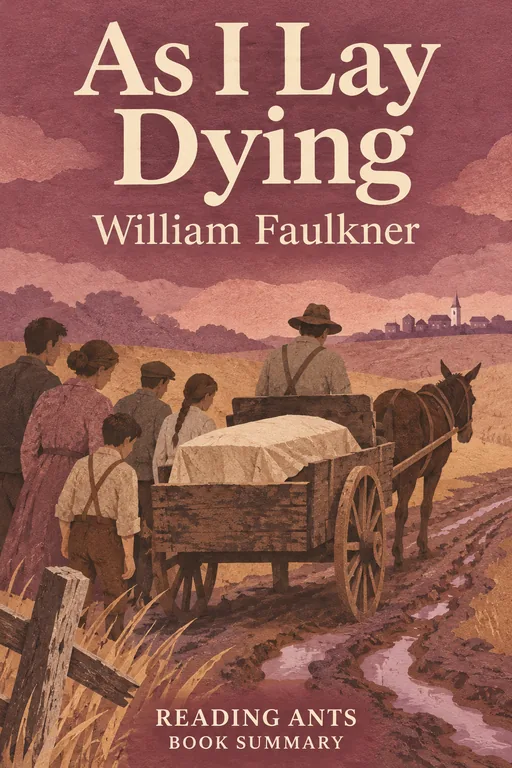
As I Lay Dying
After the death of their mother, a poor Mississippi family sets out on a nightmarish journey to bury her in the town of her birth, each member driven by a hidden need of their own.
Overview
As I Lay Dying is a novel by the American writer William Faulkner, published in 1930, and it is set in Yoknapatawpha County, the fictional Mississippi region that appears in many of his books. It is told in fifty-nine short chapters, by fifteen different narrators, mostly members of the Bundren family, along with neighbors and other onlookers. Each voice gives a different view, and some are lyrical, some comic and some disturbed. The story is a mix of tragedy and black humor, and a landmark of modernist fiction.
Main Characters
- Addie Bundren: the mother, a former schoolteacher, who dies at the start of the book.
- Anse Bundren: her husband, a lazy, self-pitying farmer.
- Cash: the eldest son, a careful carpenter.
- Darl: the second son, a sensitive, strange and perceptive man.
- Jewel: the third son, fierce, proud and devoted to his horse.
- Dewey Dell: the only daughter, who is secretly pregnant.
- Vardaman: the youngest boy, who is confused by his mother’s death.
Full Summary
Addie dies
The Bundrens live on a poor farm in Mississippi. Addie lies dying in her bed, while her eldest son Cash builds her coffin outside her window, so that she can hear the sound of the saw. She has asked to be buried in Jefferson, forty miles away, with her family, and her husband Anse has promised to take her. When she dies, a heavy rain sets in that washes out bridges on the way, but the family loads the coffin onto a wagon anyway and sets out in the heat of summer, with the mules pulling.
The family’s secrets
Each member of the family carries a hidden purpose. Anse wants to get new teeth in the town. Dewey Dell wants to find medicine to end her pregnancy, since she does not want the child. Vardaman wants to buy toy trains, and, in his confusion, comes to think of his dead mother as a fish, like the one he has just caught. Cash is practical but quiet. Jewel, who, we learn, is Addie’s illegitimate son by a preacher, loves his horse more than anything. Darl, who sees everything, observes the others with a clear but troubling gaze. Cash has already broken a leg in a fall from a church roof before the journey begins.
The flooded river
On the way, the family reaches a river that has flooded, and the bridge is washed out. They try to cross at a ford, but a drifting log strikes the wagon, and it overturns, and the mules drown. Cash, whose leg was already injured, hurts it badly again and nearly drowns. Jewel, who is willing to risk anything, fights to hold the wagon steady with a rope, and the coffin is saved. The family is forced to find new mules, and Anse trades Jewel’s horse for a team, without telling him, which enrages him. Meanwhile, the corpse begins to smell, and vultures follow the wagon, and people turn away.
The barn
When the family stops for the night at a farm, Darl, who finds the situation unbearable, sets fire to the barn in which the coffin has been put, hoping to end the journey and to put his mother to rest. Jewel, in a rage, rushes in and saves the coffin, burning his back. The act marks Darl as unstable, and the family decides that it must either send Darl to the asylum or be sued by the farm’s owner. The family becomes more divided, and Cash’s broken leg, which the family had already set in cement, grows worse.
Jefferson
At last, the Bundrens reach Jefferson and bury Addie. In the town, Dewey Dell tries to buy pills from a druggist’s clerk, who tricks her and takes advantage of her. Anse borrows shovels from a woman who lives nearby, and he takes the money that Dewey Dell had for the medicine, to get his false teeth. Darl is seized and sent to the state mental hospital at Jackson, as the others think that he is mad. Darl, who is taken away to the asylum, laughs, as if he sees the joke of it all.
A new Mrs. Bundren
In the last chapter, Anse introduces a new wife, the woman from whom he borrowed the shovels, a “duck-shaped woman” with a gramophone, whom he calls “Mrs. Bundren.” The family is left unchanged, and the surprise is comic and bitter. Anse seems pleased, and he has his new teeth. The novel ends with the impression that grief and loss have not changed the family in any deep way, and that life goes on, in its absurd and stubborn manner, while the dead are left behind.
Why It Matters
As I Lay Dying is regarded as one of the major works of American modernism, and a showcase for Faulkner’s experimental technique. The use of multiple narrators, each with a distinct voice, influenced many later writers, and the mixture of humor and horror, in the grotesque journey, gives the novel its power. The book also provides a portrait of poor white farmers in the South, and shows how family ties can both bind and harm. Critics often point to Addie’s single chapter, in which she describes her view of life, as one of the great pieces of writing in the language.
Key Takeaways
- Multiple perspectives create truth. No single narrator tells the whole story.
- Grief takes strange forms. The family’s reactions are odd and varied.
- Family can be a burden. The Bundrens’ bond is also a source of pain.
- Words and reality differ. Addie distrusts words, as they fail to express experience.
- Tragedy and comedy mix. The journey is both horrible and absurd.
What We Can Learn
You can learn from the Bundrens that people often act out of their own hidden needs, even in times of shared grief, and that it is wise to pay attention to different points of view. The novel also shows the weight of promises, and the damage that selfishness can do within a family. If you read it, notice how Faulkner gives each narrator a distinctive way of speaking, and how a single event, the journey, looks different through each pair of eyes. It may make you more aware of how to listen to others.
Criticism and Counterpoints
Some readers find the novel hard to follow, because of the shifting narrators, and the stream-of-consciousness style, and the dark humor, which can seem cruel. Others criticize the portrayal of poor Southern whites as grotesque and simple, and feel that the treatment of women, including Dewey Dell, is troubling. A few find the novel too bleak, as it offers little hope. Its representation of mental illness, as in Darl’s case, is also seen as dated. Defenders say that the difficulty is part of the art, and that the book rewards re-reading.
Who Should Read It
This book is for mature readers from about sixteen who enjoy challenging literary fiction, and who are prepared for a demanding style. It is shorter than most of Faulkner’s novels, so it is a good starting point. Readers who like it may go on to The Sound and the Fury.
Want the whole book?
A summary is a taste, not the meal. Here is where to find the full book.
You reached the end 🎉
Nicely done. Mark this one as read, and we will suggest what to read next.
Read this next

The Sound and the Fury
William Faulkner
Four sections, told by three brothers and then an outside narrator, trace the slow decline of the once-proud Compson family of Mississippi and the loss of their sister Caddy.
📜 Classics
Of Mice and Men
John Steinbeck
Two traveling farmworkers during the Great Depression, quick-witted George and the huge, gentle but mentally disabled Lennie, dream of owning their own small farm, but their dream ends in tragedy.
📜 Classics
The Grapes of Wrath
John Steinbeck
Driven off their Oklahoma farm by drought and the banks during the Great Depression, a poor family travels west to California in search of work, only to find exploitation and hunger, yet they hold on to their dignity and compassion.
📜 Classics
Beloved
Toni Morrison
A formerly enslaved woman living in Ohio after the Civil War is haunted by the ghost of the daughter she killed to save her from slavery, and by the painful memories she has tried to bury.
✨ Modern Fiction
Their Eyes Were Watching God
Zora Neale Hurston
Janie Crawford tells her best friend the story of her three marriages, as she moves from a girl taught to find security to a woman who finds love and her own voice in the Florida of the early twentieth century.
📜 Classics
Pride and Prejudice
Jane Austen
Quick-witted Elizabeth Bennet and the proud, wealthy Mr. Darcy badly misjudge each other, and only by facing their own faults do they find their way to love.
📜 ClassicsWant something different?
Pick another topic and we will show you three books to start with.