 Reading Ants
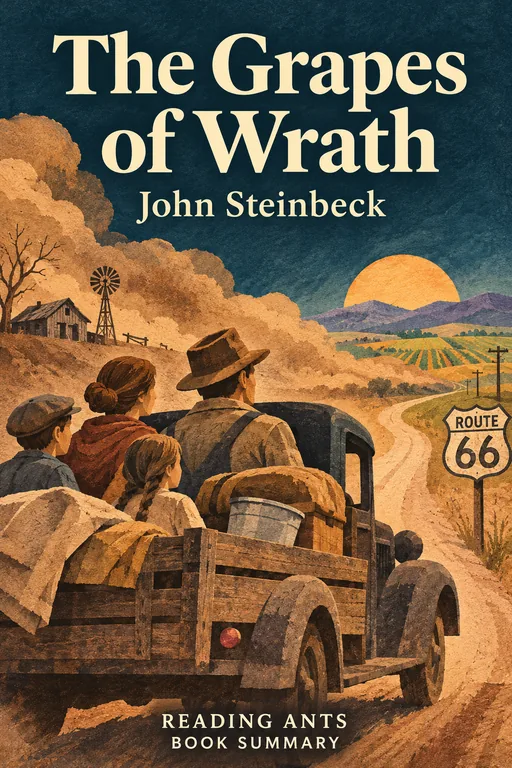
The Grapes of Wrath
Driven off their Oklahoma farm by drought and the banks during the Great Depression, a poor family travels west to California in search of work, only to find exploitation and hunger, yet they hold on to their dignity and compassion.
Overview
The Grapes of Wrath, published in 1939, follows the Joad family, tenant farmers in Oklahoma during the 1930s. Years of drought and terrible dust storms, known as the Dust Bowl, have ruined their crops, and the banks and landowners force them off the land they have farmed for generations. Like hundreds of thousands of real families, the Joads load their belongings onto an old truck and drive along Route 66 toward California, where leaflets promise plenty of work picking fruit. What they find instead is too many workers, starvation wages and hostility. Between the chapters about the Joads, Steinbeck includes short chapters describing the experience of all the migrants. The novel won the Pulitzer Prize and remains one of the most powerful protests against injustice in American literature.
Main Characters
- Tom Joad: the family’s son, just released from prison, who becomes a fighter for justice.
- Ma Joad: the strong, loving mother who holds the family together.
- Pa Joad: Tom’s father, who struggles as he loses his role as provider.
- Jim Casy: a former preacher who has lost his faith but believes in people.
- Rose of Sharon: Tom’s pregnant younger sister.
- Grampa and Granma Joad: Tom’s elderly grandparents.
- Al Joad: Tom’s younger brother, who loves cars.
- Uncle John: Pa’s guilt-ridden brother.
- Connie: Rose of Sharon’s young husband.
Full Summary
Coming Home to Dust
Tom Joad is released on parole from prison in Oklahoma after serving four years for killing a man in a fight. Walking home, he meets Jim Casy, a former preacher who used to baptize people but has lost his faith and now believes that all people share one great soul. They find the Joad farm empty. A neighbor explains that the landowners and banks have forced the tenant farmers off the land. Tractors have plowed straight through their homes.
Tom finds his family at his Uncle John’s house, preparing to leave for California. They have seen handbills promising good wages for fruit pickers. They sell what they can, pack everything onto an old truck and set off, with Casy joining them.
Route 66
The family travels west along Route 66 with thousands of other migrants. On the first night, Grampa, who didn’t want to leave his land, dies of a stroke. They bury him by the road, leaving a note in case anyone finds his body. On the journey, they share food and help other families, but they hear warnings from returning migrants that there is no work in California.
Crossing the desert, Granma dies. Ma lies beside her body all night in the back of the truck, keeping her death secret so the family can cross the border into California without being stopped. Tom’s brother Noah decides to stay behind at a river.
California
California is beautiful, with green orchards and vineyards, but the reality is harsh. Thousands of migrants compete for few jobs, and landowners pay as little as possible. The migrants, called “Okies,” are treated with contempt. The Joads stay in a crowded, dirty camp called a Hooverville. When a labor contractor tries to cheat workers and a deputy sheriff opens fire on a man who has spoken out, Tom trips the deputy and Casy knocks him out, then Casy takes the blame and is arrested so that Tom can get away. Connie, Rose of Sharon’s husband, abandons her and his unborn child.
The Government Camp
The Joads find a place at a government-run camp, where the migrants govern themselves, there are clean toilets and hot showers, and the police cannot enter without permission. For the first time, they are treated with respect. They hold dances and share food. But there is still no steady work, and their money runs out.
The Strike
The Joads move on to a peach orchard where they are hired to pick fruit. They discover that they are being used to replace striking workers. Tom finds Casy among the strikers outside the farm. Casy has become a labor organizer, believing that workers must unite to demand fair pay. That night, guards attack the strikers, and one kills Casy with a club. Enraged, Tom kills the man who killed Casy and is wounded in the face.
Tom’s Promise
The family hides Tom while his wound heals, and they move on to pick cotton, living in an old boxcar. When his younger sister accidentally reveals that Tom killed a man, he knows he must leave to protect the family. In a moving farewell, Tom tells Ma that he will carry on Casy’s work. Wherever people are fighting for justice, wherever a hungry person struggles or a policeman beats a man, he will be there.
The Flood
Heavy rains arrive, flooding the camps. Rose of Sharon goes into labor and gives birth to a stillborn baby. As the water rises, the family flees to a barn on higher ground. There they find a boy and his father, who is dying of starvation because he has given all his food to his son. In the novel’s final, startling scene, Rose of Sharon, understanding what she must do, gently feeds the starving man with her own breast milk, offering him life.
Why It Matters
The Grapes of Wrath caused a sensation when it was published in 1939. It became a bestseller, won the Pulitzer Prize in 1940 and was quickly made into a celebrated film directed by John Ford. It drew national attention to the suffering of migrant farmworkers and helped push for reforms. Steinbeck later won the Nobel Prize in Literature in 1962.
At the same time, the book was attacked as communist propaganda and banned and burned in parts of California, where landowners resented its portrayal of them. Today it is considered one of the great American novels and an essential record of the Great Depression and the Dust Bowl. Its title comes from “The Battle Hymn of the Republic,” a famous American song.
Key Takeaways
- Solidarity gives the powerless strength. People survive by sharing and standing together.
- Economic systems can crush ordinary people. Banks and landowners treat workers as disposable.
- Family is a source of strength. Ma Joad’s courage keeps the family going.
- Dignity can survive poverty. The Joads stay kind and generous despite suffering.
- Compassion extends beyond family. The final scene shows love for a stranger.
What We Can Learn
The novel reminds us to treat people facing hard times with respect, not contempt. Migrants, refugees and the poor are often blamed for their situation, but the Joads show that ordinary, hardworking people can lose everything through no fault of their own.
It also teaches the power of community. The government camp and the families who share food show how much people can do when they help each other. Joining with others to solve problems, rather than struggling alone, can make a real difference.
Finally, the story encourages us to stand up against injustice. Like Tom and Casy, we can choose to care about fairness for everyone, not only for ourselves.
Criticism and Counterpoints
When it was published, critics, farm owners and politicians accused the book of exaggerating conditions and spreading socialist ideas. Some historians have since noted that most Dust Bowl migrants came from areas not directly hit by the dust storms, and that Steinbeck simplified some aspects of their experience.
Literary critics have found the dialogue, written in the migrants’ dialect, and the short general chapters between the family’s story occasionally heavy-handed or preachy. The ending, with Rose of Sharon nursing a stranger, shocked many readers and remains controversial, though others consider it one of the most powerful images of human compassion in literature.
Who Should Read It
This long novel suits older teenagers and adults interested in history, social justice and American literature. It is especially valuable alongside studies of the Great Depression. Readers should expect a powerful but heartbreaking story.
Want the whole book?
A summary is a taste, not the meal. Here is where to find the full book.
You reached the end 🎉
Nicely done. Mark this one as read, and we will suggest what to read next.
Read this next
Of Mice and Men
John Steinbeck
Two traveling farmworkers during the Great Depression, quick-witted George and the huge, gentle but mentally disabled Lennie, dream of owning their own small farm, but their dream ends in tragedy.
📜 Classics
East of Eden
John Steinbeck
Over several decades in California's Salinas Valley, the Trask and Hamilton families repeat the Bible's story of Cain and Abel, and the novel asks whether people are doomed by their inheritance or can choose their own path.
📜 Classics
The Jungle
Upton Sinclair
A Lithuanian immigrant family comes to Chicago hoping for a better life and is crushed by the brutal conditions of the meatpacking industry, until the father discovers socialism as a possible hope.
📜 Classics
Nickel and Dimed
Barbara Ehrenreich
Journalist Barbara Ehrenreich spent months working low-wage jobs in three American cities, to see whether a person could live on such pay, and found that even hard, full-time work often did not cover basic needs.
⚖️ Politics & Society
Uncle Tom's Cabin
Harriet Beecher Stowe
A devout, gentle enslaved man named Tom is sold from owner to owner and finally dies at the hands of a brutal master, while other enslaved people try to escape, in a novel that shocked America into facing the cruelty of slavery.
📜 Classics
Pride and Prejudice
Jane Austen
Quick-witted Elizabeth Bennet and the proud, wealthy Mr. Darcy badly misjudge each other, and only by facing their own faults do they find their way to love.
📜 ClassicsWant something different?
Pick another topic and we will show you three books to start with.