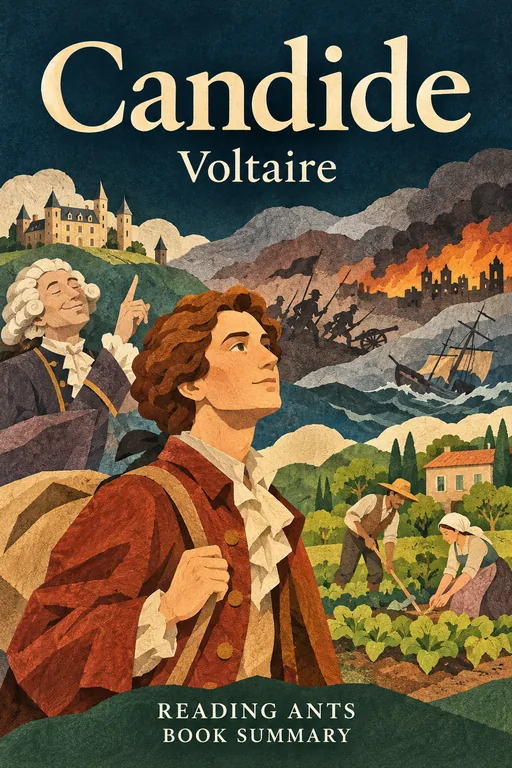
Candide
Original title: Candide, ou l'Optimisme
A trusting young man travels through a world of war, disaster, greed and cruelty, slowly learning that cheerful theories matter less than useful work and care for others.
Overview
Published anonymously in 1759, Candide is a short, fast-moving satire by the French writer Voltaire. Its innocent hero grows up in a German baron’s castle, where his teacher Pangloss insists that everything happens for the best in the best possible world. After being driven from this sheltered home, Candide crosses Europe and South America, survives wars and disasters, finds and loses his beloved Cunégonde, and meets people whose suffering challenges Pangloss’s confidence. Voltaire uses wild coincidences, sudden reversals and deliberately exaggerated violence to attack empty optimism, religious hypocrisy, political cruelty and the idea that suffering can always be explained away. Beneath its dark comedy lies a practical question: if no theory can make the world fair, how should people live?
Main Characters
- Candide: an innocent young man whose faith in easy optimism is repeatedly tested.
- Cunégonde: the baron’s daughter and Candide’s beloved, who survives terrible abuse.
- Pangloss: Candide’s teacher, who explains every disaster as part of a perfect plan.
- Martin: a gloomy scholar who expects selfishness and misery.
- Cacambo: Candide’s clever, loyal and practical servant.
- The old woman: Cunégonde’s resourceful companion, whose life has been full of suffering.
- The baron’s son: Cunégonde’s proud brother, who rejects Candide as socially inferior.
Full Summary
Expelled from Paradise
Candide lives at the castle of Baron Thunder-ten-tronckh in Westphalia. He listens eagerly to Pangloss, who teaches that this world must be the best one possible and that every event has a sufficient reason. Candide loves the baron’s daughter, Cunégonde. When the two are caught kissing, the baron drives Candide away.
Hungry and homeless, Candide is tricked into joining the Bulgar army. Brutal discipline and battle teach him that military glory hides organized slaughter. He escapes to Holland, where a kind Anabaptist named Jacques helps him. Candide then finds Pangloss, sick and destitute. Pangloss says the castle was destroyed and Cunégonde killed, yet still claims that all is for the best. Jacques pays for Pangloss’s treatment and takes both men toward Lisbon.
Disaster and Judgment
A storm wrecks their ship near Lisbon. Jacques drowns while trying to save a sailor, and the sailor makes no effort to rescue him. Candide and Pangloss reach land just as a devastating earthquake strikes. Rather than helping victims, local authorities arrange a religious ceremony and punish supposed sinners in the belief that executions will prevent further earthquakes. Pangloss is hanged and Candide is publicly beaten.
An old woman rescues Candide and takes him to Cunégonde, who is alive. She explains that soldiers attacked her home and that she passed into the control of several men. She is now shared as a mistress by Don Issachar and the Grand Inquisitor. When both men arrive separately, Candide kills them. Candide, Cunégonde and the old woman flee toward Cádiz, then sail for South America. During the voyage, the old woman tells an even more terrible life story, showing that suffering is widespread rather than exceptional.
Flight Across South America
In Buenos Aires, the governor desires Cunégonde. When officers arrive looking for the Lisbon killers, Candide escapes with Cacambo while Cunégonde and the old woman remain behind. The two travelers reach a Jesuit settlement in Paraguay, where Candide discovers that the commander is Cunégonde’s brother, believed dead. Their joyful reunion ends when her brother, the baron’s son, refuses to let his sister marry a man of Candide’s low birth. Enraged, Candide stabs him and flees again.
After several dangerous misunderstandings, Candide and Cacambo discover El Dorado, an isolated country without poverty, religious persecution or hunger for gold. Its people treat precious stones as ordinary objects and value learning and public welfare. Candide could stay, but he wants Cunégonde and hopes wealth will win acceptance. He leaves with sheep carrying a fortune, losing most of them on the difficult journey.
Wealth Brings No Safety
At Suriname, Candide meets an enslaved man whose injuries expose the human cost of European luxury. The sight badly weakens his optimism. A dishonest merchant steals much of Candide’s remaining treasure. Candide sends Cacambo to recover Cunégonde and meet him in Venice, then chooses the pessimistic Martin as a traveling companion.
On their way through France and England, Candide sees greed, deception and state violence. In Venice, Cunégonde does not appear. Candide meets Paquette, once a servant at the castle, and Brother Giroflée; both are miserable despite appearing cheerful. He visits the wealthy Senator Pococurante, who owns beautiful things but enjoys none of them. At dinner with six deposed rulers, Candide learns how quickly rank and fortune disappear. At last Cacambo arrives and reports that Cunégonde is enslaved near Constantinople.
The Garden
Candide and Martin travel east. On a galley, Candide is astonished to find Pangloss and Cunégonde’s brother alive and chained as rowers. He buys their freedom. Pangloss explains that his hanging was badly performed, while Cunégonde’s brother survived his wound. Pangloss still defends optimism, although experience has given him little reason to do so.
Candide finds Cunégonde, now worn down by hardship, and buys her freedom. He marries her because he promised, despite her brother’s renewed objections. The group settles on a small farm, but boredom and argument make them unhappy. A local farmer, who lives simply through steady work with his family, offers a better example than all their philosophy. Candide concludes that they must cultivate their garden. Each person takes on useful work, and life becomes bearable. The ending does not promise a perfect world; it recommends shared labor over endless explanations.
Why It Matters
Candide is one of the most famous works of the European Enlightenment, an era that emphasized reason and challenged inherited authority. Voltaire turns a philosophical argument into an entertaining adventure, making abstract questions about evil and providence understandable through story. The Lisbon earthquake of 1755 had shaken European confidence that a just order governed every event, and the novel refuses to treat real suffering as a clever puzzle with a comforting answer.
Its targets remain recognizable: leaders who call war glorious, institutions that punish outsiders, wealthy people insulated from suffering, and thinkers who protect a theory by ignoring evidence. The closing image of cultivating a garden has endured because it offers neither despair nor a grand solution. People may not control history or explain every tragedy, but they can do useful work, reduce nearby suffering and build a decent life together.
Key Takeaways
- Easy optimism can become cruel. Calling every event necessary or beneficial may protect a theory, but it dismisses the pain of actual victims.
- Institutions often disguise self-interest as principle. Armies, courts, churches and colonial systems repeatedly use noble language to excuse violence or greed.
- Wealth cannot guarantee contentment. El Dorado uses riches wisely, while people elsewhere chase money without becoming secure or happy.
- Experience should correct belief. Candide matures when he begins trusting what he sees rather than forcing each disaster into Pangloss’s system.
- Useful work gives life shape. The garden represents practical effort, cooperation and limited responsibility in a world no philosophy can perfect.
What We Can Learn
The book warns us to notice when a comforting explanation prevents us from responding to harm. Telling someone that a setback happened for a good reason may sound hopeful, yet listening and offering practical help are often kinder. Ideas should be tested against experience, especially the experience of people who bear the cost.
Candide also suggests a way to act when enormous problems feel overwhelming. We cannot repair the entire world alone, but we can cultivate a garden: learn a skill, care for people nearby, share necessary work and improve the part of life within reach. This is not permission to ignore injustice. It is a reminder that action must accompany criticism. A modest task completed with others can be more valuable than a perfect theory discussed forever.
Criticism and Counterpoints
The novel’s speed and exaggeration can make terrible events feel like punch lines. Sexual violence, enslavement and mass death receive little emotional space, and several characters are treated more as examples in an argument than as fully developed people. Modern readers may also encounter stereotypes and insensitive descriptions shaped by eighteenth-century European attitudes.
Voltaire attacks the claim that this is the best possible world, but he does not build a detailed alternative philosophy. Some readers interpret the ending as a retreat from public problems into private comfort; others see the garden as a model of responsible, cooperative action. Its satire is also tied to debates of Voltaire’s time, so historical notes can help readers understand particular jokes.
Who Should Read It
This short classic suits teens and adults who enjoy dark comedy, philosophical questions and extremely fast adventures. Readers interested in the Enlightenment or the problem of suffering will find it especially useful. Those sensitive to repeated violence and abuse should know that these subjects are described briefly but often used for harsh satire.
Want the whole book?
A summary is a taste, not the meal. Here is where to find the full book.
You reached the end 🎉
Nicely done. Mark this one as read, and we will suggest what to read next.
Read this next
Don Quixote
Miguel de Cervantes
An aging Spanish gentleman reads so many tales of knights that he loses his mind, sets out to become a knight himself with a down-to-earth farmer as his squire, and turns every adventure into glorious, comic disaster.
🌍 World Literature
Gulliver's Travels
Jonathan Swift
A ship's surgeon named Lemuel Gulliver visits four strange lands, from a country of tiny people to one ruled by rational horses, and Swift uses these voyages to mock human pride, politics and folly.
📜 Classics
The Little Prince
Antoine de Saint-Exupery
A pilot stranded in the desert meets a small boy from a tiny planet, who teaches him that the most important things in life, like love and friendship, can only be seen with the heart.
🌍 World Literature
The Stranger
Albert Camus
An emotionally detached office worker kills a man on an Algerian beach and discovers that society condemns him as much for refusing its expected feelings as for the murder itself.
🌍 World Literature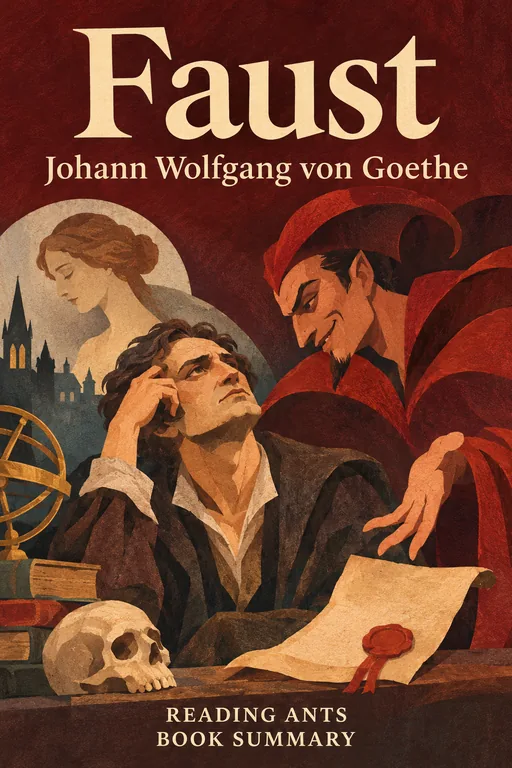
Faust
Johann Wolfgang von Goethe
A brilliant but restless scholar, frustrated that all his learning has not brought him true understanding or happiness, makes a bargain with the devil Mephistopheles, setting off a journey through love, tragedy and ambition that tests whether any human life can find lasting fulfillment.
🎭 Epics, Drama & Poetry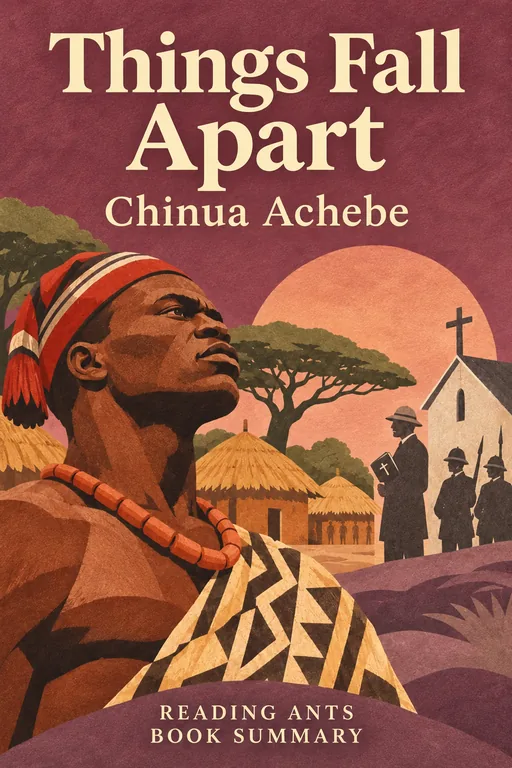
Things Fall Apart
Chinua Achebe
Okonkwo, a proud and fearsome leader in an Igbo village in Nigeria, struggles against his own fears and against the arrival of British missionaries and colonial rulers, who change his world forever.
🌍 World LiteratureWant something different?
Pick another topic and we will show you three books to start with.