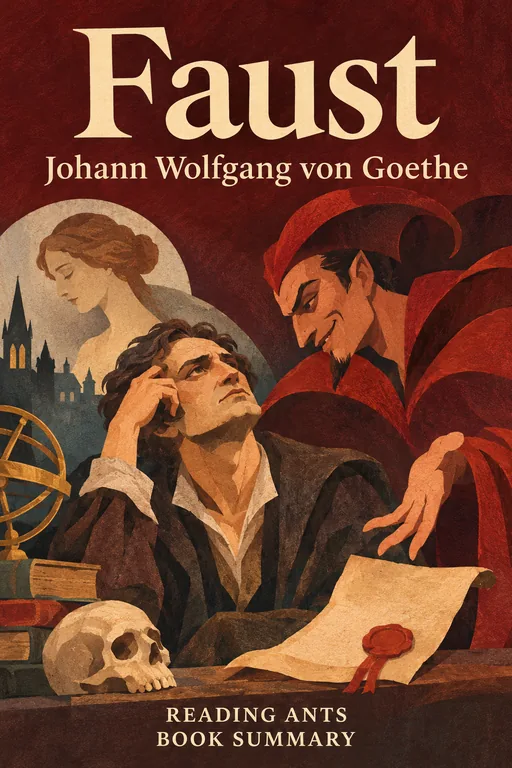
Faust
A brilliant but restless scholar, frustrated that all his learning has not brought him true understanding or happiness, makes a bargain with the devil Mephistopheles, setting off a journey through love, tragedy and ambition that tests whether any human life can find lasting fulfillment.
Overview
Faust is a play in two parts by Johann Wolfgang von Goethe, Germany’s most celebrated writer. Part One was published in 1808, and Part Two in 1832, shortly after Goethe’s death; he worked on the drama for about sixty years. It is based on an old German legend about a scholar who sold his soul to the devil. Goethe’s Faust is a man who has studied every subject but feels that he knows nothing worthwhile. He strikes a wager with Mephistopheles: if the devil can ever give him a moment so satisfying that he wishes it would last forever, Mephistopheles may take his soul. Part One is famous for the tragic love story of Faust and a young woman named Gretchen, while Part Two is a vast, symbolic journey through history, myth and politics.
Main Characters
- Heinrich Faust: a learned, restless scholar who longs for more from life.
- Mephistopheles: a witty, cynical devil.
- The Lord: God, who allows Mephistopheles to tempt Faust.
- Gretchen (Margarete): an innocent young woman whom Faust loves.
- Martha: Gretchen’s neighbor.
- Valentin: Gretchen’s brother, a soldier.
- Wagner: Faust’s narrow-minded assistant.
- Helen of Troy: the legendary beauty, who appears in Part Two.
Full Summary
A Wager in Heaven
The play opens in Heaven, where the angels praise God’s creation. Mephistopheles, a devil, complains that humans are miserable creatures. The Lord mentions Faust as a faithful servant who strives for truth. Mephistopheles bets that he can lead Faust astray. The Lord allows him to try, saying that humans err as long as they strive, but a good person, even in confusion, remains aware of the right path.
The Scholar’s Despair
In his study at night, Faust despairs. He has studied philosophy, law, medicine and theology, yet he feels no wiser than before. He tries magic, calling up a powerful spirit, but it rejects him. In despair, he prepares to drink poison, but the sound of Easter bells and choirs reminds him of his childhood faith, and he puts the cup down.
During an Easter walk with his assistant, Wagner, Faust notices a black poodle following them. Back in his study, the poodle transforms into Mephistopheles.
The Pact
Mephistopheles offers to serve Faust on earth, showing him every pleasure, in exchange for Faust’s soul in the afterlife. Faust, believing nothing could ever satisfy him, makes a different kind of bet: if he ever becomes so content that he asks a moment to stay because it is so beautiful, then Mephistopheles may claim him. They sign the agreement in blood.
Mephistopheles takes Faust to a tavern full of drunken students, then to a witch’s kitchen, where Faust drinks a potion that makes him young again.
Gretchen
In the street, Faust sees Gretchen, a pure, pious young woman, and falls in love. With Mephistopheles’s help, he leaves gifts of jewels in her room and arranges meetings through her neighbor, Martha. Gretchen falls deeply in love with him. To spend a night with her, Faust gives her a sleeping potion for her mother, which accidentally kills her.
Gretchen becomes pregnant. Her brother, Valentin, a soldier, hears the gossip and challenges Faust, who kills him in a duel with Mephistopheles’s help. Faust flees, while Gretchen is left alone, shamed by the town.
Walpurgis Night and the Prison
Mephistopheles distracts Faust with the wild Walpurgis Night, a festival of witches on the Brocken mountain. But Faust sees a vision of Gretchen and learns that she has drowned her newborn baby in despair and has been condemned to death.
Faust rushes to her prison cell to rescue her, with Mephistopheles’s help. Gretchen, half mad with grief, recognizes him, but when she sees Mephistopheles, she refuses to leave, choosing instead to place herself in God’s hands. Mephistopheles declares that she is condemned, but a voice from above proclaims that she is saved. Mephistopheles drags Faust away, while Gretchen’s voice calls his name.
Part Two: Myth and History
In Part Two, Faust awakens refreshed in a beautiful landscape and travels through a series of symbolic adventures. At the emperor’s court, Mephistopheles introduces paper money, which brings temporary prosperity and chaos. Faust seeks out Helen of Troy, the most beautiful woman of ancient legend. After a journey into the classical world, Faust and Helen are united and have a son, Euphorion, who dies trying to fly, after which Helen vanishes.
Faust then turns to practical action. He is given land on the coast and works to reclaim it from the sea, building dikes and creating new land for people to live on. But his ambition causes harm: Mephistopheles kills an old couple who refuse to give up their small cottage.
Faust’s Last Moment
Now very old, Faust is blinded by the spirit of Care. Still, he imagines a future in which free people work together on fertile land won from the sea. Thinking of this, he says that he could ask such a moment to stay. Then he falls dead.
Mephistopheles prepares to seize his soul, but angels descend, scattering roses, and carry Faust’s soul to heaven. Because he never stopped striving, and through divine love and the intercession of Gretchen, now among the blessed, Faust is saved. The play ends with a mystical chorus declaring that the eternal feminine draws us upward.
Why It Matters
Faust is considered the greatest work of German literature and one of the masterpieces of world drama. It explores the deepest questions of human life: the hunger for knowledge, the search for meaning, love, guilt and redemption. The term “Faustian bargain” has become a common phrase for any deal in which someone sacrifices their values for power or pleasure.
The work has inspired operas by Gounod and Boito, a dramatic legend by Berlioz, music by Liszt and Mahler, paintings and countless later works. Faust, with his endless striving and dissatisfaction, has been seen as a symbol of the modern human being. Its ideas influenced philosophers, poets and novelists, including Thomas Mann’s novel Doctor Faustus.
Key Takeaways
- Knowledge alone does not bring happiness. Faust’s learning leaves him empty.
- Striving defines us. Faust’s restless effort is both his flaw and his salvation.
- Selfish desire causes harm. Faust’s pursuit of pleasure destroys Gretchen.
- Redemption is possible. Divine love and striving save Faust in the end.
- Beware of bargains that cost your soul. Shortcuts to power or pleasure come at a price.
What We Can Learn
Faust reminds us that true fulfillment comes not only from knowledge or pleasure, but from meaningful work and caring for others. Faust finds his greatest satisfaction when he imagines helping a free community thrive.
It also warns us to consider the cost of our choices. Faust’s pursuit of his own desires brings tragedy to Gretchen and her family. Before chasing something we want, it’s wise to think about who might be hurt.
Finally, the play encourages us to keep growing and learning throughout life, while staying humble. Striving is good, but it must be balanced with responsibility.
Criticism and Counterpoints
Faust is a very demanding work. Part One is widely read and performed, but Part Two, with its long, complex allegories drawn from mythology, history and philosophy, is difficult for most readers and rarely staged in full. Much of its beauty lies in Goethe’s German verse, which is hard to translate.
Critics have also questioned the ending: Faust is responsible for the suffering and deaths of Gretchen, her family and others, yet he is saved. Some find this troubling, while others see it as a statement about divine grace and human striving. Gretchen’s role as a victim who helps redeem the man who ruined her has also been debated by modern readers.
Who Should Read It
This drama suits mature readers interested in literature, philosophy and big questions about life. Part One is a good starting point, ideally in a modern verse translation. Readers who enjoy The Divine Comedy or Paradise Lost will find it rewarding.
Want the whole book?
A summary is a taste, not the meal. Here is where to find the full book.
You reached the end 🎉
Nicely done. Mark this one as read, and we will suggest what to read next.
Read this next
The Divine Comedy
Dante Alighieri
Lost in a dark wood in the middle of his life, the poet Dante journeys through Hell, Purgatory and Heaven, guided first by the poet Virgil and then by his beloved Beatrice, on a quest to understand sin, redemption and divine love.
🎭 Epics, Drama & Poetry
Paradise Lost
John Milton
Milton's epic poem tells how Satan rebelled against God, was cast into hell, tempted Adam and Eve to disobey, and caused humanity's expulsion from the Garden of Eden.
🎭 Epics, Drama & Poetry
The Sorrows of Young Werther
Johann Wolfgang von Goethe
A sensitive young man falls in love with a woman who is promised to another, and his passion leads him to despair.
🌍 World Literature
The Picture of Dorian Gray
Oscar Wilde
A beautiful young man wishes that his portrait would grow old instead of him, and as he lives a life of selfish pleasure and cruelty, his face stays perfect while the painting reveals the ugliness of his soul.
📜 Classics
The Odyssey
Homer
After the Trojan War, the clever hero Odysseus struggles for ten years against monsters, gods and temptations to return home to his faithful wife and son, then must win back his house from the men trying to steal it.
🎭 Epics, Drama & Poetry
Hamlet
William Shakespeare
A grieving prince of Denmark learns from his father's ghost that his uncle murdered the king to take the throne, and his struggle to decide whether and how to take revenge leads to madness and death.
🎭 Epics, Drama & PoetryWant something different?
Pick another topic and we will show you three books to start with.