 Reading Ants
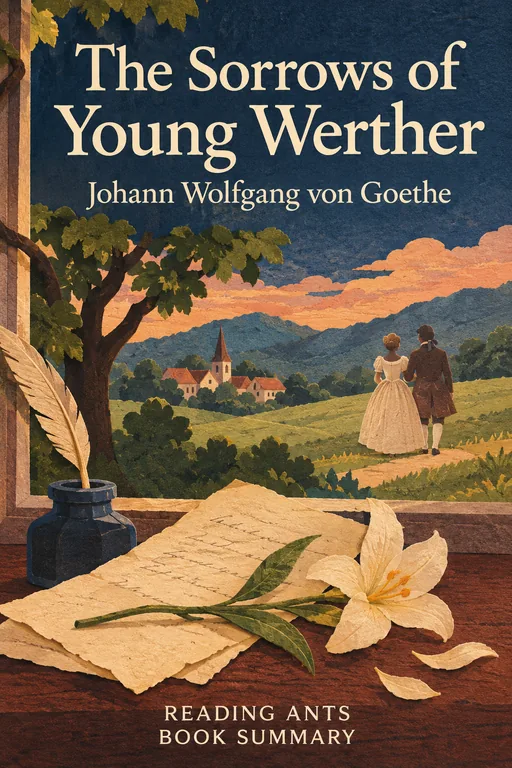
The Sorrows of Young Werther
Original title: Die Leiden des jungen Werthers
A sensitive young man falls in love with a woman who is promised to another, and his passion leads him to despair.
Overview
The Sorrows of Young Werther is a short novel by the great German writer Johann Wolfgang von Goethe, published in 1774, when he was in his mid-twenties. It is told mostly in letters that Werther writes to a friend, in a German village and the nearby town in the eighteenth century. The book became a sensation across Europe and gave a voice to a generation of young people who valued feeling over reason. It deals with the subject of suicide, which is described briefly here, and readers who may be struggling should take care.
Main Characters
- Werther: a sensitive young man, an artist and a dreamer, who writes the letters.
- Lotte: a warm, kind young woman who looks after her younger brothers and sisters.
- Albert: Lotte’s steady fiance, and later her husband.
- Wilhelm: Werther’s friend, to whom the letters are written.
Full Summary
Arrival in the Country
Werther moves to a small village to handle some family business, and in his first letters, he writes with joy about the beauty of nature, the simple people and the pleasure of living away from city life. He loves to read Homer, to draw and to talk with the villagers. He feels at peace.
On the way to a country dance, he calls at Lotte’s house to take her to the ball, and he is immediately taken by her. She is lovely, but she is also kind and sensible. He finds her cutting bread for her younger siblings, whom she cares for since their mother died.
Albert
Soon after, Albert returns. He is Lotte’s fiance, a calm and honest man, and Werther cannot help liking him, although he feels a growing pain. Lotte has been promised to Albert, and she is loyal. She likes Werther, and they share a love of poetry and music, but she makes it clear that she cannot love him as he wishes.
Werther spends his days with Lotte and sometimes with Albert. He is happy and miserable at once. He walks in the fields, he reads poetry aloud, and he plays with Lotte’s younger brothers and sisters, who adore him. In his letters, he tells his friend that he is both blessed and cursed to have found her.
He also begins to meet the other people in the village, such as an old pastor and a young farm worker who is in love with a widow. Werther sees in these people the same powerful feelings that he has, and he is moved by their stories. Yet these friendships also seem to deepen his own sadness.
Leaving
Seeing that he cannot go on, Werther decides to leave. He takes a position as a secretary to an ambassador in another town. But the work is dull, the ambassador is difficult and the society is full of strict rules about rank. When he is asked to leave a party of nobles, he feels deeply humiliated, and he resigns.
He wanders for a while, visiting the place where he was born, and then drifts back to the village, drawn by his love. His letters become shorter, darker and more restless. He tells his friend that nothing can heal him, and that he will not take advice.
The Return
By now, Albert and Lotte have married. Werther is in a worse state than before. He grows more and more depressed, and he feels that his feelings are out of control. He sees a servant who is driven to violence by a similar love, and he feels strong sympathy for the man.
Albert is patient at first, but he begins to be uncomfortable with Werther’s visits, and Lotte, who has a warm regard for him, asks him to stay away for a time.
The Last Visit
Werther comes one last time, on a winter evening. He reads aloud to Lotte, and he is overcome with emotion and embraces her. She pulls away and tells him that he must not see her again. Heartbroken, he leaves.
Werther writes a final letter, and takes his own life. The book ends with a short account by the editor, who tells of the funeral and says that no priest came to the burial.
Why It Matters
This novel made Goethe famous throughout Europe, and it is one of the key works of the “Sturm und Drang” (“Storm and Stress”) movement in German literature, which put emotion and individual feeling at the center of art. It was a bestseller in its day and was read with passion by young people, who copied Werther’s style of dress. There were reports that some readers imitated Werther’s death, and this has been called the “Werther effect,” a term now used for the way that stories of suicide can influence people. This led to the book being banned in places. Today, it is read as a classic of Romanticism, and for its picture of a sensitive mind.
Key Takeaways
- Passion can overwhelm. Werther’s feelings take over his life.
- Unfulfilled love hurts. The story shows the pain of wanting what one cannot have.
- Society limits individuals. Werther chafes against rank and convention.
- Nature offers comfort. Werther’s joy in the countryside is real.
- Isolation deepens despair. He shuts out the voices that might help him.
What We Can Learn
The book is a powerful reminder of how dangerous it can be to put all our hope on one person or one thing. Werther lets his love fill his whole life, and he has no other source of support. It is wise to keep friendships, interests and goals that can help us in hard times.
It also shows how important it is to reach out. Werther writes letters, but he does not truly listen to his friend’s advice. If you or someone you know feels hopeless, talk to a trusted person or a counselor, or contact a local crisis line. Finally, the story encourages us to respect each other’s feelings, and to be kind to people who are in pain.
Criticism and Counterpoints
Some readers find Werther self-absorbed and melodramatic, and Lotte’s character is seen mostly through his eyes. The novel’s influence on real-world suicides was a major concern, and some think the book glamorizes his death. Goethe himself said later in life that he had written the book partly to free himself from similar feelings, and in later years he distanced himself from it. The book’s style, with its long emotional outbursts, can seem dated.
Who Should Read It
This short classic is for teens and adults interested in Romantic literature and in the history of ideas about feeling and individuality. Readers who are going through a hard time, or who are sensitive to the subject of suicide, may wish to approach it with care, or read it with someone they trust.
Want the whole book?
A summary is a taste, not the meal. Here is where to find the full book.
You reached the end 🎉
Nicely done. Mark this one as read, and we will suggest what to read next.
Read this next
Faust
Johann Wolfgang von Goethe
A brilliant but restless scholar, frustrated that all his learning has not brought him true understanding or happiness, makes a bargain with the devil Mephistopheles, setting off a journey through love, tragedy and ambition that tests whether any human life can find lasting fulfillment.
🎭 Epics, Drama & Poetry
Madame Bovary
Gustave Flaubert
A romantic young woman, bored by her provincial marriage to a kind but dull doctor, seeks excitement in love affairs and luxury, and is crushed by debt and disillusion.
🌍 World Literature
Anna Karenina
Leo Tolstoy
In imperial Russia, a married aristocrat falls passionately in love with a dashing officer and loses her place in society, while a thoughtful landowner seeks a meaningful life through love, work and faith.
🌍 World Literature
Wuthering Heights
Emily Bronte
On the wild Yorkshire moors, an orphan named Heathcliff falls into a fierce, all-consuming love with Catherine Earnshaw, and when she marries another man, his bitterness drives a revenge that poisons two families for a generation.
📜 Classics
The Red and the Black
Stendhal
A clever carpenter's son in France tries to rise through love, religion and ambition, and in the end his pride and passion destroy him.
🌍 World Literature
The Little Prince
Antoine de Saint-Exupery
A pilot stranded in the desert meets a small boy from a tiny planet, who teaches him that the most important things in life, like love and friendship, can only be seen with the heart.
🌍 World LiteratureWant something different?
Pick another topic and we will show you three books to start with.